American photographer detained
New York, April 27, 2005— Sudanese security forces in Darfur, Sudan, detained an American freelance photographer yesterday as he photographed a refugee camp. Hartford-based Brad Clift is under house arrest at a United States Agency for International Development office building after being detained in Nyala in the Darfur region of Sudan, the daily Hartford Courant…
CHINA
APRIL 26, 2005 Posted: May 3, 2005 Zheng Yichun, freelance LEGAL ACTION, IMPRISONED Zheng was tried in Yingkou Intermediate Court on charges of inciting subversion. A prolific Internet writer and poet, he had been imprisoned since December 3 after writing articles critical of the Communist Party and Chinese government policy.
SUDAN
APRIL 26, 2005 Posted: May 17, 2005 Brad Clift, freelance IMPRISONED Sudanese security forces detained Clift while he was taking photographs at an internally displaced persons camp outside Nyala, capital of Darfur’s southern state. Clift works for The Hartford Courant but was in Sudan as a freelancer traveling with the relief group, Hartford Catholic Worker,…
Internet writer tried on anti-state charges
New York, April 26, 2005 – The Committee to Protect Journalists calls for the immediate release of Zheng Yichun, who was tried today in Yingkou Intermediate Court on charges of inciting subversion. Zheng, a prolific Internet writer and poet, has been imprisoned since December 3 after writing articles critical of the Communist Party and Chinese…
in separate case
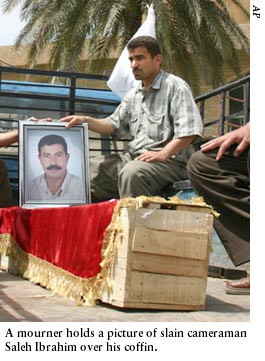
New York, April 25, 2005—An Iraqi cameraman working for Associated Press Television News was killed on Saturday while covering fighting in the Iraqi city of Mosul, bringing to 41 the number of journalists killed in Iraq since March 2003. Saleh Ibrahim was killed by gunfire near the city’s al-Yarmouk Circle, the scene of an earlier…
IRAQ
APRIL 23, 2005 Posted: April 25, 2005 Saleh Ibrahim, APTN KILLED—CONFIRMED Ibrahim was killed by gunfire near the city’s al-Yarmouk Circle, the scene of an earlier explosion that he and his brother-in-law, AP photographer Mohamed Ibrahim, had gone to cover, according to The Associated Press. The AP said Mohamed Ibrahim suffered shrapnel wounds to the…
Three journalists sentenced to prison
New York, April 18, 2005—The Committee to Protect Journalists condemns the sentencing of three Egyptian journalists to one year in prison. In a Cairo criminal court yesterday, Abdel Nasser al-Zuheiry, Alaa al-Ghatrifi, and Youssef al-Oumi, reporters for the independent daily Al Masry El Youm (The Egyptian Today) were found guilty of defaming Egypt’s Minister of…
IRAQ
APRIL 15, 2005 Updated September 29, 2005 Saman Abdullah Izzedine, Kirkuk TV KILLED—CONFIRMED Unidentified assailants gunned down Izzedine, a 33-year-old news anchor for the Patriotic Union of Kurdistan (PUK)-backed Kirkuk TV as he was driving on the main highway from Kirkuk to Baghdad. Kurdish journalists in Kirkuk said that Izzedine’s car was fired on by…