Features & Analysis
2012
Accreditation disputes at center of US arrests
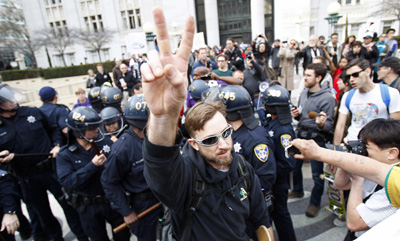
The issue of press accreditation continues to reverberate. In November, when the Occupy movement came into conflict with law enforcement across the country and at least 20 journalists covering the events were arrested, CPJ reported that disputes over press accreditation were at the center of many of those arrests. Last week, credentials played a role…
Can selective blocking pre-empt wider censorship?
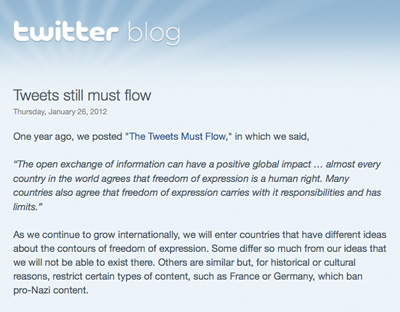
Last week, Twitter provoked a fierce debate online when it announced a new capability–and related policy–to hide tweets on a country-specific basis. By building this feature into its website’s basic code, Twitter said it hoped to offer a more tailored response to legal demands to remove tweets globally. The company will inform users if any…
Does the Internet boost freedom? We decide, book says
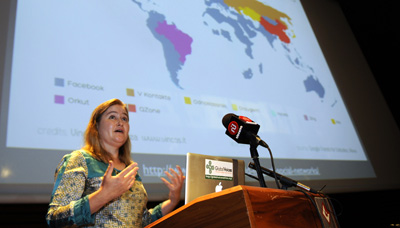
The Internet doesn’t bring freedom. Not automatically, anyway. That’s one of the main messages of Rebecca MacKinnon’s new book, Consent of the Networked, which had its New York launch at the offices of the New America Foundation last night. In a conversation with CNN managing editor Mark Whitaker, MacKinnon, a CPJ board member, said it’s…
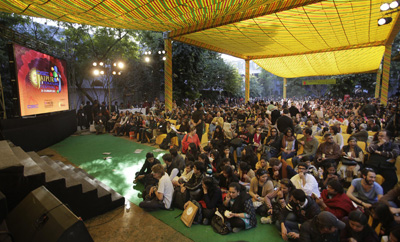
India’s challenge: Intolerance vs. intellectual freedom
Because of criticism from Hindu fundamentalists, the showing of a documentary by filmmaker Sanjay Kak at the Symbiosis College of Arts and Commerce in Pune has been indefinitely postponed. The conservative student organization Akhil Bharatiya Vidyarthi Parisha protested Kak’s film, “Jashn-e-Azadi” (How we celebrate freedom), which is critical of the Indian army’s role in Kashmir.…
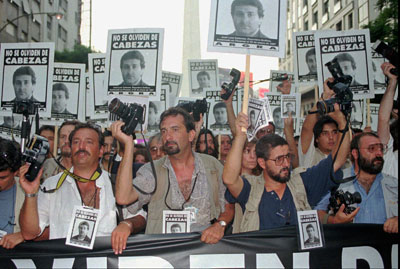
Cabezas’ convicted killers are free, 15 years after murder
It was a cold winter morning more than 15 years ago. As part of my daily routine as a foreign correspondent, I opened my laptop to read the Argentine papers. I was shocked by a headline: my colleague José Luis Cabezas, a photographer for the newsweekly magazine Noticias, had been murdered. His bullet-ridden body was…

Chinese press has impact, against the odds
In China, state control over the media hasn’t become more lax in recent years. Each year brings a new excuse for Communist Party censors to tighten the screws. The year of the rabbit brought the Arab Spring, and fears of a Jasmine Revolution. The year of the dragon brings a major political transition.
Can an Indian cartoonist be barred from mocking the state?
The case of a cartoonist charged with treason and offending India’s national sentiments reflects a growing debate over what constitutes freedom of expression in India. His accusers argue that while it is permissible to make fun of politicians, you cannot make fun of the state. Not everyone agrees.
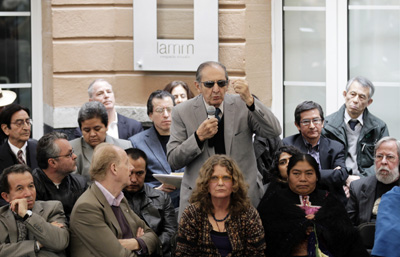
In Mexico mission, PEN speaks for a silenced press
The leading American author Russell Banks set the tone on Sunday as he stood among international writers and their local colleagues in Mexico City: “A nation’s journalists and writers, like its poets and story-tellers, are the eyes, ears, and mouths of the people. When journalists cannot freely speak of what they see and hear of…
For journalists, cyber-security training slow to take hold
For centuries, journalists have been willing to go to prison to protect their sources. Back in 1848, New York Herald correspondent John Nugent spent a month in jail for refusing to tell a U.S. Senate committee his source for a leak exposing the secret approval of a treaty with Mexico. In a digital age, however,…