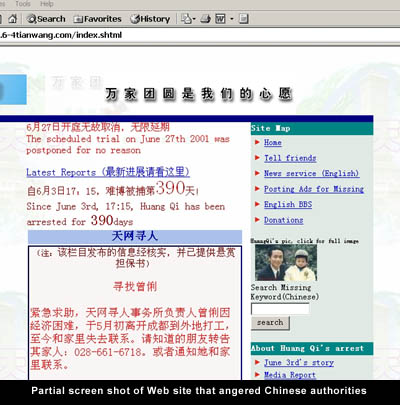
JAILED CHINESE WEB PUBLISHER’S TRIAL POSTPONED
New York, June 26, 2001 — The Chengdu Intermediate Court in Sichuan Province announced today that the trial of Internet publisher Huang Qi had been postponed indefinitely. Huang was scheduled to face trial tomorrow on charges of subversion. No reason was given for the postponement, according to a U.S.-based source who had spoken with Huang’s…
Internet essayist jailed for “subversion”
Your Excellency: The Committee to Protect Journalists (CPJ) is dismayed by the recent imprisonment of essayist Liu Weifang on subversion charges. We call for his immediate and unconditional release. The government’s case against Liu is based on essays that he had posted on the Internet. In mid-June, the Ninth Agricultural Brigade district’s Intermediate People’s Court in the Xinjiang Uighur Autonomous Region sentenced him to serve three years in prison, according to a June 15 report in the Xinjiang Daily.
State media launch smear campaign against Tamil journalist
Your Excellency: The Committee to Protect Journalists (CPJ) is deeply concerned about the security of Dharmeratnam Sivaram, veteran journalist and editor of the TamilNet Web site. Over the past two weeks, state media have featured articles accusing Sivaram of being a spy for the rebel Liberation Tigers of Tamil Eelam (LTTE)–a charge that seriously endangers him and his family.
CPJ welcomes journalists’ release, but says sedition charges should be dropped
New York, June 18, 2001 — Three journalists with the Nepali-language daily Kantipur, Yubaraj Ghimire, Kailash Shirohiya, and Binod Raj Gyawali, were released from jail on June 15. They face a trial next month on sedition charges stemming from an opinion piece that suggested a conspiracy behind the assassination of Nepal’s royal family. “We are…
CPJ and Human Rights Watch protest editor’s contempt prosecution
Your Excellency: The Committee to Protect Journalists and Human Rights Watch are writing jointly to protest the prosecution of Vineet Narain, founding editor of the New Delhi-based investigative journal Kalchakra. Narain faces contempt of court charges in Jammu and Kashmir State, where he says his life would be in serious danger. We urge you to order an immediate inquiry into possible political motivations behind Narain’s prosecution, and to provide him with appropriate protection if he is required to appear in court in Jammu.
Bomb explodes outside radio station
New York, June 7, 2001 – The Committee to Protect Journalists (CPJ) condemns the bomb attack yesterday on DYHB Radio Station in Bacolod City, Negros Occidental, and calls for a prompt and thorough investigation into the incident. DYHB is known for its hard-hitting reports on local crime and drug syndicates, according to the Manila-based Center…
CPJ welcomes lifting of censorship, urges press access to conflict areas
Your Excellency: The Committee to Protect Journalists (CPJ) welcomes your decision to lift censorship restrictions on the Sri Lankan media. We hope that your administration will now work to lift other obstacles that prevent reporting on the country’s long-running civil war.
Newspaper executives arrested in aftermath of palace killings
New York, June 6, 2001 – The Committee to Protect Journalists (CPJ) condemned today’s arrest of three leading Nepalese journalists and called for their immediate and unconditional release. Yubaraj Ghimere, editor of the Nepali-language daily Kantipur, Kailash Shirohiya, managing director of Kantipur and its sister English-language publication the Kathmandu Post, and Binod Raj Gyawali, director…