CPJ’s Simon on Huffington Post: What is at stake in Egypt
CPJ’s executive director lays out “What Is at Stake With Egypt’s Media Crackdown” in a February 3 piece on the Huffington Post. Joel Simon writes: “With no witnesses, those undertaking the violence in Egypt will have a free hand to carry out their brutal campaign without restraint. Standing up for the rights of journalists at this…
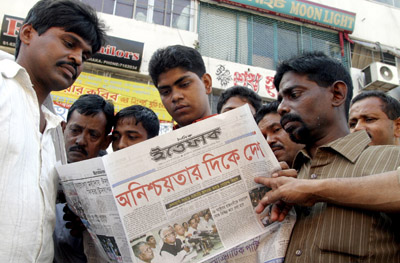
Press freedom has its limitations in Bangladesh
In the last decade, the growth of print and electronic media and a new generation of journalists have changed the face of the media in Bangladesh. But there is a long way to go until there is true press freedom. Politicians, criminals, and businessman exert undue influence, and the industry itself lacks the professionalism to…
CPJ’s Abdel Dayem talks Egypt on Democracy Now!
CPJ Middle East and North Africa Program Coordinator Mohamed Abdel Dayem spoke to Democracy Now! on February 5 about the deteriorating environment for journalists in Egypt. He told host Amy Goodman that state news outlets have become something unrecognizable: “State-owned media are no longer engaged in the business of news,” Abdel Dayem said. “They are…
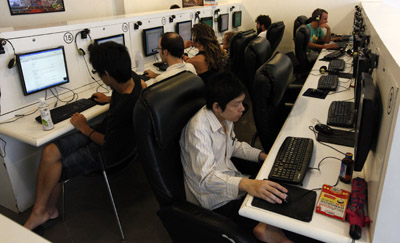
Internet freedom on trial in Thailand
Hearings commenced today in the trial of Chiranuch Premchaiporn, executive director of the Thailand-based independent news website Prachatai. She stands accused of 10 different violations of the country’s draconian 2007 Computer Crime Act (CCA), each of which carries a maximum penalty of five years in prison.
Russian media combats false piracy prosecutions
Some good news out of Samara. As we’ve reported previously, trumped-up piracy accusations have been frequently used in Russia to intimidate independent media. Sergei Kurt-Adzhiyev, a Russian editor, has spent years fighting piracy prosecutions against himself and his publications in the region. This week, he was declared not guilty. Russia’s Finance Ministry was ordered to…
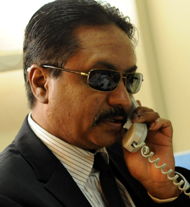
Mauritius no heaven for news media
American author Mark Twain once quoted a Mauritian as saying that heaven was copied after this Indian Ocean island paradise. Mauritius is cited today as one of the few havens of press freedom in Africa, but for Raj Meetarbhan, left, editor-in-chief of the island’s largest newspaper L’Express, the country is fast losing its glow.Meetarbhan was…
Diplomats divert from issues at UNESCO symposium
UNESCO’s International Symposium on Freedom of Expression at the world culture organization’s Paris headquarters January 26 brought together a wide range of experts to construct a full picture of the state of freedom of expression in the world today. Not everyone in the audience liked what they heard.

In Kashmir, Tehelka takes on press freedom abuses
The latest issue of India’s Tehelka weekly magazine carries some great reporting on press freedom issues, an effort supported by CPJ and the John S. and James L. Knight Foundation. The article, by Pragya Tiwari, includes many examples of journalists being harassed and assaulted while reporting on clashes between security and separatist groups in Jammu…
Egypt rejoins the Net
Internet connectivity has been restored to Egypt, though it’s hard to tell from the outside just how reliable that connection is. Monitoring organizations Renesys and BGPMon provide technical details on their blogs. For a more dynamic display, RIPE, the community which helps co-ordinate the European Internet, has a live graph of the numbers of Internet…
Is Taiwan’s media independence under threat?
As business relations develop between China and Taiwan, concerns are growing that Taiwan’s media freedom may be compromised. The culprits include some journalists themselves, promoting China to preserve their own business interests, and Taiwan’s Kuomintang (KMT) government, apparently attempting to exert control over the media through legislation.