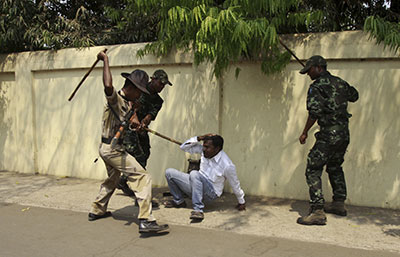
Indian law enforcement unaccountable in journalist attacks
Anyone who has been to India or is familiar with the country knows how chaotic it can be: from the congestion on the streets of Delhi to the messy way in which democracy functions. And for journalists, covering the chaos of India can be risky business. This week alone, Indian law enforcement officials assaulted two…
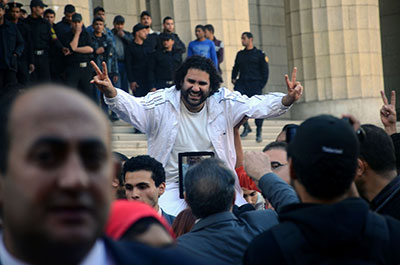
In Egypt, crackdown against media reaches new lows
The government of Egyptian President Mohamed Morsi continues to escalate its offensive against journalists. Details of the most recent case, in which an arrest warrant was issued for blogger Alaa Abdelfattah for inciting “aggression” against members of the Muslim Brotherhood, show how low the government is willing to go in order to silence its critics.
In Uzbekistan, speculation swirls as Karimov out of sight
In the most tightly controlled countries, the media is told what they are allowed to report on and what topics are taboo. Anything related to the leader’s health or his family is generally in the latter category. The resulting information vacuum can lead to rumors and uncertainty.

At OAS, a victory for human rights and free expression
By reaffirming the autonomy and independence of the regional human rights system and rejecting attempts to neutralize the work of the Inter-American Commission on Human Rights (IACHR) and its special rapporteur for freedom of expression, the Organization of American States (OAS) chose last week to discard proposals that would have made citizens throughout the hemisphere…
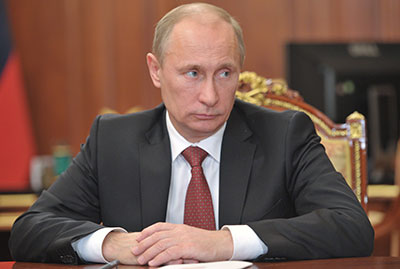
Russia steps up crackdown on rights groups, Internet
Recent statements by Vladimir Putin and Russian Member of Parliament (MP) Aleksey Mitrofanov, as well as raids on human rights organizations, signal that the threat hanging over civil society and freedom of expression in Russia has become reality. Since Putin returned to presidential office in May, the Kremlin has passed a series of restrictive laws…
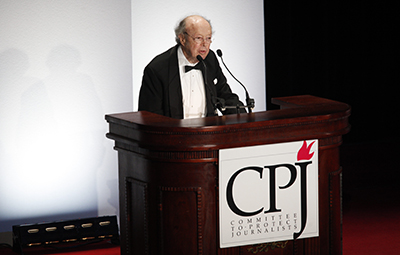
Tony Lewis gave CPJ authority, devotion over decades
Back in 1981, when CPJ was being formed and its board of directors assembled, Tony Lewis, who died today at age 85, was one of the first people we approached. As the author of books such as Gideon’s Trumpet, as a widely read columnist for The New York Times, and as an outspoken defender of…
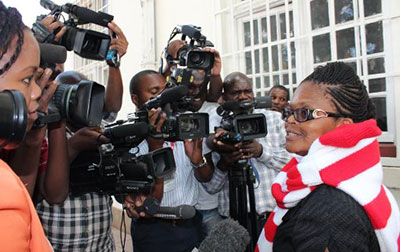
Zimbabwe frees prominent lawyer Mtetwa on bail
Beatrice Mtetwa, a tenacious lawyer who has won accolades for stubbornly defending journalists and others persecuted by Robert Mugabe’s regime in Zimbabwe, regained her freedom today after a hellish week that began on March 17 when she was arrested and charged with the criminal offense of “defeating or obstructing the course of justice.”
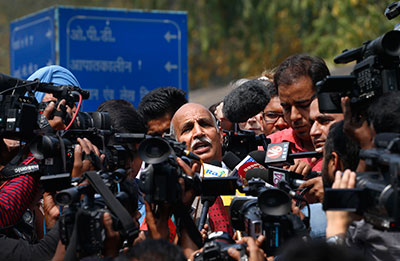
In India, media gag order on rape trial lifted
In a welcome move, Indian media will finally be allowed to cover court proceedings in the rape case that shook India’s conscience. On Friday, the Delhi High Court lifted a gag order on media covering the ongoing trial of those accused of the gang rape and murder of a 23-year-old student in Delhi in December.
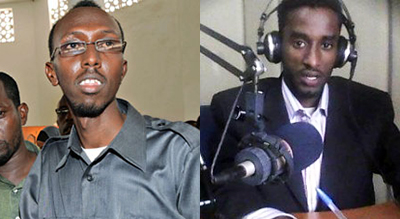
Jubilation, then tragedy, for Mogadishu press this week
“He’s free! He’s free!” a friend of mine from Somalia’s capital, Mogadishu, shouted down the phone line on Sunday. For a fleeting second I did not know whom he referred to, given the high number of journalists imprisoned in the Horn region of Africa–but then it dawned on me: Abdiaziz Abdinuur had finally found justice.…