Criminal Defamation Laws in South America
Contents Critics Are Not Criminals: Comparative Study of Criminal Defamation Laws in the Americas I. Argentina A. Criminal Laws Restricting Freedom of Expression Argentina’s Law 26.551 of November 2009 amended articles 109 to 117 of the Criminal Code to eliminate criminal sanctions for libel and slander, replacing them with monetary penalties. 1. Libel Libel consists…
How U.S. copyright law is being used to take down Correa’s critics in Ecuador
On December 30, César Ricaurte, the executive director of Fundamedios, received a copyright complaint with the potential to close his entire website. The complaint, filed on behalf of Ecuador’s communications regulator SECOM by a company called Ares Rights, ordered the independent press freedom group to remove an image of President Rafael Correa from its website,…
Inter-American Human Rights System, campaigns against defamation laws keep journalists from jail in Americas
When a prison guard told Ángel Santiesteban Prats that he would be released from jail on a scorching summer day in July, the Cuban independent writer and blogger decided to ignore him, brushing off the news as a cruel joke. By then, Santiesteban had already spent two years and five months in prison, half of…
Firing of critical newspaper editor raises concern in Ecuador
When the Quito daily El Comercio was sold in December to a Latin America media tycoon known for avoiding editorial conflict, press freedom advocates feared the newspaper would soften its coverage of the Ecuadoran government. Those concerns have now increased with last month’s firing of Martín Pallares, one of El Comercio’s most prominent journalists and…
Cartoonists are vulnerable worldwide, CPJ report finds
CPJ releases global assessment of threats faced by cartoonists New York, May 19, 2015–The attack on French satirical magazine Charlie Hebdo in January 2015 shed light on the grave dangers confronting those who draw satirical and political cartoons. But threats against cartoonists are a global phenomenon and are as diverse as the content of the…
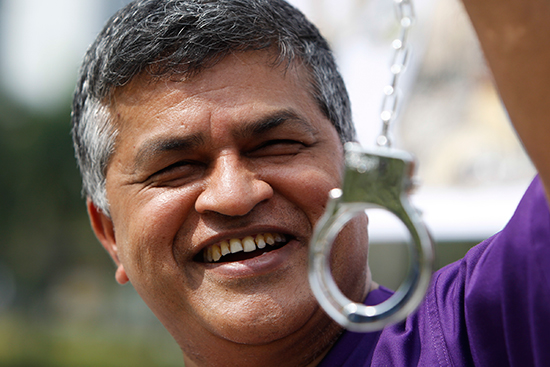
Drawing the line: Cartoonists under threat
On January 7, two gunmen burst into the offices of French satirical magazine Charlie Hebdo, killing eight journalists and bringing into focus the risks cartoonists face. But with the ability of their work to transcend borders and languages, and to simplify complex political situations, the threats faced by cartoonists around the world—who are being imprisoned,…
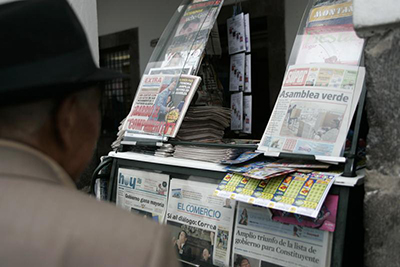
How Ecuador’s plans to make communications a public service is threat to free press
Attempts to amend Ecuador’s constitution to categorize communications as a “public service” has sparked a fierce debate, with one critic drawing comparisons to the way dictators such as Stalin and Hitler used the press as a propaganda tool, and supporters of President Rafael Correa’s government arguing that the proposed reforms will make journalism more accountable…
Life on the run in Amazon jungle for journalist charged with defaming president
For Ecuadoran journalist and political activist Fernando Villavicencio, life on the lam has meant wading through jungle rivers to avoid police checkpoints, dining on crocodile and monkey meat, and penning his latest book from a series of safe houses.
Ecuador court paves way for media regulation under constitution
Bogotá, November 5, 2014–The Committee to Protect Journalists is alarmed by a decision by Ecuador’s highest court that has paved the way for a constitutional amendment that would categorize the news media as a “public service” subject to government regulation.
Pressured by government, Ecuadoran cartoonist is forced to adjust
Called to testify before a government media oversight commission, editorial cartoonist Xavier Bonilla–known by his penname Bonil–showed up with a pair of four-foot-long mock pencils. But rather than having a small eraser on the tip, one of Bonil’s giant pencils was nearly all eraser.