CPJ Calls for Prosecution of Journalist’s Killers
Your Excellency: The Committee to Protect Journalists (CPJ) is deeply disturbed by the recent murder of Withayut Sangsopit, a radio journalist and commentator who was gunned down on April 10 in the southern city of Surat Thani. While we are pleased that arrests have been made in the case, we trust Your Excellency will urge local prosecutors to pursue charges vigorously against the arrested men.
Russia: Managing the Messengers
The first year of Vladimir Putin’s presidency has been a trying time for Russian civil society generally and for the media in particular. The new president has steadfastly worked toward Soviet-style centralized control over the vast country, battling Yeltsin-era oligarchs, wayward regional leaders, and non-governmental organizations. All this activity has been undertaken under the Orwellian…
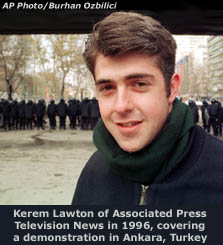
Journalist killed on Kosovo-Macedonia BorderCPJ Calls For Investigation Into Source Of Attacks
New York, March 29, 2001 — CPJ deplores the death of a British journalist this morning in the Kosovo village of Krivenik, near the Macedonian border. Kerem Lawton, 30, a British national and producer for Associated Press Television News, died from shrapnel wounds sustained when a shell struck his car. At least two other civilians…
2000 prison census: 81 journalists jailed
EIGHTY-ONE JOURNALISTS WERE IN PRISON AROUND THE WORLD at the end of 2000, jailed for practicing their profession. The number is down slightly from the previous year, when 87 were in jail, and represents a significant decline from 1998, when 118 journalists were imprisoned. While jailing journalists can be an effective means of stifling bad…
Attacks on the Press 2000: Introduction
By Ann CooperIN THE COMMUNITY OF JOURNALISTS WHO HAVE CHRONICLED the past decade’s worst wars, the news last May was devastating. Two of the world’s most dedicated war correspondents, Kurt Schork of Reuters and Miguel Gil Moreno de Mora of The Associated Press, were killed in a rebel ambush in Sierra Leone, a country where…
Attacks on the Press 2000: Africa Analysis
PRESS COVERAGE OF ARMED CONFLICTS CONTINUED TO STIR THE HOSTILITY of governments and rebel factions alike and claim reporters’ lives, but the prominent role of the press in the often-volatile process of democratization also brought unprecedented challenges to journalists working in Africa. CPJ confirmed that in 2000, five journalists were killed specifically because of their…
Attacks on the Press 2000: Asia Analysis
DESPITE PRESS FREEDOM ADVANCES ACROSS ASIA IN RECENT YEARS, totalitarian regimes in Burma, China, North Korea, Vietnam, and Laos maintained their stranglehold on the media. Even democratic Asian governments sometimes used authoritarian tactics to control the press, particularly when faced with internal conflict. Sri Lanka, for instance, imposed harsh censorship regulations during the year in…
Attacks on the Press 2000: Angola
AS ANGOLA’S AUTHORITARIAN GOVERNMENT CONTINUED ITS LONG SIEGE against all forms of dissent last year, independent journalists received special attention from the repressive apparatus of the state. Although most private media outlets are weekly newspapers that reach no more than a few thousand people, the hypersensitive regime of President José Eduardo dos Santos has routinely…
Attacks on the Press 2000: Argentina
IN A FRUSTRATING YEAR FOR PRESS FREEDOM in Argentina, a proposed bill that would have eliminated criminal penalties for defamation cases involving public officials foundered after local journalists implicated members of the Senate in a major bribery scandal. Senators who had supported the proposed bill quickly withdrew their support. The long battle to reform Argentina’s…