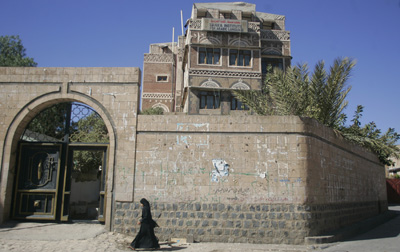
Foreign journalists have privileges locals don’t in Yemen
It is possible that so-called “Christmas Day bomber” Umar Farouk Abdulmutallab came to Yemen for Al-Qaeda terrorist training because it was out of the limelight. Until now, international media has sent in journalists intermittently to cover stories on Somali refugees or the Houthi rebellion in the North, but few foreign journalists are based here and the majority of coverage had come from local…
Fatullayev isolation prolonged in Azerbaijan
New York, March 1, 2010—The Committee to Protect Journalists issued the following statement today in response to Azerbaijani press reports that the isolated detention of imprisoned editor Eynulla Fatullayev, a 2009 recipient of CPJ’s International Press Freedom Award, on a new trumped-up charge of drug possession, has been prolonged by two months.

‘Our Society Will Be a Free Society’ launches petition
New York, March 1, 2010—In response to the brutal crackdown against journalists, writers, and bloggers in Iran, a coalition of leading press freedom and free expression groups have launched a petition drive calling for the release of those imprisoned. More such professionals are now in prison in Iran than in any other country in the world—at least 60,…
CPJ calls for UK to investigate Munadi death in rescue
Dear Prime Minister Brown: We last wrote to you on November 5 to urge you to authorize the Ministry of Defence to carry out an investigation into the September 9, 2009, military operation that rescued British-Irish journalist and New York Times correspondent Stephen Farrell and unfortunately led to the death of his Afghan colleague, Sultan Munadi. In our November 5 letter, we offered our condolences on the loss of British Parachute Regiment Cpl. John Harrison, but also pointed out that many questions about the operation remain unanswered. Among them is whether Munadi’s rescue was a central objective, what circumstances existed when he was killed, and why his remains were left behind after British forces withdrew.
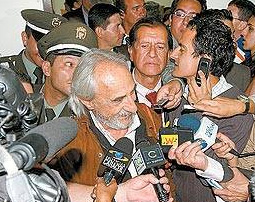
Latin America takes steps against criminal defamation
In an encouraging development, three courts in Colombia, Costa Rica, and Chile have recently followed the growing regional consensus against criminal defamation by dismissing criminal penalties against journalists accused of libel and slander.The newsweekly magazine Semana reported that a piece written by Alfredo Molano, at left, in the op-ed pages of the Bogota-based daily El Espectador in February 2007 described how…
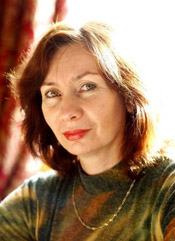
CPJ seeks information on Estemirova murder in Russia
New York, February 26, 2010—The Committee to Protect Journalists calls on authorities investigating the July 2009 murder of prominent Russian journalist and human rights defender Natalya Estemirova to publicize their progress on the case seven months after the crime. The New York Times reported on Thursday that a top investigator with the Investigative Committee of…

Garcia-Esperat murder suspects back at work in Philippines
On the run for more than a calendar year from court-ordered arrest warrants, Osmeña Montañer and Estrella Sabay, the alleged masterminds in the 2005 murder of Philippine investigative journalist Marlene Garcia-Esperat, at left, are now out of hiding and back at work as senior Department of Agriculture finance officials, according to recent reports in the Philippine Daily Inquirer.
In prison, Tunisian journalist’s health is worsening
New York, February 25, 2010—The Committee to Protect Journalists calls on the Tunisian authorities to immediately release journalist Taoufik Ben Brik, who is serving a six-month jail sentence, so that he can receive the medical treatment he needs.