Features & Analysis

  
People use the internet at a hotspot in Havana, Cuba in December 2018. Journalists and bloggers say recent internet regulations could legitimize censorship. (REUTERS/Stringer)

In new Cuban internet measures, journalists see a trap

International media announced the dawn of legal private Wi-Fi in Cuba this July. But a decree published the same month signals that content controls are expanding alongside access, local journalists and bloggers told CPJ.

Read More ›

A journalist films outside the Sulaymaniyah International Airport in January 2019. Journalists in Iraqi Kurdistan say disputes between the region's main political parties, the PDK and PUK, leave the press vulnerable. (AFP/Shwan Mohammed)

Press freedom on ‘brink of extinction’ in Iraqi Kurdistan, journalists say

“Ever since I started working as a journalist nine years ago, I have been under constant pressure from my family, my tribe, and my community to give up journalism. Friends have been asked by security forces to sever ties with me,” said freelance journalist Guhdar Zebari, when he met with CPJ in the empty lobby…

Read More ›

Pope Francis is seen with Mozambique President Filipe Nyusi at the Vatican on September 14, 2018. The pope recently began a visit to Mozambique, which has seen a crackdown on journalists over the past year. (Alberto Pizzoli/Pool via AP)

CPJ joins letter to Pope Francis urging focus on human rights during Mozambique visit

The Committee to Protect Journalists and 14 other human rights and freedom of expression organizations sent an open letter to Pope Francis yesterday, on the eve of his three-day visit to Mozambique, urging the pontiff to publicly support the protection and promotion of human rights as the country prepares for its general elections on October…

Read More ›

Reporters work during a panel for a television series in Beverly Hills, California, in August 2016. Female and gender non-conforming journalists in the U.S. and Canada say there is a need for greater training on dealing with harassment and threats. (Reuters/Mario Anzuoni)

‘The threats follow us home’: Survey details risks for female journalists in U.S., Canada

Ask any female journalist about harassment or safety while on assignment and they’ll likely have a story to tell.

Read More ›

A protester uses her phone to film during protests in Charlotte, North Carolina, in September 2016. CPJ's safety survey found 85 percent of respondents believe journalism is becoming a less safe job. (Reuters/Mike Blake)

Why going solo is a risk for female reporters in the US and Canada

In June 2016, an attacker was terrorizing women on a jogging path in Edmonton, Canada. A video journalist at a large Canadian broadcaster was assigned to cover the story on the night shift. Multiple sexual assaults had been reported and the man was still at-large.

Read More ›

A photographer sets a remote camera before Facebook CEO Mark Zuckerberg's appearance at a joint hearing on Capitol Hill in April 2018. Online harassment is perceived as the biggest threat for journalists in the U.S. and Canada, CPJ's safety survey found. (AFP/Brendan Smialowski)

Why newsrooms need a solution to end online harassment of reporters

Stef Schrader was on vacation in Germany last year when spam messages started to flood her inbox. Seeing random emails from Macy’s—and job alerts for the position of “Chief Idiot”—she realized someone had signed her work email up to dozens of email lists.

Read More ›

Police detain a man during a protest in Moscow, Russia, on August 10, 2019. CPJ on August 22 joined a call for Russian authorities to end the harassment of journalists covering the Moscow protests. (Evgeny Feldman/Meduza via AP)

CPJ joins call for Russian authorities to end harassment of journalists covering Moscow protests

The Committee to Protect Journalists today joined seven other press freedom organizations in calling on the Russian authorities to end their harassment of journalists covering opposition protests in Moscow. Protests have taken place on four consecutive Saturdays in July and August after the local electoral commission’s decision to ban several opposition politicians from participating in…

Read More ›

The New York Times logo is seen on a newspaper rack at a convenience store in Washington, D.C., on August 6, 2019. CPJ and RCFP filed a lawsuit on August 8 seeking documents in a leak investigation involving a Times reporter. (AFP/Alastair Pike)

CPJ, RCFP file lawsuit seeking documents in leak investigation

Yesterday, the Committee to Protect Journalists and the Reporters Committee for Freedom of the Press (RCFP) filed a lawsuit against the United States government seeking to obtain documents concerning steps taken by U.S. Customs and Border Protection (CBP) to investigate leakers and to identify journalists’ sources.

Read More ›

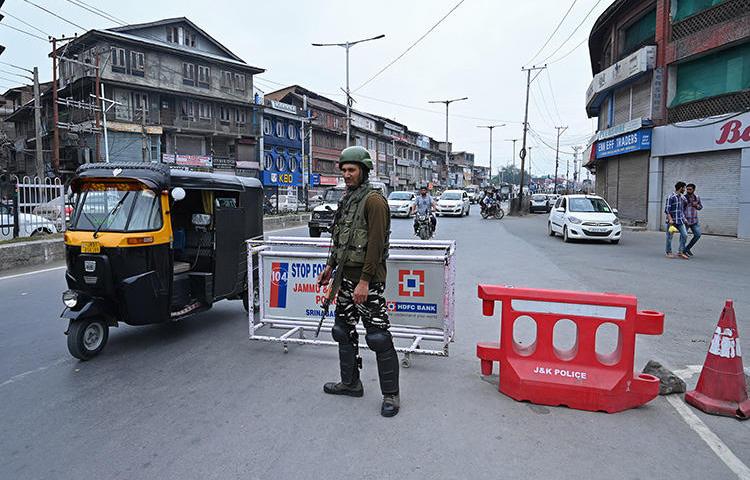
Indian security personnel check the identity of a motorist during a curfew in Srinagar on August 8, 2019, as widespread restrictions on movement and a telecommunications blackout are in place after the Indian government stripped Jammu and Kashmir of its autonomy. (AFP/Tauseef Mustafa)

In Kashmir, obstruction, confiscated equipment, and hand-carrying stories and photos on flash drive

“You are from the press, you are not allowed,” a local Kashmiri news editor says Indian security forces told him yesterday at one of the dozens of checkpoints set up across the region.

Read More ›

A protester displays a Nicaraguan flag in Managua on March 16, 2019. Journalists covering anti-government protests across the country were attacked, harassed, and in some cases, detained. (AFP/Maynor Valenzuela)

Nicaragua: A crackdown in four parts

When protests erupted in Nicaragua in April last year, it was clear from the beginning that the country’s media landscape would be a battleground. One day into the unrest, the government ordered cable providers to cut the signals of at least five TV channels. By the end of the year, CPJ had documented attacks, arrests,…

Read More ›