High-tech security information needs better dissemination
After the London launch of CPJ’s Attacks on the Press at the Frontline Club this week, I had an opportunity to talk to a number of young journalists setting out to regions where reporters are frequently at risk. As CPJ Executive Director Joel Simon noted, these discussions took on an extra poignancy the next day,…
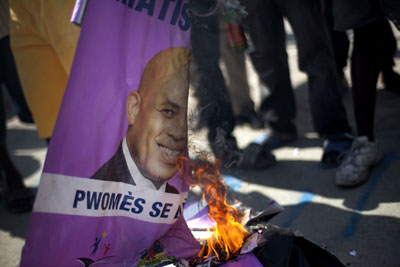
Was letter to Haiti website just part of Martelly’s theatrics?
As a former entertainer better known as “Sweet Micky,” it is perhaps unsurprising that Haitian President Michel Martelly has been theatrical at times in his dealings with the press. At one media event in October, the President answered a critical question posed by a journalist by telling him, “I curse your mother,” according to press…
Recalling Marie Colvin, the ‘greatest of our generation’
In her final hours, Marie Colvin gave this damning report to CNN’s Anderson Cooper. Bravery, generosity, and commitment: These are the three characteristics of Marie Colvin that have surfaced, again and again, in the many tributes spoken and published since the veteran Sunday Times reporter was killed Wednesday in the besieged city of Homs by…
Paul Conroy appeals for help from Homs
In a video posted to YouTube by a Syrian activist, injured Sunday Times photographer Paul Conroy speaks from Homs with his local doctor, describing his injuries and asking for humanitarian assistance, cessation of the shelling, and safe passage out. In English with some Arabic.Click here for Edith Bouvier and William Daniels’ appeal video.
To quote Marie Colvin: ‘What is bravery, and what bravado?’
Not since the worst period of the Iraq war, or in the Balkans the decade before, have so many storied journalists been killed or seriously injured in such a short period of time. Inevitably, the spate of deaths leaves many journalists asking questions about whether and how much they are willing to risk their own…
From Homs, injured journalists seek world’s help
In this video posted to YouTube by a Syrian activist, injured Le Figaro reporter Edith Bouvier and Sunday Times photographer William Daniels speak from Homs along with the local doctor who has been treating them. They are pleading with the world to make the barrage of rockets stop and to allow Bouvier to get urgent…
Slideshow: Colvin, Ochlik at work
International journalists Marie Colvin, 55, and Rémi Ochlik, 28, were killed Wednesday during shelling of the besieged city of Homs in Syria. « Previous Image | Next Image » Pictured are Colvin, an American reporting for the Sunday Times, in Cairo’s Tahrir Square (AP/Ivor Prickett); Ochlik, a French photojournalist (AP/Julien de Rosa); Colvin with Libyan…

As live streaming expands, challenges intensify
The world lost one of the only direct windows into the carnage in Homs, Syria, when Rami al-Sayed’s video live stream went dark Tuesday. A citizen journalist, al-Sayed was live streaming the Assad regime’s bombardment of Baba Amr and the brutal after-effects when he was struck by shrapnel and bled to death soon after, according…
Risk and reporting
Last night at London’s Frontline Club, CPJ launched its global survey of press freedom conditions, Attacks on the Press. The topic of discussion was the safety of journalists covering conflict and the panel consisted of journalist and documentarian Jenny Kleeman, ITN safety guru Colin Pereira, and journalist and filmmaker Maziar Bahari, who was imprisoned in…
Attacks on Zaman test EU-Turkey ties
Last week, suspected supporters of the Kurdistan Workers’ Party (PKK), an armed group listed as a terrorist organization by the European Union and the United States, took their confrontation with the Turkish state to Western Europe, attacking the French and German offices of one of Turkey’s most influential newspapers, Zaman.