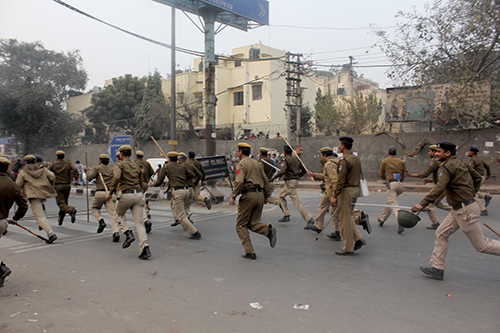
‘I kept telling them I’m a journalist but they kept beating me’: Photographer beaten at Delhi protest
As police cracked down on protesters in Delhi during recent protests over the treatment of Dalits, who occupy the lowest rungs of India’s caste ladder, journalists were caught in the fray. The protests were sparked by the suicide of Rohith Vemula, a student who had been barred from halls of residence and parts of campus,…
Claims police spied on two journalists revive surveillance fears of Colombia’s press
When Claudia Morales’s six-year-old daughter asks about her mother’s bodyguards, the Colombian journalist tells her they are colleagues. “She’s too young to understand,” Morales, who works for the Bogotá-based Caracol Radio in the city of Armenia, told CPJ in a telephone interview. Vicky Dávila, the news director of LA Fm Radio who also has private…
CPJ raises concerns over UN agenda on preventing violent extremism
Preventing and countering violent extremism has been a major issue on the international agenda in the past year, prompting the United Nations Secretary-General to launch a Plan of Action to Prevent Violent Extremism in December and the UN Human Rights Council to adopt a resolution last fall.
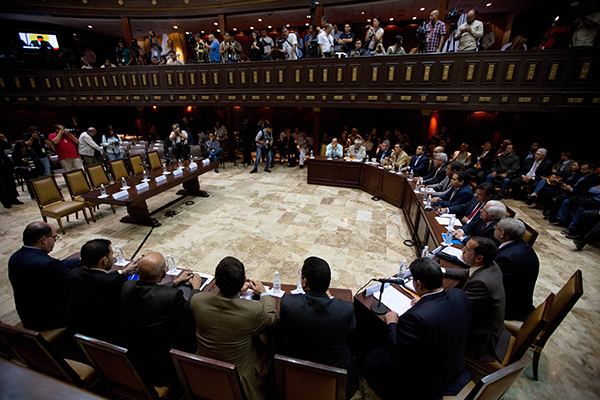
Venezuela’s national assembly reopens to the press after five-year ban
When security guards opened the doors to Venezuela’s colonial-era National Assembly building last Wednesday, I was among the dozens of reporters who swarmed inside. Even though the day’s legislative session would not be called to order for another three hours, every seat in the press galley, located on the second-floor balcony overlooking the chamber, was…

As editor-informant Li Xin disappears, journalists share their experiences with China’s security services
The case of Li Xin, a journalist who disappeared in Thailand in January after telling the international press in November he had fled China after being forced to work for years as a government informant, has shed light on the pressures some journalists face to provide information to the authorities.
How U.S. copyright law is being used to take down Correa’s critics in Ecuador
On December 30, César Ricaurte, the executive director of Fundamedios, received a copyright complaint with the potential to close his entire website. The complaint, filed on behalf of Ecuador’s communications regulator SECOM by a company called Ares Rights, ordered the independent press freedom group to remove an image of President Rafael Correa from its website,…

We’re live from Taipei! Please don’t tell China’s censors
Typically, news organizations like to promote original reporting. When an outlet covers a breaking news event at the time and from the place where the event is happening, they want their audience to know. However, for Chinese commercial media that covered this weekend’s presidential election in Taiwan, this was apparently not the case.
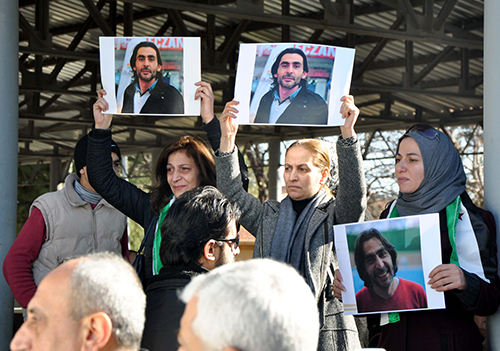
For journalists fleeing Islamic State, Turkey ‘is as dangerous as Syria’
For the past two years, activists and journalists seeking refuge from Islamic State repression in Raqqa would take sanctuary across the border in southern Turkey, setting up safe houses and offices, and darting back to Syria regularly with camera equipment and other vital supplies. But that sanctuary is now under threat.
‘They wanted me to say I was wrong’: Freed Ethiopian journalist on why 1,500 days in jail failed to silence her
Reeyot Alemu, an Ethiopian journalist who worked for the independent weekly Feteh, spent almost 1,500 days in prison after being arrested in June 2011 and charged with terrorism in 2012. She was released unexpectedly in July.

Will the EU’s actions speak louder than its words on Poland’s new media law?
On January 13, the European Commission–the so-called guardian of EU treaties–will meet in Brussels to debate a troubling law passed in Poland today that, according to reports, paves the way for the government to take control of public service TV and radio.