


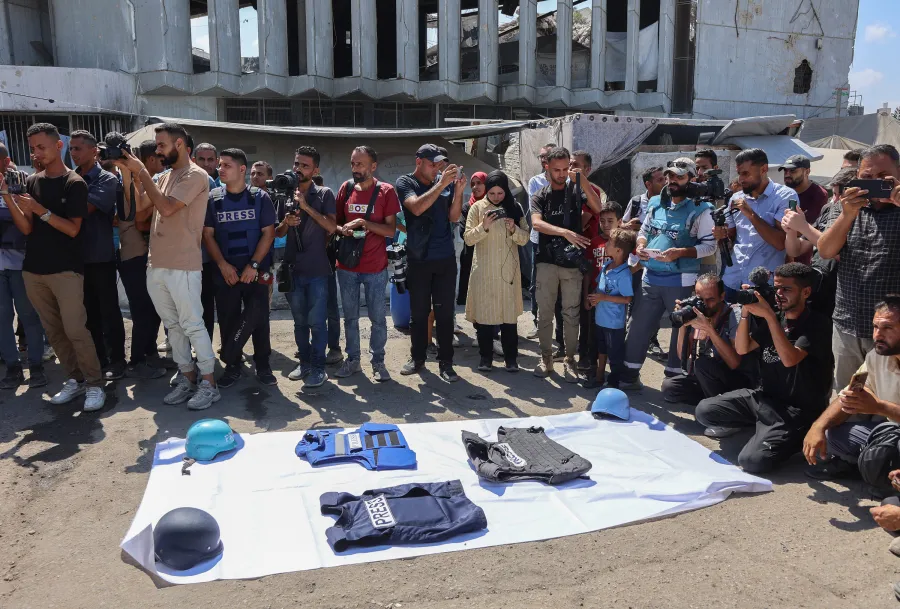
Editor’s note: In keeping with CPJ’s methodology, data will be updated as new information becomes available. See CPJ’s database for the most current data on killed journalists.
As of September 24, 2026, CPJ’s preliminary investigations show that at least 247 journalists and media workers are among the more than tens of thousands killed across Gaza, Yemen, Lebanon, Israel and Iran since the Israel-Gaza war began on October 7, 2023, and the Iran war began on February 28, 2026. Israel has now killed more journalists and media workers than any other government since CPJ began collecting data in 1992. More press members have died in the combined Israel-Gaza and related regional conflicts than in any other war that CPJ has documented.
To date, CPJ has documented a total of 247 journalists and media workers killed in Gaza, Iran, Lebanon and Yemen.
241 journalists and media workers killed by Israel, of which:
- 189 were Palestinians killed in Gaza in the Israel-Gaza war
- 2 Palestinians killed in Israeli detention centers
- 31 Yemenis in Yemen
- 7 Lebanese in Lebanon during the war on Gaza
- 9 Lebanese in Lebanon during the Iran war
- 3 Iranians in Iran during the 12-day war
6 journalists and media workers killed by other actors, of which:
- 1 Iranian killed in U.S.-Israeli strikes during the Iran war
- 4 Israelis killed in Israel by Hamas
- 1 Palestinian journalist killed by an armed group in Gaza
In addition to:
- 174 journalists reported injured
- 2 journalists reported missing
- 118 journalists arrested
- Multiple assaults, threats, cyberattacks, censorship, and killings of family members
Targeted murder of journalists
CPJ has confirmed a total of 74 journalists and media workers were murdered to date in Gaza, Lebanon, Iran, and Yemen, of which 58 were journalists and 16 media workers. Amid the extreme constraints imposed on Gaza — including Israel’s ban on foreign press access, destroyed communications infrastructure, mass displacement, and widespread loss of life — verifying information consistent with CPJ’s methodology is extraordinarily difficult. The total number of targeted killings may be far higher. With much contemporaneous evidence now destroyed, the true number of Palestinian journalists in Gaza who were deliberately targeted by Israel may never be known.
Editor’s notes:
- This page was updated on June 25, 2026. Following a review of our records, we discovered two inadvertent errors on this list. Mohammed al-Maqri, a Yemeni journalist who was killed in Yemen on December 28, 2024, by Al-Qaeda, was mistakenly included and has now been removed. Amna Hamid, a Palestinian journalist who was killed in Gaza on April 24, 2024, by Israel, was inadvertently omitted and has now been added.
- On September 25, 2026, CPJ deleted an erroneous duplicate reference stating that Mossab Ashour was removed after new research established that he engaged in combat. He was removed after CPJ established that he was not a journalist or media worker.
Amna Hamid, Mohammed al-Bardaweel, Murad Halboub al-Faqih, Mohamed Qeshta, Mahmoud Wadi, Anas Ghnaim, Abed Shaat, Ahmad Qalaja, Ahmed Mansour, Anas al-Sharif, Ayman Al Gedi, Fadi Hassouna, Faisal Abu Al Qumsan, Ghassan Najjar, Hamza Al Dahdouh, Hossam Shabat, Ibrahim Zaher, Ibrahim Sheikh Ali, Ismail Al Ghoul, Ismail Baddah, Issam Abdallah, Mahmoud Islim Al-Basos, Moamen Aliwa, Mohammad al-Khaldi, Mohammed Al-Ladaa, Mohammed Qreiqeh, Mustafa Thuraya, Nima Rajabpour, Rami Al Refee, Suleiman Hajjaj, Wissam Kassem, Abdulaziz al-Sheikh, Abbas al-Dailami, Youssef Shams al-Din al-Bahri, Mohammed al-Omeisi, Abdullah al-Harazi, Jamal al-Adhi, Bashir Hussein Ahsan Dablan, Abdulqawi Mohammed Saleh al-Asfour, Abdo Taher Musleh al-Saadi, Lutf Ahmed Nasser Hadiyan, Qais Abdo Ahmed al-Naqeeb, Mohammed Ali Hamoud al-Dawi, Faris Abdo Ali al-Rumaisa, Abdulrahman Mohammed Mohammed Jaman, Amal Mohammed Ghaleb al-Manakhi, Abdullah Mahdi Abdullah al-Bahri, Sami Mohammed Hussein al-Zaidi, Mariam Abu Dagga, Hussam Al-Masri, Mohammed Salama, Ahmed Abu Aziz, Moaz Abu Taha, Fatima Ftouni, Mohamad Ftouni, Ali Shoaib, Mohammed Washah, and Amal Khalil.
Masoumeh Azimi, Mohammed Reda, Ali Naji al-Shara’i, Ali Mohammed Ahmed al-Faqih, Arif Ali Abdo al-Samhi, Mohammed Hamoud Ahmed al-Matari, Abdul Wali Abdo Hussein al-Najjar, Abdul Aziz Saleh Ahmed Shas, Mohammed Ahmed Mohammed al-Zakri, Zuhair Ahmed Mohammed al-Zakri, Essam Ahmed Murshid al-Hashidi, Salim Abdullah Abdo Ahmed al-Watiri, Mohammed Abdo Yahya al-Sanfi, Mohammed al-Azzi Ghaleb al-Harazi, Mohammed Noufal, and Ali Mohammed al-Aqel.
Definitions and methodology
For more information on how CPJ defines “Murder” please see our Methodology page.
Clarifications and corrections:
CPJ updates its data and the accompanying narrative accounts as new information becomes available over time.
CPJ conducted a review in June 2026, and, as a result, has removed 22 press members, reinstated six, and reclassified 12:
Individuals removed after new research established engagement in combat
Abdallah Iyad Breis, Ahmed Abu Eisha, Ahmed Abu Sharia, Hussam al-Dabbaka, Mohamed El Sayed Abu Skheil, Mohamed Nabil Al-Zaq, Mohammad Jarghoun, Mohammed Bassam Al Jamal, Mostafa Bakeer, Rasheed Albably, Tarek El Sayed Abu Skheil, Yahya Abu Manih, Yasser Abu Namous, Hilmi al-Faqaawi, Hassan Farajallah, Mohamed Adel Abu Skheil, Mohammed Al-Sakani, Salem Abu Toyour, and Assem Al-Barsh.
Individuals removed after new research confirmed they were not journalists or media workers
Ahmed Al-Qara, Duaa Jabbour, and Mossab Ashour.
Individuals reinstated after new research determined their deaths were confirmed to be work-related
Ahmed Fatima, Assaad Shamlakh, Mohamed al-Jaja, Mohamed Khaireddine, Shai Regev, and Ayelet Arnin.
Individuals reclassified after new research confirmed their roles
Reclassified from “Media Worker” to “Journalist”: Ibrahim Sheikh Ali, Amro Salah Abu Hayah, and Mohamed Khalifeh.
Reclassified from “Journalist” to “Media Worker”: Ahmed Abu Mhadi, Husam Mubarak, Iyad Matar, Mohamed Abu Hassira, Mohamed Jamal Sobhi Al-Thalathini, Mohammed Ali, Mohammad Jameel Balousha, Saed Al-Halabi, and Mohammed Noufal.
From 2023-April 2025, CPJ also removed the following:
Individuals removed after CPJ’s subsequent research established engagement in combat
Mohamed Manhal Abu Armanah, Mohamed Naser Abu Huwaidi, Yacoup al-Borsh, Rizq Abu Shakian, Maisara Ahmed Salah, Mahdi al-Mamluk, Mustafa Bahr, and Abdullah Darwish.
Individuals removed after CPJ’s subsequent research and investigations confirmed that they were not journalists or media workers
Bahaa Okasha, Salma Mkhaimar, and Mohamed Fayez Abu Matar.
Individuals removed after CPJ’s subsequent research and investigations confirmed that they were not on assignment
Journalist Oded Lifschitz.
Individuals removed after CPJ’s subsequent research and investigations confirmed that they were not killed
Journalist and presenter Alaa Taher al-Hassanat was removed following reports that she survived the attack thought to have killed her. Journalist Mansour Shouman was removed from this list after he was found alive on February 6, 2024, after being reported missing over two weeks prior.