


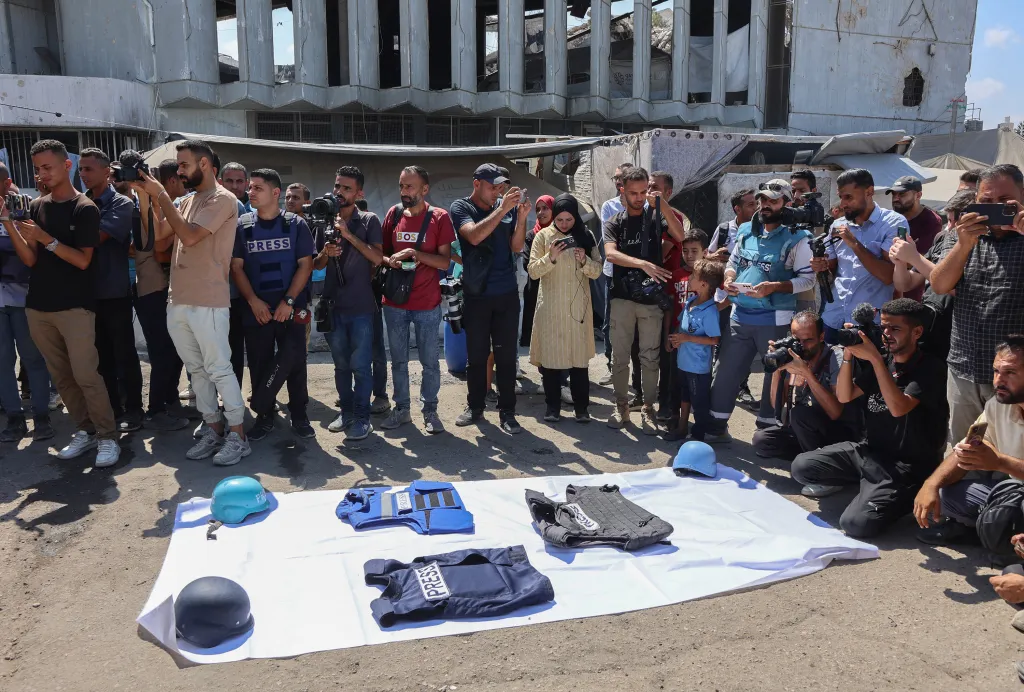
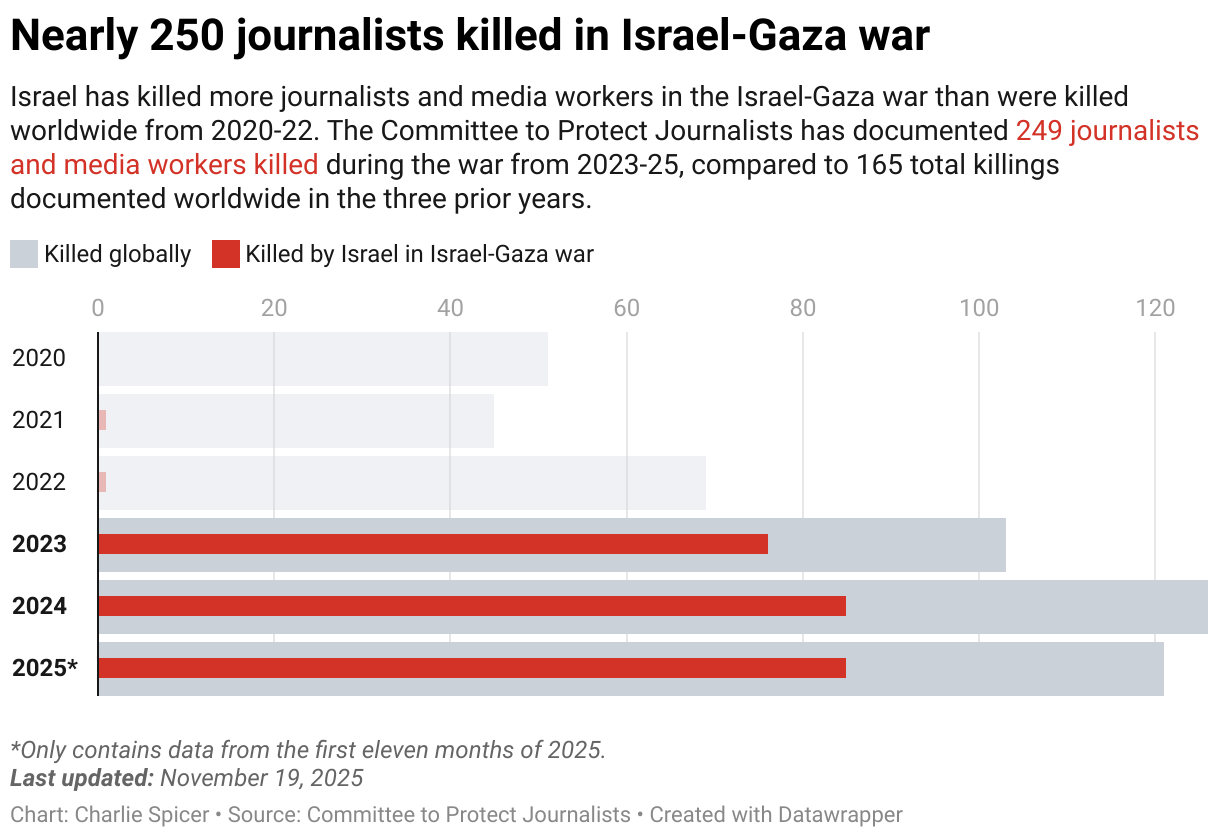
As of March 28, 2026, CPJ’s preliminary investigations show that at least 259 journalists and media workers are among the more than tens of thousands killed across Gaza, Yemen, Lebanon, Israel, and Iran since the Israel-Gaza war began. Israel’s disregard for the lives of journalists — and for the international laws designed to protect them — is unparalleled. Israel has now killed more journalists than any other government since CPJ began collecting data in 1992, making this war the deadliest on record for journalists.
To date, CPJ has documented:
- 256 journalists and media workers killed by Israel, of which:
- 210 were Palestinians killed in Gaza
- 31 Yemenis in Yemen
- 11 Lebanese in Lebanon
- 3 Iranians in Iran
- 1 Iranian killed in U.S.-Israeli strikes
___ - 2 Israelis killed in Israel by Hamas
- 1 Palestinian journalist killed by an armed group in Gaza
___ - 174 journalists reported injured
- 3 journalists reported missing
- 106 journalists arrested
- Multiple assaults, threats, cyberattacks, censorship, and killings of family members

CPJ is also investigating dozens of additional cases of potential journalist killings, arrests, and injuries, as well as damage to media offices and homes by Israel, cases that remain difficult to document and verify amid what human rights organizations and United Nations experts deem a genocide.
Journalists in Gaza have faced extreme, often fatal, risks as they try to cover relentless Israeli airstrikes, the destruction of most of the territory’s infrastructure, the forced displacement of 90% of Gaza’s population, trauma, and widespread famine.
Explore CPJ’s database of journalists and media workers killed*:
- In Gaza and Israel during the war (2023-25)
- In Lebanon during the war (2023-25)
- In Iran (2025)
- In Yemen (31 of 32 killed by Israel 2025)
“Since October 7, 2023, Palestinian journalists have been slaughtered with impunity, while the world watches. This is a direct, unprecedented assault on press freedom,” said CPJ Regional Director Sara Qudah. “Journalists cannot carry out their work — let alone survive — while being deliberately starved and denied life-saving aid. Israel must allow humanitarians, international media, and human rights investigators into Gaza at once.”
Targeted murder of journalists
While war reporting is inherently dangerous, Israel has fundamentally shifted the paradigm through the deliberate and unlawful targeting of journalists. Since 1992, CPJ has documented cases of targeted journalist killings: where a journalist is killed deliberately for their work, which CPJ classifies as “murder.” Under international humanitarian law, journalists are civilians, and the deliberate targeting and killing of them constitutes a war crime.
Following this longstanding methodology, CPJ has found that the Israel Defense Forces (IDF) has committed more targeted killings of journalists than any other government’s military since CPJ began its documentation. Indeed, in 2025, CPJ documented 47 cases of journalists murdered for their work worldwide — 81% of them attributed to Israel.
To date, CPJ has determined that at least 64 journalists and media workers were directly targeted and killed by Israeli forces in direct reprisal for their work, and continues to investigate many other cases of suspected targeted killings. Amid the extreme constraints imposed on Gaza — including Israel’s ban on foreign press access, destroyed communications infrastructure, mass displacement, and widespread loss of life — verifying information consistent with CPJ’s rigorous methodology is extraordinarily difficult. The total number of targeted killings may be far higher. With much contemporaneous evidence now destroyed, the true number of Palestinian journalists in Gaza who were deliberately targeted by Israel may never be known.
The 53 journalists that CPJ has confirmed were murdered to date in Gaza, Lebanon, Iran, and Yemen are: Mohamed al-Maqri, Murad Halboub al-Faqih, Mohamed Qeshta, Mahmoud Wadi, Anas Ghnaim, Abed Shaat, Ahmad Qalaja, Ahmed Mansour, Anas al-Sharif, Ayman Al Gedi, Fadi Hassouna, Faisal Abu Al Qumsan, Ghassan Najjar, Hamza Al Dahdouh, Hilmi al-Faqaawi, Hossam Shabat, Ibrahim Zaher, Ismail Al Ghoul, Ismail Baddah, Issam Abdallah, Mahmoud Islim Al-Basos, Moamen Aliwa, Mohammad al-Khaldi, Mohammed Al-Ladaa, Mohammed Noufal, Mohammed Qreiqeh, Mustafa Thuraya, Nima Rajabpour, Rami Al Refee, Suleiman Hajjaj, Wissam Kassem, Abdulaziz Al-Sheikh, Abbas al-Dailami, Youssef Shams al-Din al-Bahri, Mohammed al-Omeisi, Abdullah al-Harazi, Jamal al-Adhi, Bashir Hussein Ahsan Dablan, Abdulqawi Mohammed Saleh al-Asfour, Abdo Taher Musleh al-Saadi, Lutf Ahmed Nasser Hadiyan, Qais Abdo Ahmed al-Naqeeb, Mohammed Ali Hamoud al-Dawi, Faris Abdo Ali al-Rumaisa, Abdulrahman Mohammed Mohammed Jaman, Amal Mohammed Ghaleb al-Manakhi, Abdullah Mahdi Abdullah al-Bahri, Sami Mohammed Hussein al-Zaidi, Mariam Abu Dagga, Hussam Al-Masri, Mohammed Salama, Ahmed Abu Aziz, and Moaz Abu Taha.
The 17 media workers in Gaza, Lebanon, Iran, and Yemen are Ibrahim Sheikh Ali, Masoumeh Azimi, Mohammed RedaIbrahim, Murad Halboub al-Faqih, Ali Naji al-Shara’i, Ali Mohammed Ahmed al-Faqih, Arif Ali Abdo al-Samhi, Mohammed Hamoud Ahmed al-Matari, Abdul Wali Abdo Hussein al-Najjar, Abdul Aziz Saleh Ahmed Shas, Mohammed Ahmed Mohammed al-Zakri, Zuhair Ahmed Mohammed al-Zakri, Essam Ahmed Murshid al-Hashidi, Salim Abdullah Abdo Ahmed al-Watiri, Mohammed Abdo Yahya al-Sanfi, Mohammed Al-Azzi Ghaleb al-Harazi, and Ali Mohammed al-Aqel.
One of the primary methods used in targeted killings is the deployment of armed drones. Since October 7, 2023, Israeli drone strikes alone have killed at least 49 Palestinian journalists and media workers, including:
- 1 in 2023
- 17 in 2024
- 28 in 2025
- 3 as of January 2026
Israeli claims that journalists were “not identified” or that their civilian status was “unclear” are not credible given Israel’s advanced surveillance, intelligence, and targeting capabilities. “With such technology, there is no plausible deniability about who is being targeted,” Qudah said.
Smear campaigns and impunity
In addition to physical attacks, journalists—particularly Palestinians—have faced coordinated smear campaigns and efforts to delegitimize their work. Israeli officials, pro-government media, and online networks have repeatedly labeled journalists as “terrorists” or accused them of acting on behalf of Hamas, often without evidence, placing them at greater risk and attempting to discredit documentation of war crimes.
To date, no one has been held accountable for any targeted killing of a journalist by Israel since October 7, 2023 — nor for any such killing in the preceding 22 years. As documented in CPJ’s 2023 report “Deadly Pattern”, this reflects a longstanding pattern of impunity in cases involving the killing of journalists.
The persistent failure to investigate and prosecute these killings represents a grave threat to press freedom. More than a decade after the UN established the International Day to End Impunity for Crimes Against Journalists, 80% of such killings worldwide remain unsolved.
IDF officials have repeatedly told media outlets that the army does not deliberately target journalists. Shortly after the war started, the IDF also told news agencies that it could not guarantee the safety of journalists operating in Gaza.
CPJ has called on international authorities to ensure that all targeted killings of journalists by the IDF are independently and impartially investigated as war crimes. The perpetrators — from the individuals in the IDF units through to the highest level of the command chain — must be held to account.Israel’s long-standing pattern of impunity has enabled continued violations — and the silencing of journalists reporting on starvation, attacks on hospitals, and other potential war crimes.
Definitions and methodology
CPJ has tracked and documented the cases of members of the press killed in relation to their work since 1992. This includes each journalist and media worker killed since the Israel-Gaza war began on October 7, 2023. CPJ’s longstanding and rigorous methodology has been widely cited by United Nations bodies, government officials, and human rights organizations. For more information see: How CPJ documents press killings in the Israel-Gaza war.
Clarifications and corrections:
CPJ removes names if later evidence shows the individual was not a journalist or media worker, or if they were not active at the time of their death. Notable updates include:
A Palestinian man, Mohamed Khaireddine, was removed after family clarified he was not a journalist.
Palestinian men Bahaa Okasha, Salma Mkhaimar, Ahmed Fatima, Mohamed Al Jaja, Assaad Shamallakh, Mohamed Fayez Abu Matar, and Abdullah Darwish were removed after research and investigations confirmed that they were not journalists or media workers.
Israeli journalists, Shai Regev and Ayelet Arnin were removed after their outlets confirmed that the journalists were not on assignment to cover the music festival, nor were they in a position to begin reporting on the attack by Hamas militants that killed them on October 7. CPJ’s global database of killed journalists includes only those who have been killed in connection with their work or where there is still some doubt that their death was work-related.
Palestinian journalist and presenter Alaa Taher Al-Hassanat was removed after receiving reports that he may have survived the attack thought to have killed her, CPJ has removed her name from its database pending further investigation.Canadian-Palestinian journalist Mansour Shouman was removed from this list after he was found alive on February 6, 2024, after being reported missing more than two weeks before. Israeli journalist Oded Lifschitz was removed from the list after CPJ’s research found that he wasn’t working when he was taken as a hostage by Hamas on October 7, 2023.