


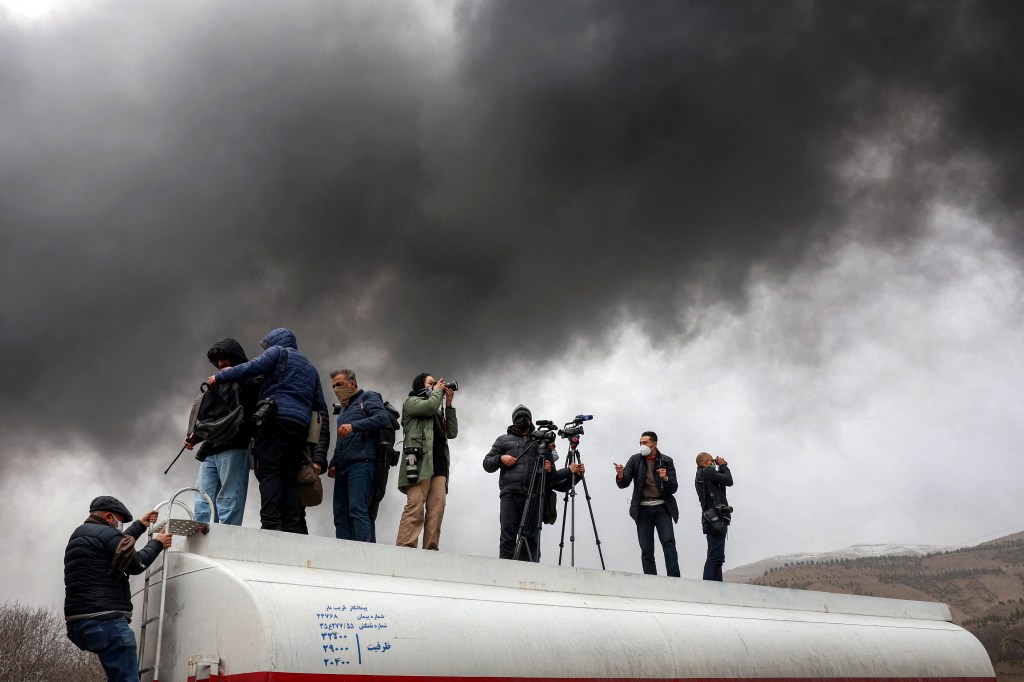
The Committee to Protect Journalists is monitoring press freedom violations related to the ongoing military escalation between Israel, the U.S and Iran and its spillover across the Middle East, including its regional and global impact on journalists and media workers.
Since the Iran war broke out on February 28, when the U.S and Israel launched strikes on Iran and Tehran retaliated with attacks across the region, CPJ has documented arrests of journalists, interference with reporting, airstrikes damaging media infrastructure, and sweeping restrictions on coverage both within the region and globally.
To date, CPJ has documented:
- 7 journalists killed since the Iran war began
- 8 journalists, assaulted, threatened, or harassed
- 9 media outlets damaged in airstrikes, with some reports of injuries
- 9 journalists detained or questioned
- Censorship measures in several countries worldwide, including a nationwide internet blackout in Iran
- 11 journalists obstructed while reporting
Below is a developing timeline of incidents affecting journalists and the media worldwide:
March 30, 2026, Day 31 — CPJ has yet to document any press freedom violations related to the war on this date.
March 29, 2026, Day 30 — Al-Araby TV bureau damaged in Israeli strike in Tehran; Regulatory warnings against broadcasters in Iraq
- An Israeli missile strike severely damaged a civilian commercial building housing Qatari-funded broadcaster Al-Araby TV’s bureau in Tehran, according to the network, the attack hit the second and third floors, including its office. The strike occurred while correspondent Hazem Kallas was live on air. Iran’s Red Crescent reported 10 injuries and no fatalities. Al-Araby TV condemned the attack, stating that “endangering journalists or considering them targets runs counter to international law and the relevant Geneva Conventions.”
- Iraq’s Communications and Media Commission issued formal warnings to Saudi-owned broadcasters Al Arabiya Al Hadath and Qatar’s Al Jazeera English over alleged breaches of broadcasting rules. Authorities cited an Al Arabiya Al Hadath report showing a convoy with Iranian and Popular Mobilization Forces flags, which the outlet said was heading from Basra toward Iran; officials said it was carrying humanitarian aid and accused the channel of airing “misleading” content and inciting harm. Al Jazeera English was separately penalized over its reporting on a strike on the Habbaniyah base, which regulators said included inaccurate information and undermined state institutions. Both outlets were ordered to remove or correct the content, with authorities warning of further legal action for continued violations.
March 28, 2026, Day 29 — Three Lebanon journalists killed in Israeli strike.
- In southern Lebanon, an Israeli strike targeted a media car on the Jezzine highway, killing Al-Manar journalist Ali Shoaib, Al-Myadeen journalist Fatima Ftouni, and a freelance photojournalist Mohamad Ftouni while they were reportedly on their way to cover an assignment.
March 27, 2026, Day 28 — CPJ has yet to document any press freedom violations related to the war on this date.
March 26, 2026, Day 27 — CPJ has yet to document any press freedom violations related to the war on this date.
March 25, 2026, Day 26 — Lebanon journalist killed in Israeli strike; Hezbollah bans filming in Beirut suburb; Iran official files complaint against journalist
- In Lebanon, freelance photojournalist Hussein Hammoud, who worked for Hezbollah-affiliated broadcaster AlManar TV and the media office of Jabal Amel region, was killed in an Israeli airstrike while reporting in the southern city of Nabatieh.
- Lebanese armed group Hezbollah circulated a directive via WhatsApp to a group of foreign journalists based in Lebanon, according to two sources who spoke to CPJ. The message, which CPJ reviewed, “strictly prohibits” filming in Beirut’s southern suburb. It warns that journalists who violate the directive will have their equipment confiscated “without prior warning,” and states that the restriction is a security measure aimed at protecting all parties.
- A judicial official in Iran filed a complaint against Siamak Rahmani, journalist and editor-in-chief of the Bartarinha website, over the alleged publication of “criminal content” on his personal Instagram account, according to a judiciary statement reported by Mehr News Agency. The complaints follow an image he posted on his Instagram story showing a bookstore wall covered with handwritten messages, including the phrase “Long live the Shah.”
March 24, 2026, Day 25 — Israeli police obstruct a journalist
- Israeli police officers obstructed Qatari-based Al-Araby TV correspondent Ahmad Darawsheh while he was reporting live on a missile strike on a building in Tel Aviv. Darawsheh was later targeted by an incitement campaign on digital platforms affiliated with the Israeli right-wing supporters, where posts questioned his journalistic work and accused him of supporting “terrorism.”
March 23, 2026, Day 24 — Israeli strike near journalists in southern Lebanon; Pentagon imposes new press restrictions
- In Lebanon, the Israeli military struck the vicinity of the Qasmiyeh bridge in southern Lebanon approximately 150 meters from where journalists were reporting, forcing them to leave the area.
- In the United States, the Pentagon imposed new restrictions on the press after a ruling held that some of its prior limits on journalists’ reporting were unconstitutional. The new rules would “sharply limit” coverage, the National Press Club said, at a time when the public depends on journalists’ “being able to observe, report, and ask questions freely” about the Iran war.
March 22, 2026, Day 23 — CPJ has yet to document any press freedom violations related to the war on this date.
March 21, 2026, Day 22 — Iran says blocks news outlets; journalist detained in Israel
- Iran’s judiciary media center said authorities have temporarily blocked several news websites and one news agency, without naming the outlets. The judiciary said authorities have also carried out “legal follow-up, asset seizures, judicial case formation, arrests, bans on activity” against select journalists and media outlets.
- Israeli police detained a Palestinian photojournalist, who requested anonymity, while he was covering the impact of missile debris in the southern city of Arad. Officers confiscated his equipment and held him for about an hour, he told CPJ.
March 20, 2026, Day 21 — CPJ has yet to document any press freedom violations related to the war on this date.
March 19, 2026, Day 20 — RT journalists injured in Israeli strike
- In southern Lebanon, Russia Today correspondent Steve Sweeney and camera operator Ali Rida Sbeity were injured in an Israeli strike by the Qasmiyeh bridge, north of the city of Tyre, just feet from where they were filming in clearly marked press gear. Both were hospitalized with shrapnel wounds. In a post on X, the IDF acknowledged the strike at the bridge, noting footage of a journalist at the scene, adding that it had given prior “explicit warning” for civilians to leave the area.
March 18, 2026, Day 19 — Lebanese journalist killed in Israeli strike
- In Lebanon, Mohamed Sherri, a journalist with Hezbollah-affiliated broadcaster Al-Manar TV, was killed in an Israeli strike on a residential building he lived in with his family in the central Beirut neighborhood of Zuqaq al-Blat on the morning of March 18, 2026. In response to a request for comment, a spokesperson for the Israeli Defence Forces’ situation room told CPJ by phone that the incident was being looked into.
March 17, 2026, Day 18 — Two journalists obstructed in Israel
- In Israel, Al-Ghad correspondent Razi Tatour told CPJ that Haifa Municipal Officers prevented him and camera operator Suhayb Hijazi from conducting field coverage in the Stella Maris area of Haifa. He said officers told them to stop filming, informing them that it was prohibited without prior approval from the police spokesperson. Tatour added that he and Hijazi agreed to wait for this authorization and went into a nearby restaurant while waiting for a response, but officers followed and threatened to arrest them if they did not vacate the area.
March 16, 2026, Day 17 — Censorship, hacking and legal pressure on Lebanese media
- In Lebanon, the Ministry of Communications issued a directive to national media outlets, banning the descriptive term of “resistance” when used in relation to Hezbollah.
- Private-owned Lebanese media outlet MTV was briefly hacked by individuals described as pro-Hezbollah supporters. CPJ also reviewed a judicial complaint filed by six lawyers accusing MTV of incitement to violence after it aired a report alleging that Hezbollah was using residential buildings. According to the complaint, the lawyers argue the report constitutes the crime of providing information to the enemy as those locations were later targeted by Israeli airstrikes.
- Iranian documentary filmmaker Mojgan Ilanlou was arrested in Tehran during an early morning raid by plainclothes security forces, BBC Persian reported. Officers reportedly entered her home without presenting a judicial warrant, and a physical confrontation occurred during the arrest. Ilanlou was detained alongside her husband, film producer Mohammad Pirhadi, and their daughter, Leila Pirhadi. Authorities have not disclosed the reasons for their arrest or where the family is being held.
- Security forces from Iraq’s Interior Ministry prevented an Al Arabiya Al Hadath correspondent from conducting a live broadcast in Baghdad’s Green Zone on Monday night, footage showed, as he attempted to cover air defenses intercepting a drone near the U.S. Embassy during the Rashid Camp incident.
March 15, 2026, Day 16 — Threats and media suspension in Iran, Iraq, and the US
- Iranian authorities threatened to target satellites and infrastructure linked to the Farsi-language broadcaster Iran International, with a spokesperson for the IRGC’s Khatam al-Anbiya Central Headquarters accusing the network of attempting to “wage psychological warfare against the Iranian people.” Iran International, in a statement sent to CPJ, said Iranian authorities had issued “explicit warnings” to Turkmenistan and Monaco over hosting the TürkmenÄlem 52°E / MonacoSAT satellite that carries the channel’s broadcasts. The network said the threat was followed by attempts to jam the satellite carrying its signal from Iran, which forced the channel off air.
- In Iraq’s Kurdistan Region, Qatari-owned broadcaster Al Jazeera was suspended from “field work and media coverage throughout the Kurdistan Region for a period of two weeks” over a violation of recent media guidelines, Ster Hakim, the network’s reporter in the Kurdistan Region told CPJ. In an order reviewed by CPJ, authorities said “continued violations could lead to stricter legal measures, including revoking the channel’s license and permanently closing its office in the region.”
- U.S. President Donald Trump, in a Truth Social post, accuses news outlets of “false reporting” on strikes against U.S. targets in the Iran war, and says other outlets, which he accused of working with Iran to create “FAKE NEWS” about a strike on a U.S. warship, should be charged with treason.
March 14, 2026, Day 15 — U.S. regulator threatens broadcasters over Iran war coverage; Qatar arrests columnist
- U.S. Federal Communications Commission Chair Brendan Carr threatens to revoke broadcasters’ licenses over Iran war coverage.
- Qatari authorities arrested Palestinian columnist and media commentator Saeed Ziad under a legal warrant issued by the Ministry of Interior’s Cybercrime Department, reportedly in connection with tweets and commentary addressing the Iran war. He was later released on March 20. CPJ was unable to independently confirm the reasons behind his arrest or the conditions of his release due to restrictions imposed by the Qatari government, as many sources feared retaliation.
March 13, 2026, Day 14 — Lebanon photojournalist injured while reporting
- In Lebanon, freelance photojournalist Kwanat Hajou, also known as Ali Hajou, was injured while reporting on an attack in the town of Abbassieh, southern Lebanon. His wife told CPJ that he sustained a shoulder injury and was taken to hospital for treatment.
- In northern Israel’s Galilee region, Roya News correspondent, Ward Qarara was heckled while live on air by a passerby, shouting insults.
March 12, 2026, Day 13 — Iraqi armed group attack TV crew
- In Iraq, fighters affiliated with the Popular Mobilization Forces (PMF) obstructed a television crew from Rudaw Media Network in front of a general hospital in the city of Kirkuk while covering injuries sustained by PMF members following a U.S. airstrike. Rudaw TV reporter Hiwa Hussamadin said five PMF fighters attacked him, and he was hit with the stock of a weapon. The fighters also confiscated the crew’s camera, which was later returned.
March 11, 2026, Day 12 — Lebanon media worker injured in Israeli strike
- In Lebanon, Al Jazeera media worker Mazen Balouza was injured when an Israeli strike hit a residential apartment building in central Beirut. Balouza was not working at the time. The union of journalists confirmed his injury to CPJ.
March 10, 2026, Day 11 — Iran expands legal crackdown; Israel reporter threatened; Pakistan warns journalists
- Iran’s judiciary has criminalized “any filming or reporting” of U.S. or Israeli strikes on Iranian positions as evidence of “cooperation with a hostile enemy,” according to the judiciary-affiliated Mizan News Agency.
- Times of Israel correspondent Emanuel Fabian began receiving pressure, which later escalated to online death threats, to change his reporting on an Iranian missile attack on Israel to resolve a prediction on the Polymarket betting site, he said in an article.
- Pakistan officials threaten legal action against journalists crossing “red lines” on foreign policy coverage.
March 9, 2026, Day 10 — Palestinian journalist killed in Gaza
- In central Gaza, an Israeli strike on tents housing displaced people killed Palestinian journalist Amal Shamaly, a correspondent for Qatar Radio. In response to an email request for comment, the IDF told CPJ it “did not conduct a strike in the given location and date.”
- In Lebanon, Haitham Almossawi, head of the photography department of local daily Al-Akhbar newspaper, was injured while covering the aftermath of an Israeli airstrike in the southern suburbs of Beirut.
March 8, 2026, Day 9 — Journalist blocked from reporting in Haifa
- Al Araby TV journalist Abdel Qader Abdel Halim was prevented from reporting by Israeli municipal police in Haifa. In a video reviewed by CPJ, an officer can be heard telling the journalists that “filming is prohibited in Haifa.”. Abdel Halim told CPJ that he was forced to leave the scene.
March 7, 2026, Day 8 — Journalist killed in Iran; journalists detained in India
- Masoud Salimi, Iranian journalist and former director of the Tasnim News Agency bureau in Qom, was killed in a U.S.-Israeli strike on the Iranian city of Qom, according to the agency. This marks the first known case of a killed journalist since the war started in the region. CPJ is still investigating his killing for further information.
- The Kurdistan Regional Government’s Department of Media and Information introduced special regulations and restrictions for domestic and foreign media outlets, digital platforms, and social media users prohibiting broadcasting live footage showing the direction of drones or missiles or revealing the precise locations of impacted sites, and specifying how to handle citizen-submitted content.
- Iran state-affiliated news website Tabnak published an article calling on the country’s armed forces to target the Persian-language broadcaster Iran International and individuals associated with it, urging authorities to increase the “cost of betrayal” and suggesting action against the network’s offices but also against the private homes of several Iran International television staff members and analysts living in Israel.
- Indian authorities detained two journalists for filming an Iranian warship docked in India.
March 6, 2026, Day 7 — Threats against Lebanese journalist; new reporting restrictions
- Lebanese journalist Ghada Eid posted on Facebook and X that she has been receiving death threats via social media and phone from what she believes are Hezbollah supporters, since March 5, 2026. Eid said that she will undergo legal proceedings against those that threatened her.
- Israeli strike on the headquarters of Al-Saksakiyah media outlet in the town of Al-Saksakiyah in southern Lebanon. In Iran, parts of the pro-reformist Tehran-based Sazandegi newspaper building were also damaged due to U.S. and Israeli airstrikes. No staff were injured as the incident occurred outside working hours.
- The United Arab Emirates warned citizens and residents against photographing, filming, publishing, or circulating images and videos of incident sites or damage resulting from the Iranian attacks. Violating this warning can lead to up to one year of imprisonment and financial fines under UAE law. Bahrain echoed similar warnings.
- In Lebanon, Sky News correspondent John Sparks and his camera operator were stopped and questioned by Hezbollah members while filming at the site of an airstrike in Beirut’s southern suburb of Dahiye. Sparks said a Hezbollah member escorted the crew to the site and gave them only two minutes to report before another group later blocked their van, checked their identities, and asked their purpose for being there before allowing them to leave.
March 5, 2026, Day 6 — Reporting disrupted across Israel and Lebanon
- Israeli municipal police in Haifa attempted to disperse several international news crews, including CNN, Fox News, the BBC, Turkish-owned Anadolu News Agency, and Al-Arabiya TV, among others, while reporting. Marwan Athamneh, an Al Arabiya reporter, and Samir Abdul-Hadi, an Anadolu Agency correspondent, told CPJ that officers ordered them to leave despite complying with military censorship guidelines. Journalists said a police spokesperson told them there was no legal basis for dispersing the press, but additional patrol units later repeated the orders.
- An airstrike hit the building of Kurdistan Network Television in Iran’s Sannadaj city, the Kurdish-language channel that is run by the state-run IRIB. No casualties were reported.
- The Union of Journalists in Lebanon told CPJ that Alian Dergham, a correspondent for MTV-Lebanon, was physically assaulted by a group of men in the northern Lebanese city of Batroun while conducting an interview.
- Three U.S freelance journalists – Nicholas Frakes, Hunter Williamson and Daniel Carde – told CPJ they were harassed and assaulted while covering residents fleeing from Dahiyeh, in the southern suburb of Beirut. They told CPJ that individuals asked them not to film as soon as they were seen, attempting to seize their equipment and physically push them away. “I was severely beaten and my press vest was taken from me,” Williamson said, “before the Lebanese army intervened and pulled us to safety and returned our belongings.”
- In Qatar, the interior ministry warned the public against gathering at incident sites, heading toward such locations, or photographing and sharing content related to field developments, as this may result in legal accountability.
March 4, 2026, Day 5 — Turkish journalists detained in Israel; US restricts press briefings
- Israeli officials detained Turkish journalists İlyas Efe Ünal, the editor-in-chief of Turkish government-affiliated outlet En Son Haber, and Adem Metan while crossing from Egypt to Israel. Metan later said on social media that both journalists were released after approximately six hours of questioning.
- CNN reported that the U.S. Defense Secretary Pete Hegseth has restricted press briefings and access to information related to the Iran war. During a Pentagon press briefing on the war, Hegseth accused the media of trying to make President Trump look bad by reporting on war casualties.
March 3, 2026, Day 4 — Journalists detained during live broadcast; Iranian state media area struck again
- CNN Türk correspondent Emrah Çakmak and camera operator Halil Kahraman were detained by Israeli security forces during a live broadcast from Tel Aviv following Iranian missile strikes on the city. A video published online shows officers halting the transmission. The journalists were taken into custody, and their phones, camera and microphone were confiscated. The journalists later told CPJ they had not regained access to their equipment at the time of reporting. Çakmak said Israeli authorities accessed his password-protected phone without his consent.
- Israel struck the area around the headquarters of Iran’s state broadcaster, Islamic Republic of Iran Broadcasting (IRIB), in Tehran. The IDF said it destroyed a communications center it alleged was used by the Islamic Revolutionary Guard Corps (IRGC) for military purposes. No casualties were immediately reported.
- Jordan’s Media Commission banned publishing videos or information related to the kingdom’s “defensive operations,” effectively limiting reporting to official updates from military and public security media. Similar restrictions were imposed in Saudi Arabia and Kuwait.
- India blocks social media accounts of several news outlets following protests over the killing of Iranian leader Ayatollah Ali.
March 2, 2026, Day 3 — Israel hits three Lebanon media outlets; UAE blocks press X accounts
- In Lebanon, where the fighting quickly expanded to, Israeli strikes hit three media facilities in Lebanon: Sawt Al-Farrah Radio local radio in Tyre, as well as Hezbollah affiliated outlets Al-Nour Radio, and the Al-Manar TV building in Haret Hreik, south of Beirut. It was not immediately clear whether members of the press were injured in the attacks.
- The Israel Defense Forces (IDF) ordered residents in parts of Tehran evacuated, including where Evin prison is located, raising concerns about the safety of imprisoned journalists. According to CPJ’s data, at least 15 journalists remain jailed in Iran. Three of them — Reza Valizadeh, Shinnosuke Kawashima, and Mohammad Zare-Foumani — are held in Evin Prison.
- In the United Arab Emirates (UAE), the public prosecutor issued a decree blocking access to several X accounts within the country. Among the accounts affected were those of Saudi state-owned channel Al Arabiya, Saudi journalist Malek Al-Rougui, and Algerian journalist Ahmed Hafsi.
March 1, 2026, Day 2 — Iranian state broadcaster hit
- Iran’s state-run broadcaster Islamic Republic of Iran Broadcasting (IRIB) reported that parts of the organization’s headquarters in Tehran were attacked by the U.S. and Israel in airstrikes, but that there was no information on possible casualties.
- In Israel, the military censor issued new directives to foreign media limiting the coverage of rocket impacts and interceptions inside the country. The directive, that CPJ has obtained and reviewed, prohibited live broadcasting during air raid sirens and restricted filming of interceptions or impacts near security sites. Journalists were instructed not to publish exact addresses of civilian impact sites and were warned against reposting footage from social media without prior approval.
February 28, 2026, Day 1 — Internet blackout as war breaks out; strike on Radio Dezful
- Within hours of U.S.-Israel strikes that killed Supreme Leader Ali Khamenei and other senior officials, Iranian authorities shut down internet access nationwide – a tactic repeatedly used by the government, including in January during the mass protests. Connectivity fell to about 4% of normal levels on the first day of the conflict, and later to around one 1%, according to NetBlocks, leaving most of the country offline. A number of journalists told CPJ the blackout has severely hindered reporting and communication, while only a small number of users, including some media linked to the government, retained limited access through the restricted “white internet.”
- The same day, Israeli airstrikes targeted the offices of state-run Radio Dezful in Khuzestan province were targeted by Israeli airstrikes. There were conflicting reports on injuries, with one stating that there were four injuries, but others reporting no one hurt.
This timeline will be updated as CPJ gathers additional information.
If you are a journalist covering these developments and experiencing threats, censorship, detention, or violence related to your work, contact CPJ on mena@cpj.org.
Editor’s note: A reference to Jordan’s Prosecutor General summoning Majed al-Qaraan, journalist and editor-in-chief of Saraha News, has been removed after his son, Mohammed, told CPJ the inquiry concerned domestic coverage rather than the Iran war, as previously reported.