


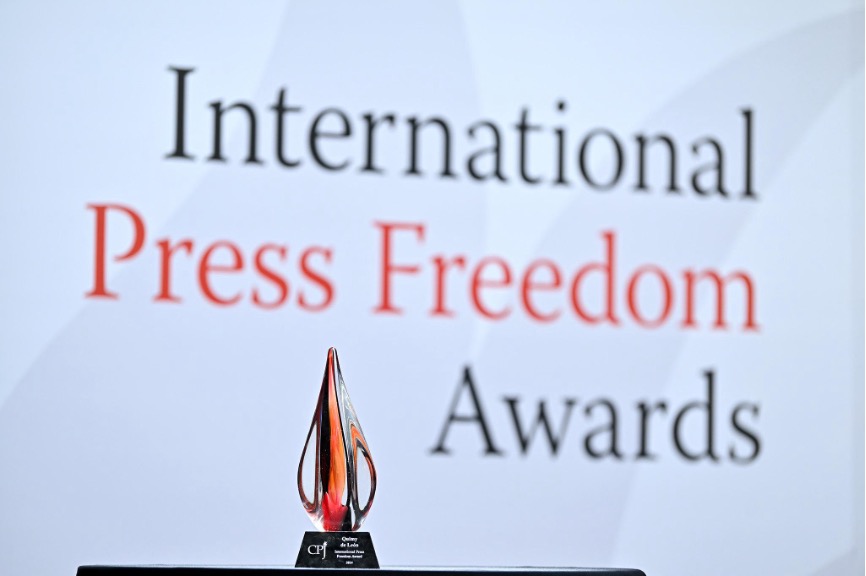
Awardees to be honored in November in New York
New York, August 5, 2026—The Committee to Protect Journalists (CPJ) today announced it will honor journalists from Colombia, Eritrea, El Salvador, Hungary, Lebanon, and Myanmar at the 36th annual International Press Freedom Awards in New York on Thursday, November 19, 2026.
The event will be chaired by Cesar Conde, chairman of the NBCUniversal News Group. Lulu Garcia-Navarro, journalist at The New York Times and co-host of “The Interview” podcast and CNN contributor, will serve as the master of ceremonies.
“This year’s awardees exemplify the determination and courage of journalists worldwide,” said CPJ CEO Jodie Ginsberg. “They have endured targeting, imprisonment, exile, and surveillance for simply reporting the news. It is an honor to recognize their commitment to documenting the truth.”
Carlos Dada, the Salvadoran journalist who in 1998 co-founded El Faro, the first digital newspaper in Central America, will receive the 2026 Gwen Ifill Press Freedom Award. The award is presented annually by CPJ’s board of directors in recognition of an individual’s sustained commitment to press freedom.
“For decades, Carlos Dada’s ingenuity and perseverance has seen El Faro’s journalism hold power to account in El Salvador and throughout Latin America,” said CPJ Board Chair Jacob Weisberg. “Today, Carlos leads a newsroom in exile from Costa Rica. Under his leadership, El Faro continues to deliver incisive reporting amid the erosion of press freedom under President Bukele’s administration.”
CPJ’s 2026 awardees are:
Christina Assi, Lebanon
Since 2018, Lebanese journalist Christina Assi has worked as photojournalist and photo editor for Agence France-Presse (AFP) in Cyprus. On October 13, 2023, Assi and six other journalists were targeted by Israel in a double-tap strike while reporting in Alma Al-Shaab on the Israeli-Lebanese border. Reuters correspondent Issam Abdallah, Assi’s best friend, was killed in the first strike, from which she sustained serious injuries resulting in the amputation of her right leg.
Multiple independent investigations concluded that Israel conducted a deliberate attack on the group of clearly identifiable journalists, which would constitute a war crime under international law.
Despite being the most well-documented attack on journalists by Israel on record, nearly three years on, no one has been held accountable. CPJ has recorded a longstanding pattern of journalist killings by Israel and a systemic failure to hold anyone accountable over them. Since the attack, Assi has campaigned for justice for Abdallah’s killing, advocated for journalist safety, and supported a rehabilitation program for people with similar life-altering injuries.
The Eritrea 16, Eritrea
This year marks the 25th anniversary of the silencing of independent Eritrean media and the arrest of some of the world’s longest-detained journalists.
On September 18, 2001, known as “Black Tuesday,” the Eritrean government shut down the country’s privately owned newspapers. Most of the Eritrea 16 were arrested in the weeks following the crackdown. The group comprises Amanuel Asrat, Dawit Habtemichael, Dawit Isaak, Ghebrehiwet Keleta, Hamid Mohamed Said, Idris Said, Jimi’ie Kimeil, Mattewos Habteab, Medhanie Haile, Said Abdelkader, Saleh Aljazeeri, Sahle Tsegazeab, Seyoum Tsehaye, Temesgen Ghebreyesus, Tesfay Ghebreab, and Yusuf Mohamed Ali.
The journalists who remain imprisoned have never been charged or brought to trial. They continue to be held incommunicado, without access to their families or lawyers. There is no independent information about their health, conditions of detention, or even whether they remain alive.
Eritrea’s media landscape has never recovered from the 2001 crackdown, and an entire generation of Eritreans has grown up knowing only state-controlled media.
Szabolcs Panyi, Hungary
Szabolcs Panyi is one of Europe’s leading investigative journalists. His reporting exposing the workings of the former Orbán regime has not only had a huge impact at home in Hungary, but also influenced wider European policy debate.
Informed by his access to sources from national security experts to the highest ranks of government, Panyi’s reporting made him a target of former Hungarian Prime Minister Viktor Orbán, particularly in the run-up to Hungary’s 2026 high-stakes election. This year, his reporting on Russian influence operations brought him into direct confrontation with Hungarian authorities, who brought espionage charges against him in retaliation for his investigation into the Hungarian foreign minister’s murky relationship with the Kremlin.
Panyi’s reporting on national security, foreign influence, corruption, and political power dynamics has been instrumental in exposing Russian influence networks in Hungary and shaping public debate in the run-up to the election that ultimately led to the Orbán government’s defeat.
Estefany Rodríguez, Colombia
Estefany Rodríguez is a Spanish-language reporter for the local Tennessee news outlet Nashville Noticias. On March 4, 2026, she was detained by federal agents and held in U.S. Immigration and Customs Enforcement (ICE) custody in Alabama and Louisiana despite being in the United States legally. Rodríguez was in a car marked with “Nashville Notícias” branding and in the company of her husband, a U.S. citizen, when she was arrested.
Leading up to her detention, Rodríguez had reported on immigration enforcement operations in Nashville. She came to the United States in 2021 from her native Colombia, after receiving death threats in connection with her reporting. She arrived on a tourist visa and then sought asylum. Rodríguez’s case is emblematic of the way in which immigration authorities have increasingly been used to chill speech that is critical of the Trump administration and its policies.
Sai Zaw Thaike, Myanmar
Sai Zaw Thaike, a photojournalist with the independent news outlet Myanmar Now, was arrested on May 23, 2023, while covering the aftermath of Cyclone Mocha in Sittwe, where many members of the persecuted Rohingya minority were killed in the storm.
In September 2023, a military tribunal sentenced Sai Zaw Thaike to 20 years with hard labor in Yangon’s Insein Prison. This is among the longest known journalism-related sentences given in Myanmar since the military’s democracy-suspending coup in 2021. In prison, Sai Zaw Thaike has been subjected to physical abuse and retaliatory torture, and denied medical treatment for serious ailments.
Myanmar was ranked as the world’s second-worst jailer of journalists, with 30 cases documented in CPJ’s 2025 prison census. Sai Zaw Thaike’s case is emblematic of the Myanmar junta’s abysmal record of jailing journalists to silence critical media coverage and snuff out the country’s once-flourishing free press.
###
About the Committee to Protect Journalists
The Committee to Protect Journalists (CPJ) is an independent, nonprofit organization that promotes press freedom worldwide. We defend the right of journalists to report the news safely and without fear of reprisal.
For more information about attending or sponsoring CPJ’s International Press Freedom Awards, please fill out this form, call Buckley Hall Events at (+1) 914-579-1000, or contact CPJ’s Development Office at (+1) 212- 300-9021 or CPJIPFA@buckleyhallevents.com.
Note to editors: Interviews with awardees or with relevant CPJ experts, may be arranged by emailing press@cpj.org. Spokespersons are available in Arabic, English, French, Hungarian, and Spanish. Images of the awardees will be provided upon request.