


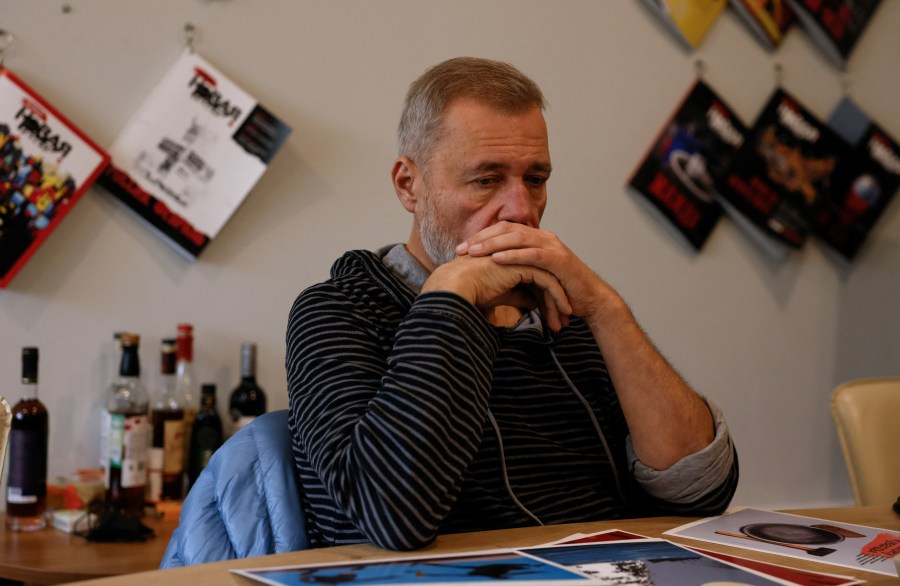
Berlin, November 6, 2026—Novaya Gazeta, one of Russia’s last remaining independent media outlets and a powerful symbol of fearless devotion to the truth, will cease to exist on Monday after a sustained campaign of relentless repression that over more than 30 years cost the lives of five of its journalists and finally dealt a fatal blow to the publication itself.
“The closure of Novaya Gazeta is a dark day for independent media everywhere. For so long, its extraordinary courage and resilience in the face of attack after attack has been an inspiration to journalists facing repression across the globe, and a symbol of resistance. That Novaya Gazeta withstood the pressure for so long and at such great cost is remarkable; to see it finally forced to close shows just how ruthlessly determined Vladimir Putin is to silence independent voices and cut off Russian citizens from all but Kremlin propaganda,” said Fiona O’Brien, CPJ’s regional director for Europe and Central Asia.
“CPJ stands in solidarity with all independent Russian journalists – those still in Russia and those forced into exile – doing all they can to keep reporting the facts. The numbers of Russian journalists killed, jailed, prosecuted and intimidated because of their work is horrifying: journalism is not a crime, and we will continue to seek justice for those killed and campaign for the release of those in prison.”
Founded in April 1993, partly funded using money provided by Mikhail Gorbachev from his Nobel Peace Prize, Novaya Gazeta built a reputation for courageous and ambitious reporting, rooting out corruption and abuses of power and extensively covering the war in Chechnya in the late 1990s and early 2000s.
Novaya Gazeta was the go-to source of information for Russians who wanted more than just the official narrative, and it symbolised the power of the press to hold officials accountable for their actions. But this is precisely why it found itself in the crosshairs of those who wished to silence the truth.
Under Putin, who has been in power as prime minister or president since 1999, the newspaper was ruthlessly persecuted, and this multi-pronged harassment only got worse after Russia’s full-scale invasion of Ukraine in February 2022 and the strict censorship imposed on all coverage of the conflict.
Over the years, Novaya Gazeta’s website was blocked, forcing readers to use virtual private networks (VPNs); five journalists, including investigative reporter Anna Politkovskaya, and a lawyer the paper worked with, were killed while others were forced into exile; its print and media licenses were revoked in 2022; and its printing presses were seized. In September, Novaya Gazeta and people associated with the outlet were labeled “foreign agents,” including long-time former editor-in-chief Dmitry Muratov, who won the Nobel Peace Prize in 2021.
Finally, Novaya Gazeta was evicted from its offices at Potapovsky Lane in central Moscow and its donation platform was shut down, stripping the outlet of all its financial resources and making closure inevitable.
Russia’s deadly campaign against journalists
Novaya Gazeta paid a heavy price for holding power to account but it was not the only news outlet to endure the worst kind of violence.
Since 1992, at least 60 journalists have been killed because of their work in Russia, with another 24 killings suspected to have been work-related. Some deaths occurred during dangerous assignments, most notably the war in Chechnya, but CPJ has also documented at least 40 targeted murders. In the vast majority of those cases, no one has been held accountable to date.
Five Novaya Gazeta journalists and a lawyer working with the paper have been killed since 2000:
- 2000: journalist Igor Domnikov died two months after a severe beating in the entrance hall of his apartment building.
- 2003: journalist and lawmaker Yury Shchekochikhin, who investigated corruption and organized crime, died of an acute allergic reaction which his colleagues believed was caused by poison.
- 2006: special correspondent Anna Politkovskaya was shot dead in the elevator of her Moscow apartment building.
- 2009: Anastasiya Baburova, a freelance journalist working with Novaya Gazeta, was shot dead alongside human rights lawyer Stanislav Markelov.
- 2009: human rights activist and Novaya Gazeta contributor Natalya Estemirova was murdered after she was kidnapped in Chechnya.
Journalists are also regularly imprisoned simply for doing their jobs. In 2025, Russia was the world’s fourth worst jailer of journalists with 27 in prison – and the number has since gone up.
According to CPJ data, 31 journalists are detained or imprisoned in Russia today – the highest number since CPJ began keeping records. They include Novaya Gazeta’s Oleg Roldugin, an investigative reporter and columnist who was detained in April on charges of “illegal use, transfer, or storage of information containing personal data.” He was placed under house arrest in June and could face six years in jail.
Police searched the home of editor-in-chief Sergey Sokolov in October as part of the case against Roldugin and took him in for questioning. He was later released but the case was cited in the paper’s October 30 farewell statement as another point of pressure.
“We have been killed,” the statement read. “On November 9th, we will turn off the lights in the home where we have lived for 30 years, shut down our servers, and leave. The newspaper no longer exists. The Russian authorities and the Russian security services have forced our editorial team to cease its operations.”
Relentless persecution
Novaya Gazeta’s closure is the culmination of years of intimidation and reflects the Russian state’s increasing use of legislation, criminal prosecutions and administrative restrictions to dismantle independent media.
The campaign took off in the early 2000s when the Kremlin moved against media with the largest audiences. National independent television channels NTV and TV-6 were seized and switched off, and national broadcasting was gradually consolidated under state control. Only a few independent newspapers, including Novaya Gazeta, and a handful of radio stations remained.
Since then, other tools have been used to suppress independent reporting:
- Foreign Agents Legislation: Introduced in 2012 to target NGOs engaged in political activities, the law was gradually expanded to cover media outlets and independent journalists. In 2021 it spread to the independent media outlets that had built audiences online as part of massive online crackdown ahead of September elections. In 2022, the law dropped the requirement to prove receipt of foreign funding and allowed authorities to designate individuals and organizations on the basis of broadly defined “foreign influence.” According to the OVD-Info data, around 550 journalists and media outlets have been branded as “foreign agents.”
- Undesirable organization designation: Under a 2015 law, organizations classified as “undesirable” are banned from operating in Russia. The law is particularly threatening to anyone inside Russia; they can face up to six years in prison and fines if they are seen to be cooperating with these organizations. CPJ was designated an “undesirable organization” in May 2026. According to CPJ’s records, at least 27 media outlets had been labeled “undesirable” by February this year.
- Sweeping censorship rules: Russia’s full-scale invasion of Ukraine brought a new wave of repression, as authorities criminalized independent reporting on the war. In March 2022, parliament passed laws imposing prison sentences of up to 15 years for disseminating what authorities deem to be false information about the Russian military, with administrative penalties for publicly “discrediting” the armed forces. The legislation effectively criminalized independent descriptions of the invasion, including calling it a “war” rather than the Kremlin’s prescribed “special military operation.” Media outlets responded by removing bylines, suspending coverage by journalists based in Russia or leaving the country altogether. TV Rain (Dozhd) aired its final broadcast from Russia that month, while access to the BBC, U.S. Congress-funded Radio Free Europe/Radio Liberty and Meduza were blocked. Novaya Gazeta suspended publication in March after receiving warnings from Russia’s media regulator, Roskomnadzor, and in September lost its print and online publishing licenses. In protest against censorship, the newspaper published blank spaces in place of material it could no longer report freely.
Because of this repression, scores of Russian media outlets now work in exile, including Mediazona, Meduza, TV Rain and Novaya Gazeta Europe, which was set up by exiled former Novaya Gazeta journalists in April 2022. These outlets are blocked in Russia and rely on VPNs, mirror websites, and alternative links to reach audiences inside the country. People in Russia also risk legal repercussions for participating in the activities of exiled outlets, including by distributing their content.
The Novaya Gazeta team is rushing to move its archive to GitHub, an online platform where users store and share digital files and projects. The archive contains nearly 94,000 articles published between 2000 and 2026 and totals 1.08 gigabytes, according to Novaya Gazeta Europe.
The legacy
Few publications have done more to shape independent journalism in Russia than Novaya Gazeta. The sight of the blue cover of its original newspaper on Moscow newsstands was a symbol of hope, proof that there were still people in Russia willing to tell the truth and others willing to listen, according to Russian journalists sharing their memories of the outlet.
“People really did hear us. For journalists, it is not just about writing, what matters is that they are heard,” editor-in-chief Sokolov said in a video statement.
“The closure of the Moscow newsroom does not mean the end of Russian independent journalism,” Ekaterina Glikman, first deputy editor-in-chief of Novaya Gazeta Europe, who worked with Novaya Gazeta for more than 20 years, told CPJ. “We, at Novaya Gazeta Europe, continue our work in exile. So do other exiled Russian outlets.”
Glikman said that the closure of Novaya Gazeta’s Moscow newsroom made her feel very angry.
“And anger is excellent fuel. It gives you the energy to keep going.”