


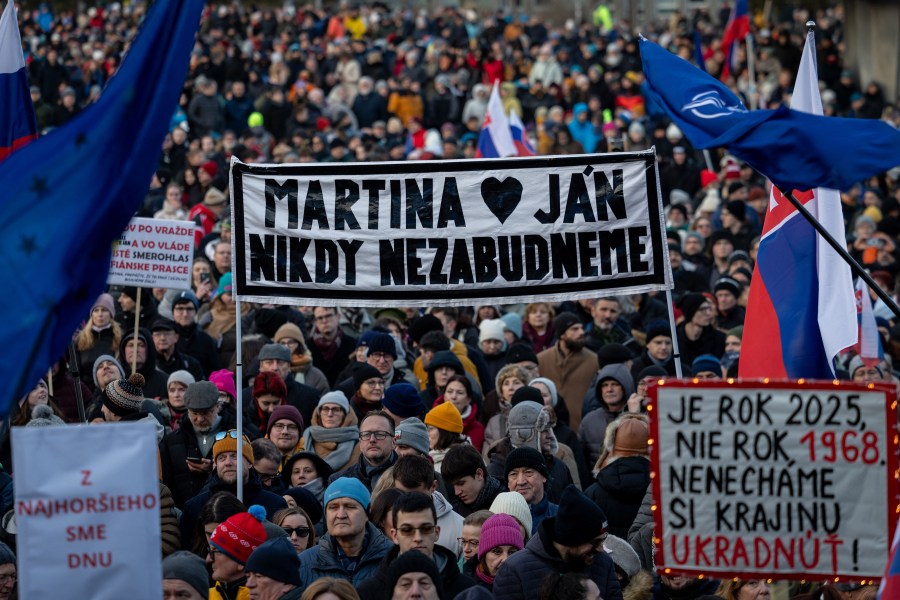
When Ján Kuciak, an investigative journalist who exposed corruption and tax fraud, was murdered alongside his fiancee in Slovakia in 2018, a national outcry ensued with 65,000 people hitting the streets and the subsequent ouster of the Slovak prime minister. Justice in Kuciak’s case is still in process but in February 2026, well over 1,000 still rallied to mark the eighth anniversary of his killing.
Similar scenes of public demands for justice, even years after journalists have been murdered, have become rituals around the world, from protests for Sri Lanka’s Lasantha Wickrematunge, Malta’s Daphne Caruana Galizia, Mexico’s Javier Valdéz Cárdenas, and Palestinian-American journalist Shireen Abu-Akleh, to calls for accountability in the murders of the Philippines’ Gerry Ortega and Ghana’s Ahmed Divela, among countless others. This persistent wave of outrage continues because of the resounding public sentiment that lies will not be tolerated, that facts matter, and that those who report the truth are on the right side of history.
Seeking justice for journalists killed in the line of duty or murdered in retaliation for their work has long been a priority for the Committee to Protect Journalists. More than 1,050 journalists have been murdered since CPJ began keeping records in 1992, and impunity remains rampant, with 86% of cases in the last decade having complete impunity: meaning that no one has been held accountable. Since 1992, the vast majority of those murdered were local journalists reporting on politics, corruption and in the trenches of war. Too often, such cases are limited to apprehending those who executed the crime, rather than those who planned or funded it. Full justice – where all perpetrators, from killers up to masterminds, are successfully prosecuted – has been achieved in only 50 cases.


The pattern of attacks and impunity over the decades is similar regardless of the context. Local authorities tend to ignore basic steps to investigate and secure evidence. Examples abound, where cases are botched entirely by local authorities, or where some progress is made but masterminds evade accountability. Most recently, a report by CPJ and Free Press Unlimited found the investigation into the murder of Indonesian journalist Rico Sempurna Pasaribu, following his reports of illegal gambling allegedly involving a member of the Indonesian army, was severely flawed. Investigators never questioned a soldier linked to the heart of the case “as a suspect or used investigative methods such as digital forensics or financial analysis to ascertain the extent of his connections with the victim and perpetrators,” according to the report, which includes a call to reopen the case. In 2010, CPJ challenged governments to deliver justice in 10 murder cases with shoddy investigations and failed prosecutions. In most instances, those cases fell short or barely scratched the surface on those responsible for the ultimate silencing crime. Since then, only three of those cases have resulted in partial justice – none have received full justice.
In May 2023, CPJ research showed that in two decades, no one has ever been charged or held accountable for the deaths of mostly Palestinian journalists at the hands of the Israeli military. This pattern of impunity remains to this day, exacerbated by an overwhelming scale of journalist killings in Gaza.
The willful disregard for the rules of war, which classify journalists as civilians entitled to protective measures, represents a new frontier. While conflict settings in particular can significantly complicate or challenge the application of the rule of law, delivering justice is ultimately a choice. As officials ignore the pleas for thorough, transparent and independent investigations it is families, friends and fellow journalists who are left alone to piece together the facts and to advocate relentlessly for answers, for justice.
That indifference breeds further deadly violence and the silencing chill that accompanies the murder of those who report the facts. Yet, these cases are generally not unsolvable. Political willーparticularly at the local level- is a critical factor in determining the course of justice. Then, it must be complemented by adequately resourced prosecutorial independence that can overcome undue influence and apply technical expertise, with global support and scrutiny, as appropriate.
Unpunished violence remains an overwhelming threat to journalists and the free flow of information globally. The failure of local authorities to investigate and deliver justice is also a failure to local communities whose reliance on the rule of law and accountability crumbles with every unaddressed killing of a journalist. Paralysis in efforts to end impunity is, therefore, not an option. Governments are responsible for ensuring the safety of journalists and for investigating all attacks, in particular deliberately targeted killings, taking place in or under their jurisdiction.
CPJ’s new Impunity Action List sets out the essential steps for authorities to champion justice for journalists. The list is informed by numerous investigations of contexts with entrenched impunity, individual cases, and reports on trends that CPJ has conducted individually or with partner organizations, and provides a new roadmap for champions of press freedom determined to overcome impunity.
The Impunity Action List
CPJ calls on government authorities at the local, national or international level to take the following essential actions to stem the murder of journalists and end impunity:
- Condemn publicly and unequivocally all acts of violence against journalists; reject and refrain from actions that vilify journalists for their work, which compromise investigations and diminish the political will to deliver justice.
- Listen to the families and colleagues of killed journalists and vigorously pursue the leads identified in investigations carried out by news organizations, which often provide a roadmap from killers to masterminds.
- Provide sufficient resources and political support to ensure that authorities conduct exhaustive and timely investigations and trials relating to crimes against journalists. Where national or local authorities are unwilling or unable to investigate, allow international independent investigators to probe the killings and initiate proceedings for justice; include journalist cases in transitional or other justice processes post-conflict.
- Promptly and exhaustively investigate all cases of journalists killed in relation to their work, following international investigation standards, known as the United Nations’ Minnesota Protocol, which calls for prompt, effective, independent, impartial, and transparent investigations.
- Request/provide progress reports on all unresolved journalist killings from investigative agencies and judicial offices. Reopen closed investigations and invigorate those that have stalled. Reform laws to give national authorities broader jurisdiction to investigate and prosecute crimes where provincial authorities have failed.
- Break the cycle of compromised investigations and judicial processes; transfer cases from locations where suspects may influence proceedings to neutral jurisdictions. Assign special prosecutors and/or increase witness protection. Identify and penalize all actors who impede justice through professional misconduct, corruption, threats, or violence.
- Seek legal, forensic, or investigative assistance where capacity or resources are lacking, including from multilateral bodies and expert task forces as well as long-term training and assistance to law enforcement, investigators, and judges.
- Pursue unchecked leads, seek out and question witnesses, and track down and detain wanted suspects. Where professional motives have been dismissed without sufficient investigation, focus attention on the victim’s journalism.
- Extend the sphere of justice by embedding media freedom and accountability for crimes against journalists into diplomatic efforts, including the use of targeted sanctions against perpetrators of such crimes, including but not limited to killings.
- In cases where the killing of a journalist likely amounts to an international crime, governments should invoke universal jurisdiction to ensure accountability, irrespective of the nationality of the journalist or alleged perpetrator, or, where the crime was committed, include journalists in the design of transitional justice efforts.
- Hold companies to account when their technology enables the targeting of journalists, and take steps to mitigate the procurement, export, or use of spyware and other surveillance technologies that could be used to harm journalists.
- Implement U.N. Security Council resolutions 2222 and 1738, which call for the protection of journalists and an end to impunity; support committed countries with an investigative support task force powered by the Media Freedom Coalition; implement the UN Plan of Action steered by UNESCO, and the recommendations contained in its biennial reports on the safety of journalists and dangers of impunity.