


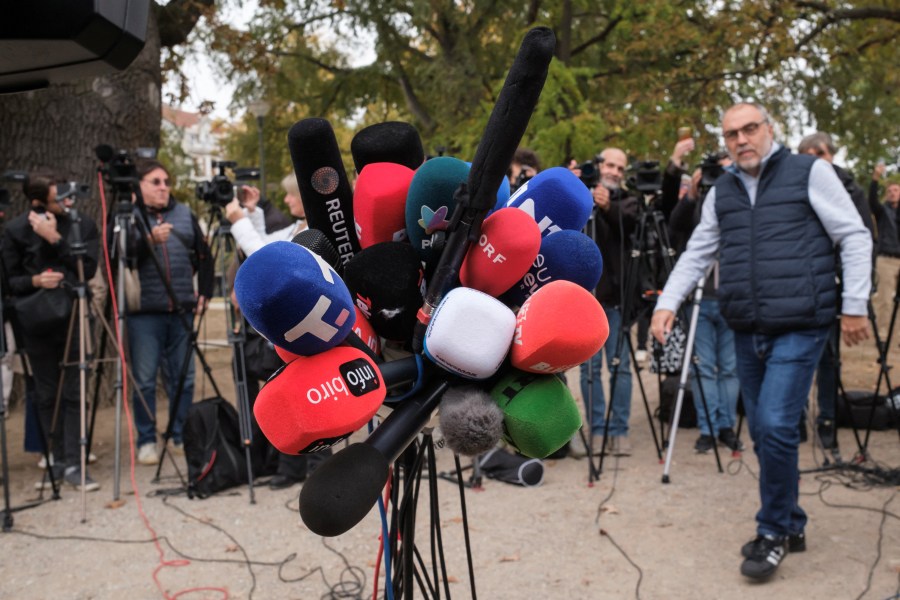
Berlin, November 6, 2026—The defeat of Aleksandar Vučić in October’s election provides a real opportunity for Serbia to reverse the backslide on media freedom that has blighted the country for 14 years. Serbia’s incoming government must now prioritize journalist safety, ensure past attacks and abuses are investigated, hold perpetrators to account, and introduce reforms to strengthen the independent media that fought so hard to report the truth during years of authoritarian drift under Vučić.
The opposition Student List won a landslide victory on October 25, with Vučić conceding defeat on the same day. The group, which includes academics, professionals, farmers, actors and activists, must now form a government and has already pledged to reform state-run media in its manifesto.
“The end of Aleksandar Vučić’s rule marks a pivotal moment for press freedom in Serbia and, coming after the defeat of Viktor Orbán in neighboring Hungary this year, offers hope that the global trend of media repression can be reversed. The incoming government must seize this opportunity and act immediately to protect journalists and rebuild trust in the institutions that are supposed to protect them,” said Attila Mong, CPJ’s program coordinator.
“The new government must ensure that past attacks and abuses are properly investigated and the perpetrators held to account, that journalists whose rights were violated have access to effective remedies, and that police, prosecutors, and other state institutions protect journalists rather than obstruct them or target their work.”
A hostile environment
Under Vučić’s increasingly authoritarian rule, state capture extended beyond the media to parts of law enforcement, security and intelligence services, as well as the judiciary. These entrenched networks will not disappear simply because the government changes, meaning journalists seeking to report freely may still face danger. In the months before the election, CPJ documented mounting pressure on independent media, attacks on journalists, police violence, and threats and smear campaigns, often without accountability.
The incoming government will have to unpick the institutional structures and mindsets that created a toxic environment that was all too evident on election day when reporters were attacked, obstructed, and denied access, and police reportedly failed to intervene in some cases.
Here are some of the abuses documented by press freedom groups on October 25:
- In Pavlovac, southern Serbia, Mihajlo Stojković of local online outlet InfoVranjske and Jelena Stojković of national daily Večernje novosti were stoned, pushed, and dragged while reporting on alleged voting irregularities; both were injured.
- In the capital Belgrade, three journalists with student-run online newsroom Blokada Info were attacked, and Galeb Nikačević, founder and host of the independent Agelast podcast, was struck by a hooded man near the presidency as police reportedly failed to intervene.
- Journalists were also blocked from polling stations and political events, while Croatian and North Macedonian reporters were denied entry to Serbia.
- After the vote, protesters entered the Belgrade newsroom of pro-government national tabloid and television outlet Informer, while police struck reporter Veselin Petrović of local online outlets Lutajući reporter and Palilula Info outside the Belgrade building of Pink TV, a pro-government national commercial broadcaster.
CPJ welcomes initial steps to detain and prosecute those responsible for these and other attacks and urges prompt and transparent investigation of all attacks against journalists and media workers on October 25 and in the preceding months.
What needs to be done
Reversing years of abuse, intimidation and silencing will require additional reforms to tackle the institutional networks that worked against press freedom, undo state capture of media, and end impunity for attacks on journalists and media workers.
The Student List’s election manifesto pledges to depoliticize the broadcast regulator REM, restore the independence of public broadcaster RTS, review national broadcasting frequencies, and strengthen media accountability.
Building on previous recommendations to Serbian authorities, CPJ urges the incoming government to:
- Ensure all reforms are carried out openly and legally by independent institutions with full respect for press freedom and due process.
- Ensure police protect journalists covering protests and public events and refrain from assaulting, detaining, or obstructing them.
- End inflammatory rhetoric and the public denigration of journalists and media workers by officials and institutions. It is the duty of state authorities to create an enabling environment for media freedom and media pluralism.
- Investigate attacks and end impunity. A new government should ensure that police and prosecutors promptly and independently investigate attacks, threats, police violence, digital attacks, and alleged unlawful surveillance. Authorities should ensure police cooperation with prosecutors and seek accountability in unsolved past attacks, including historic killings such as the 1999 murder of Slavko Ćuruvija.
- Strengthen existing journalist-safety mechanisms.A new government should ensure that authorities fully implement the 2016 agreements between police, prosecutors, and media organizations, which provide for priority handling of attacks, designated contact points, information-sharing, and coordinated follow-up.
- Cooperate with the Permanent Working Group for the Safety of Journalists, which should remain fully operational and effective throughout the political transition.
- Collaborate with relevant press organizations. Incoming officials and new leaders of relevant institutions should engage regularly with journalists, media associations, and press freedom organizations on the necessary reforms and how best to implement them.
Serbia’s partners
The European Union’s role is also critical. On October 27, the EU said it was ready to work with the incoming government to meet democratic criteria required for the EU accession process, including an independent judiciary, fundamental rights, and media freedom.
In addition to rule-of-law benchmarks set out under the accession process, the EU should also encourage and support a process of meaningful national media reforms. These should fully align with existing EU law and standards, including the European Media Freedom Act, which addresses media capture, and the 2021 Journalist Safety Recommendation.
As the new government takes shape, the EU should closely monitor all press freedom concerns, including attacks and surveillance cases, press for implementation of existing journalist-safety mechanisms, and provide sustained support to independent media and journalist-safety groups. The EU should now demonstrably stand side-by-side with Serbia’s embattled independent journalist community.
The next few weeks will be critical in determining the shape of press freedom in Serbia under a Student List government and ensuring that Serbians have access to free and fair information on the transition process.
There is huge potential for the incoming administration to reverse years of backsliding under Vučić and his allies but only if strong safeguards are erected to protect all journalists and ensure that past abuses are thoroughly investigated. These are vital steps on the road to democratic renewal.