


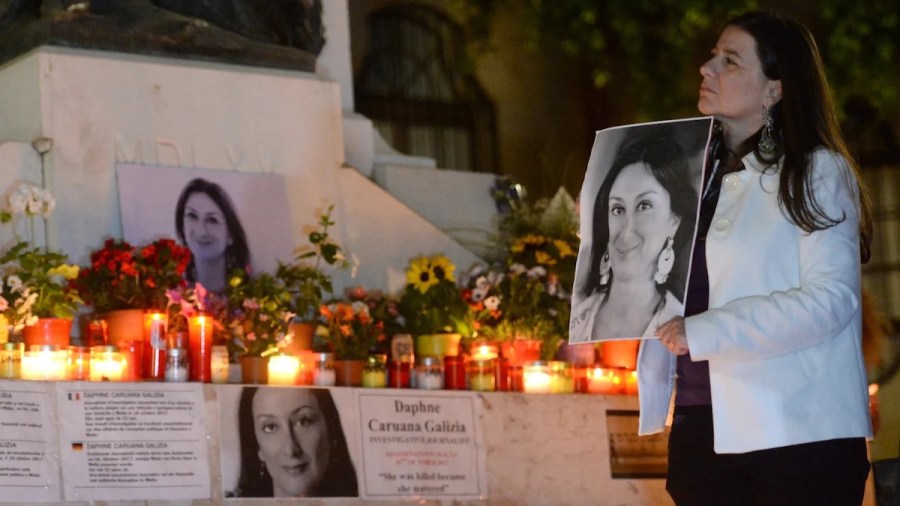
More than eight years after the assassination of Maltese journalist Daphne Caruana Galizia sent shockwaves through Europe, all eyes are once again on the capital Valletta, where the alleged mastermind of her murder has been on trial since July 1.
Yorgen Fenech, a powerful businessman, is standing trial on a charge of complicity in murder and has pleaded not guilty. Caruana Galizia, who reported extensively on corruption, money laundering, organized crime, and political misconduct in Malta, was killed in a car bomb in October 2017.
The verdict – expected in August – could finally bring justice to Caruana Galizia’s family, but it should also refocus European leaders’ minds on the action that still needs to be taken on press freedom in Malta and Europe.
“Finally, we may find out the truth of what happened, secure justice and send a powerful message across Europe: you cannot silence journalism through violence,” said Tom Gibson, CPJ’s deputy advocacy director, EU. “Throughout the long quest for justice, European officials in Strasbourg and Brussels have worked hard to shine a light on concerns about press freedom and the rule of law in Malta. Their scrutiny and support has been invaluable for the family and Maltese journalists, but there is still so much more to be done.”
Before her murder, Caruana Galizia was subjected to an orchestrated campaign of harassment and vilification by the Maltese government, including legal intimidation, to silence her reporting.
In 2019, a suspected facilitator of her murder received a presidential pardon in exchange for naming those responsible. Since then, five people have been found guilty and jailed for orchestrating or carrying out the murder.
Atmosphere of impunity
Fenech’s trial could be the final chapter in the search for justice for Caruana Galizia but press freedom groups say the Maltese authorities must introduce long-overdue reforms to guarantee journalists’ safety.
After pressure from the Caruana Galizia family and international institutions, the Maltese authorities set up a separate public inquiry in 2019 to independently examine the circumstances of the murder. Its report found that the assassination was both predictable and preventable. It said the Maltese state had created an atmosphere of impunity, failed to recognise the risks to Caruana Galizia’s life and did not take measures to protect her. The Maltese authorities have still not implemented most of the inquiry’s recommendations and have not undertaken meaningful press freedom reforms.
The Daphne Caruana Galizia Foundation has said that the failure of Maltese authorities to address the corruption and abuse of power that Caruana Galizia exposed, and that other Maltese journalists continue to investigate, contributes to an environment of insecurity and uncertainty for journalists.
Europe’s response
The robust response of the European Union, the Council of Europe and the Organization for Security and Co-operation in Europe (OSCE) to Caruana Galizia’s murder was powerful and, arguably, unparalleled.
The assassination generated meaningful debate within these multilateral institutions on journalist safety as it relates to the rule of law.
European officials put sustained pressure on the Maltese authorities to address concerns around press freedom. The European Commission has also pushed through several pan-European media reforms addressing journalist safety in EU member states, including the 2024 anti-SLAPP Directive to combat abusive lawsuits and a 2021 Journalist Safety Recommendation.
The Council of Europe and the OSCE both provided detailed legal assessments and recommendations, including on corruption. The European Parliament and the Parliamentary Assembly of the Council of Europe also worked to secure positive change around the rule of law and press freedom in Malta.
However, as European pressure mounted, the Maltese authorities responded with inaction and opaqueness and have failed to introduce long-overdue media reforms needed to spur change.
In October 2025, CPJ and other press freedom groups called on Malta to set up a national action plan on media freedom and journalist safety and provided a broad set of recommendations as part of a public consultation set up by the Maltese government.
Since then, and despite repeated requests for information from CPJ and others, the Maltese government has failed to clarify what action it would take. However, local media has reported that Prime Minister Robert Abela, who won an election in May, plans to push through national media reforms during the new legislature but without meaningful consultation with civil society.