


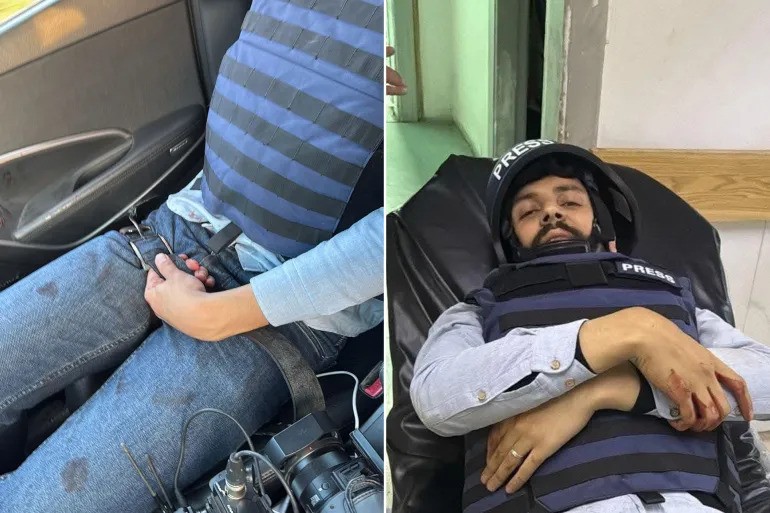
Sulaymaniyah, March 14, 2025—The Committee to Protect Journalists is alarmed by multiple attacks on journalists reporting on Syria’s worst clashes since the ouster of President Bashar al-Assad, including bullets being fired at two news teams’ cars, with one journalist shot in the leg, and the assault and detention of a third crew.
“We are appalled by the violence meted out on multiple news crews covering Syria’s sectarian killings, which prevented them from reporting on its impact on civilians fleeing the conflict,” said CPJ Program Director Carlos Martinez de la Serna in New York. “We call on all parties in Syria to take immediate steps to protect the media so that they can provide the public with vital information.”
The clashes began on March 6 when fighters loyal to al-Assad ambushed Syrian government forces in coastal Latakia province, sparking revenge killings of members of al-Assad’s minority Alawite sect. Almost 1,000 civilians and 500 combatants were killed in four days, according to the U.K.-based Syrian Observatory for Human Rights, before government forces regained control.
CPJ documented the following incidents:
- On March 6, Qatari-owned Al Jazeera TV’s camera operator Ryad Alhussein was shot in the right leg while he and reporter Sohaib Al Khalaf were driving north from Jableh city, near Hmeimim Bridge. The car was unmarked; both journalists were wearing press insignia.
“Our car was hit by direct gunfire from militants. I was shot in the thigh, causing a 5.5 cm fracture, with shrapnel embedded in my leg,” Alhussein told CPJ.
Alhussein told CPJ on March 7 that doctors were monitoring him for 20 days before deciding whether to carry out surgery to remove the bullet.
- On March 10, Qatari-funded Al-Araby TV’s reporter Qahtan Mustafa and camera operator Mohammed Qurandil came under fire as they were driving in an unmarked vehicle east of Latakia to report on people returning home.
“We were targeted with gunfire,” said Mustafa, who was driving, in a video where he pointed out six bullet holes in their car’s front and back windows and described how they ducked and then drove back to the city.
In a photo at Latakia University Hospital, both journalists have bandaged heads, which Qurandil told CPJ were injured by shards of glass, and are wearing the “Press” vests they wore during the attack.
- On March 11, privately owned Souria Post’s reporter Hashim Al-Abdullah and camera operator Ehab Khaled were assaulted and detained at a Russian air base in Hmeimim, between Latakia and Jableh, where they were reporting on discussions between Syrian Arab Red Crescent and Latakia officials about the evacuation of Alawite civilians sheltering there, the journalists told CPJ.
“We were in a parking area near the base when a group of people approached, began beating us, threatening us with death, and insulting us,” Al-Abdullah told CPJ, adding that both journalists were wearing press vests. “One of the attackers shouted, ‘You are ISIS! You want to kill!’”
Khaled told CPJ that they were handed over to Russian soldiers who questioned them about their political affiliations and whether they were using drones.
“We told them we were independent media, but they accused us of working for the government,” he said.
The journalists were detained for four hours by Russian guards, who forcefully unlocked their phones to check for footage of the military base, before being released.
CPJ’s email to the Permanent Mission of the Russian Federation to the United Nations for comment on the detention did not immediately receive a response.
See CPJ’s safety resources for journalists covering conflict here.