


Since the Israel-Gaza war began on October 7, 2023, journalists and news outlets across the region have faced a hostile environment that has made reporting on the war exceptionally challenging.
In addition to documenting the growing tally of journalists killed and injured, CPJ‘s research has found multiple kinds of incidents of journalists being targeted while carrying out their work in Israel and the two Palestinian territories, Gaza and the West Bank.
These include 94 arrests, as well as numerous assaults, threats, cyberattacks, and censorship. As of January 6, 2026, CPJ‘s records showed that 30 of these journalists were still under arrest.
In July 2024, the hostile environment for the press spread across the Middle East.
(Editor‘s note: These numbers are being updated regularly as more information becomes available.)
Several journalists have also lost family members while covering the war. Two examples are detailed below:
INDEX
Assaults
Arrests
Detentions
Threats
Cyberattacks
Censorship
Harassment
Journalist casualties
Killed
Injured and missing
- On November 8, 2023, HonestReporting — a group that monitors what it describes ”ideological prejudice“ in media coverage of Israel — raised questions about photojournalist Yasser Qudih and three other Gaza-based photographers having prior knowledge of Hamas‘ October 7 attack on Israel, prompting death threats against him on social media.
The Israeli prime minister‘s office posted on the social media platform X that the photographers were accomplices in ”crimes against humanity“ and Israeli war cabinet member Benny Gantz said they should be treated as terrorists. Major media outlets, including Reuters, rejected the claims and HonestReporting subsequently withdrew the accusations.
On November 13, 2023, eight members of Qudih‘s family were killed when their house in southern Gaza was struck by four missiles.
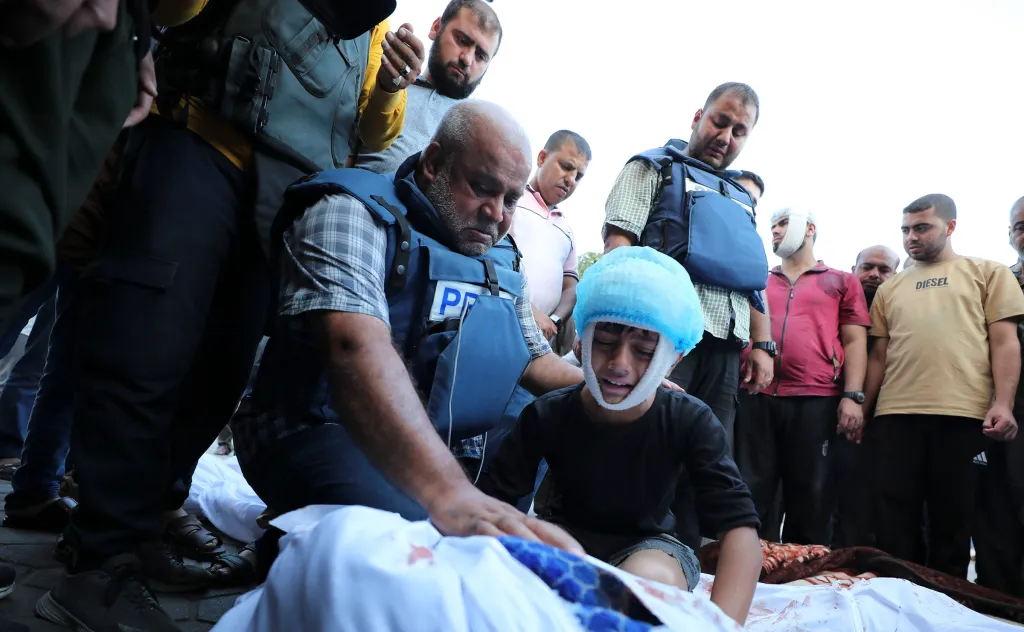
- On October 25, 2023, Wael Al Dahdouh, Al Jazeera‘s bureau chief for Gaza, lost his wife, son, daughter, and grandson when an Israel airstrike hit the Nuseirat refugee camp in the center of Gaza, according to a statement from Al Jazeera and Politico.
On January 7, the Al Jazeera bureau chief lost a fifth family member. Another son, Hamza Al Dahdouh, a journalist and camera operator for Al Jazeera, was killed along with a colleague while on their way back to the southern city of Rafah after filming the aftermath of an airstrike when their vehicle was struck by the Israel Defense Forces (IDF), news reports said.
In Gaza, 90% of the population has been displaced, many are starving, and 80% of buildings have been destroyed. Many journalists have no safe place to do their jobs as they live in tents and work from makeshift offices, such as hospitals, where they can access power.
In both Gaza and Israel, journalists reporting on the war lack personal protective equipment (PPE). CPJ has received multiple requests for PPE, but delivering this equipment to journalists in the region is difficult. CPJ recommends journalists consult CPJ‘s PPE guide to source their own equipment.
”Journalists in Gaza are facing exponential risk,“ said CPJ Chief Programs Officer Carlos Martínez de la Serna. ”Their colleagues in the West Bank and Israel are also facing unprecedented threats, assaults, and intimidation to obstruct their vital work covering this conflict.“
See CPJ‘s Safety Guide for journalists covering the West Bank.
CPJ has routinely contacted the Israel Defense Forces‘ North America Media Desk asking for comments on assaults, threats, cyberattacks, censorship, and harassment of journalists, as well as deadly airstrikes on their family members, since the start of the war.
The IDF said it could not fully address CPJ‘s inquiry about individual journalists because not enough details, such as their ID numbers or full names, were included. CPJ had advised the IDF that research limitations in Gaza prevented the provision of such information.
Ismail Al-Thawabta, Director General of Government Media Office in Gaza, said the government had received no media complaints regarding ”threats related to covering protests or public gatherings,“ threats from security personnel, or summonses from internal security agents.
Al-Thawabta said the government had ”fully opened the field“ for media to cover events freely in a ”safe, transparent“ environment and it was committed to ”ensuring that security agencies do not interfere with the content of media coverage or the work of journalists.“
Here are some of the reported obstructions to journalists‘ reporting since the war began:
Assaults
- On April 27, 2025, Tawfiq Abu Jarad, a correspondent for Ramallah-based Sawt al-Hurriya radio station, received a call from a Hamas security agent warning him not to cover a women‘s anti-war demonstration in northern Gaza‘s Beit Lahia.
”They even told me that my wife should be prevented from participating in the demonstrations themselves, and if that happened, I would be responsible for it,“ he told CPJ.
Abu Jarad was also beaten by masked security personnel on November 15, 2023, when he was fleeing the city of Rafah in southern Gaza.
”I was confronted by security personnel who assaulted me and interrogated me for about four hours, accusing me of covering events in the Gaza Strip calling for a coup against the government. They asked me to stop working and covering the press before my release,“ he told CPJ.
- In January 2024, Mohammed Abu Aoun, a correspondent for Fatah-affiliated Awda TV was beaten by several members of Hamas‘ Internal Security Service after a woman insulted Hamas during her interview with him near Al-Aqsa Martyrs Hospital in central Gaza‘s Deir al-Balah.
”The officers immediately took me to a location and beat me. They then searched my cell phone and returned it to me. They demanded that I not work inside or near the hospital,“ he told CPJ.
- On December 12, 2024, freelance photographer Ibrahim Muhareb, 28, who works for the local Quds Feed media network and the Turkish state-owned broadcaster TRT, told CPJ that he was beaten unconscious by armed men in plainclothes, who approached him in a tent where he was working near Nasser Hospital, west of Khan Yunis.
”They identified themselves as members of the investigations department, but I later learned they were members of the anti-narcotics department. Without giving any reason, they tried to assault me. When I tried to contact a police officer in charge of journalists’ affairs, they tried to dismantle my tent. When I resisted, they began assaulting me by kicking me,“ Muhareb told CPJ.
”I tried to speak to them calmly, but they began to beat me even more severely. They suddenly struck me with an instrument, causing me to lose consciousness, and blood flowed from my head. They dragged me toward the hospital, and I began to regain consciousness. Some colleagues tried to intervene, but they prevented them, literally telling them that ’the spy and the journalist were one and the same,‘ and that they had covered my entire face and head so that no one would recognize me, he said.
Some journalists eventually managed to pull him free, bandage his wounds, take him for hospital treatment.
”My injury included a laceration to my skull and a wound to it, as well as wounds all over my body,“ Muhareb said, adding that he was rapidly discharged because the hospital was so busy.

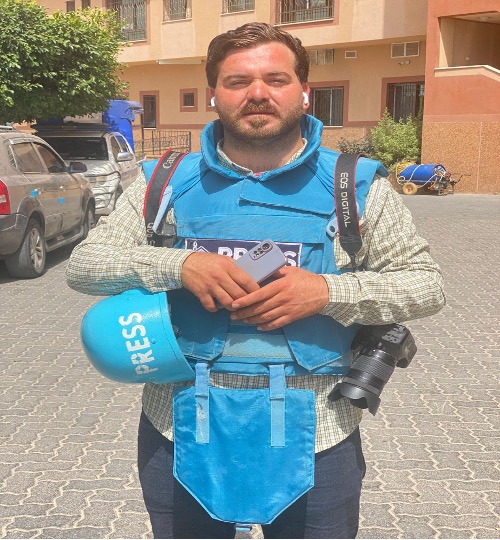
- On July 20, 2025, Gaza-based Kanan News Agency journalist Khaled Shaath and freelance photographers Abdullah al-Attar and Mohammed Salama were covering the arrival of casualties from an Israeli airstrike at Nasser Hospital, west of Khan Yunis, when members of the General Investigation Service prevented them from filming and assaulted them.
”Individuals wearing civilian clothes approached us and told us they were security personnel. They refused to identify themselves and demanded that we leave,“ Shaath told CPJ.
”We rejected their request because we had permission from the Ministry of Health and the hospital administration. Their shouts began to rise, until things escalated. They dragged me on the ground and assaulted me with fists and batons, tearing my clothes. They also assaulted Salama and al-Attar and tried to restrict my movement for a period of time until our colleagues intervened. The situation ended after about three hours.“
Shaath said he had bruises and cuts across his body — seen in a photograph published by the Palestinian Journalists‘ Syndicate, a local union — while Salama sustained a minor hand fracture. Salama and al-Attar declined to speak to CPJ.
- On March 24, 2025, masked Israeli settlers assaulted Palestinian documentary film director Hamdan Ballal, one of four co-directors of ”No Other Land,“ which won this year‘s best documentary Academy Award for its portrayal of efforts by Palestinians to stop the Israel Defense Forces (IDF) from demolishing their homes.
- In the early hours of October 19, 2024, dozens of protesters stormed and looted the offices of the Saudi state-funded broadcaster MBC in the Iraqi capital Baghdad, outraged by the TV channel‘s report that labeled key pro-Iranian figures assassinated by Israel and the U.S. as ”terrorists.“ These included former Hamas leader Yahya Sinwar, former Hezbollah leader Hassan Nasrallah, Iranian commander Gen. Qassem Soleimani, and Abu Mahdi al-Muhandis of the Iraqi Popular Mobilization Forces (PMF) militia.
Videos circulated on social media showed protesters waving PMF, Hezbollah, and Palestinian flags as they stormed the building, setting fire to the courtyard and causing significant damage.
On October 19, Iraq‘s Communications and Media Commission revoked MBC‘s broadcasting license, citing the network‘s violation of media regulations for disrespecting the ”martyrs of the resistance.“ MBC has yet to issue a response.
Saudi Arabia‘s media regulator announced that it had referred MBC‘s officials for investigation for violating media guidelines in the report.
Following Iraq‘s decision, on October 22, Algeria‘s communications ministry also suspended the operating license of MBC‘s sister outlet, the Arabic news channel Al Arabiya over allegations of reporting bias, according to news reports.
- In the early morning of October 3, 2024, a group of men attacked journalist Robin Ramaekers and camera operator Stijn De Smet, with the Belgian broadcaster VTM Nieuws, as they were reporting on the aftermath of an Israeli airstrike on a medical center in the Lebanese capital, Beirut, Ramaekers told CPJ via messaging app.
Arriving in the Bashoura neighborhood with a local fixer, Ali, the two journalists wore ”Press“ vests and made their identities clear when introducing themselves and asking questions, Ramaekers told CPJ. The three men were cornered by locals, some of whom were armed, and who assaulted, questioned, and detained the team until about 5 a.m, said Ramaekers, who sustained facial fractures. De Smet was shot in the leg and Ali‘s nose was broken.
”As far as we understand now, we were attacked, held, and questioned by people belonging to Amal,“ Ramaekers told CPJ, referring to a Shiite political party, allied with Hezbollah, that forms part of Lebanon‘s ruling coalition. ”They believed we were Israeli spies/spotters instead of journalists.“
After receiving hospital treatment, the two Belgian journalists were evacuated to Brussels.
- On the evening of July 30, 2024, MTV Lebanon reporter Nawal Berry and camera operator Dany Tanios were beaten and kicked by a group of men in the Lebanese capital Beirut‘s southern suburbs, known as Dahiyeh, while reporting live on reactions to an Israeli strike that targeted a Hezbollah leader in the area, the journalists said in an interview with their outlet and Tanios told CPJ.
”When we arrived in the area, people were very angry. We went live on TV, when a group of about five men started obstructing us. We moved to another location in a nearby street but a group of men there obstructed us as well. Some were telling us to leave. I was beaten and kicked by about four men, and one of them broke our camera, with the mic and the material on it,“ Tanios told CPJ, adding, ”I feel sore in my head and back from the beating and kicking.“
Berry published a video on Instagram showing a man destroying the camera and MTV Lebanon published a video of the journalist being attacked.
Tanios said that his lawyer would file a lawsuit against the attackers.
Dahiyeh is seen as a Hezbollah stronghold. MTV Lebanon, a local channel privately owned by businessman Michel El Murr, is considered anti-Hezbollah. A post on its website accused Hezbollah supporters of conducting the assault.
- On July 30, 2024, a Molotov cocktail was thrown at the house of David Wertheim, the controlling shareholder of Israel’s Channel 12 News. Keshet Broadcasting media group, which owns Channel 12, said in a statement that the attack was ”part of a systematic campaign of incitement against Channel 12, which crossed all lines last night.“
In addition, CNN reported that Noam Goldberg, a correspondent with Channel 13, and her camera operator were verbally and physically abused in Beit Lid, a central Israel military base where some of the soldiers under investigation were being questioned.
- On July 29, 2024, at least five Israeli journalists were attacked by right-wing Israeli demonstrators protesting over the detention and questioning of a group of reserve soldiers about the alleged sexual assault of a Palestinian prisoner at the Sde Teiman detention center, according to news reports.
Reporter Ilana Curiel of the Israeli news site Ynet reported that the protesters, who broke into the detention center in southern Israel, called her and other Israeli journalists traitors and Hamas supporters and told them to go back to Gaza.
”I’m in tears. I was spat on, called a slut, and unfaithful. My phone was thrown away twice while I was just trying to do my job. They tried to steal my phone. I was cursed again and again,“ Curiel posted on X. A team from Channel 12 News, including correspondent Ori Isaac, were also hit, spat on and verbally abused, those sources said. Security officers helped Curiel and Isaac to safety; neither sustained serious injury.
- On July 26, 2024, a group of soldiers with the Israeli border police obstructed the work of two camera operator Omar Awad, who was also assaulted, and reporter Mujahed Admeer with Turkish state broadcaster TRT who were covering Friday prayers at Jerusalem‘s Al Aqsa Mosque, according to the Beirut-based press freedom group SKeyes and the journalists who spoke to CPJ.
A video of the incident, shot by Awad and reviewed by CPJ, shows soldiers hitting two men and pushing Awad away.
”An Israeli soldier came and put his hand on my camera, pushing it away from the scene,“ Awad told CPJ. He added ”Another pushed me forcefully and threw me to the ground, which led to my arm injury and the camera was also damaged.“
Awad and Admeer told CPJ that the same soldiers checked their press cards three times before and during the incident.
Admeer said he started filming the attack on Awad on his phone but a soldier forced him to hand it over and deleted the footage. Admeer said he told the soldier, ”I‘m a journalist with accreditation,“ but she responded, ”I don‘t care, go home.“
CPJ‘s email to the Israeli border police seeking comment did not receive a response.
- On June 5, 2024, during the annual Jerusalem Day Flag March, which commemorates the capture of East Jerusalem by Israeli forces in the 1967 war, Israeli settlers and far right protesters assaulted Palestinian freelance journalist Saif Kwasmi, who contributes to the local news agency Al-Asiman News, and Israeli journalist Nir Hasson, a reporter for the Israeli daily Haaretz, according to the journalists‘ employers, and Kwasmi and Hasson, who spoke to CPJ in person and on the phone on June 5 and 6, respectively.

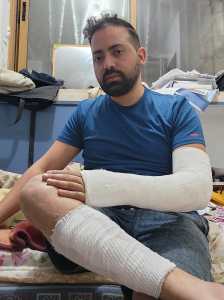
- On February 11, 2024, Itamar Cohen, a writer and editor for the Hebrew-language site News 360, arrived in Jerusalem‘s Old City to report on two stabbing incidents when several Israeli border police ordered him to leave and assaulted him.
A video posted on X showed at least five officers, one using a baton, pushing the journalist up against a wall. Cohen also posted photos of his bleeding leg and bandaged left arm on X.
Cohen told CPJ that the officer struck him several times when he refused to comply with police orders to leave, hitting him until other officers intervened. As Cohen sought treatment at a nearby ambulance, the officer approached him again and asked, ”Do you want more?“ and struck him several more times before shoving him away.
”The injuries prevented me from working for several months,“ said Cohen, whose left hand was fractured and who sustained bruises to both legs and his right hand. ”I now avoid places where police are present. I‘ve also stopped sending photographers to events where there‘s a risk of police violence.“
On August 10, 2025, the independent Department of Internal Police Investigations indicted the officer in Jerusalem‘s Magistrate Court for assault that causes actual bodily harm, under Section 380 of Israel‘s Penal Law, according to the court document, reviewed by CPJ. The punishment for this crime is up to three years in prison.
- On December 18, 2023, an Israeli soldier shot Palestinian journalist and freelance photographer Ramez Awad, injuring his thigh, while he was covering Israeli operations in the village of Jaffna, north of the West Bank city of Ramallah, according to the Palestinian Journalists‘ Syndicate, the pan-Arab newspaper Al-Araby Al-Jadeed, the Palestinian Authority-run Wafa news agency, and the Beirut-based press freedom group SKeyes.
- On November 26, 2023, several journalists reported being assaulted by Israeli forces while waiting in front of the West Bank’s Ofer Prison, near Ramallah, to cover Israel‘s release of Palestinian prisoners as part of the Hamas-Israel truce and prisoner exchange agreement, according to the Palestinian Journalists‘ Syndicate (PJS), the London-based news website The New Arab, and Al Araby TV.
Journalists from Sky News Arabia, Firas Lutfi, and Raed El-Helw, who were previously assaulted on October 7, told PJS that Israeli forces targeted them with tear gas and unidentified bullets while reporting from what they thought was a safe area, away from clashes in front of Ofer Prison. They were wearing “Press” vests and told the soldiers that they were members of the media. As a result of this attack, El-Helw’s hand was injured while trying to retrieve his camera and leave the area. El-Helw said he believed that it was a deliberate sniper attack as he observed a laser light on his hand right before he was targeted. PJS shared a video interview with Lutfi and El-Helw, and footage documenting El-Helw‘s injury. PJS added that crews from TRT and Roya News were present during the attack.
- In a separate November 26, 2023, incident near Ofer Prison, Al-Araby TV reporter Fadi Al-Assa, an Al-Araby camera operator, and a third reporter were targeted with tear gas and rubber bullets from their position on rooftops in the vicinity of the prison. Al-Assa told The New Arab that an IDF drone flew right above them, and they were clearly identifiable as journalists holding their cameras. Israeli forces entered the house, came up to the rooftop, and searched the journalists. They confiscated the memory card of Al-Araby‘s camera operator and forced them to leave at gunpoint, according to The New Arab and Al Araby TV.
- On November 17, Al Jazeera English videographer Joseph Handal was assaulted by Israeli settlers in Bethlehem, West Bank, according to the Palestinian Authority‘s official news agency Wafa, the Palestinian News Network, and the Palestinian Journalists‘ Syndicate. The attackers smashed the lights and windows of Handal‘s car and hit Handal in the face with a stone before he was taken to a hospital, those sources said.
- On November 17, 2023, in Jerusalem, reporter Murat Can Ozturk and camera operator Ahmet Bagis of Turkish news channel TRT Haber were assaulted while live on air covering Israeli forces clashing with Palestinian worshippers at Al-Aqsa mosque in East Jerusalem’s Wadi Al Joz neighborhood. An Israeli border police officer broke the camera with his weapon, according to TRT Haber, Turkey’s Daily Sabah newspaper, and TRT’s manager in Jerusalem, Yalcin Aka, who spoke to CPJ over the phone.
- On October 16, 2023, journalist and columnist Israel Frey went into hiding after his home was attacked the previous day by a mob of far-right Israelis after he expressed solidarity with Palestinians in Gaza, according to Haaretz and Middle East Eye.
- On October 12, 2023, BBC Arabic reporters Muhannad Tutunji, Haitham Abudiab, and their team were dragged from their vehicle, searched, and held at gunpoint by police in the Israeli city of Tel Aviv, despite their vehicle being marked ”TV“ in red tape and Tutunji and Abudiab presenting their press cards to police, the BBC reported. The broadcaster said Tutunji was struck on the neck and his phone was thrown on the ground while trying to film the incident.
In response, the Israeli police issued a statement, quoted by the BBC, that its officers noticed “a suspicious vehicle and stopped it for inspection” and searched the vehicle ”for fear of possession of weapons.“
- On October 7, 2023, Sky News Arabia said that its team in the southern Israeli city of Ashkelon was assaulted by Israeli police. The channel’s correspondent, Firas Lutfi, said the police pointed rifles at his head, forced him to undress, confiscated their phones, and escorted them out of the area, according to Sky News Arabia and the Cairo-based Alwafd news.
Detentions
- On August 24, 2025, Israeli police detained two Arab journalists soon after midnight while they were covering a suspected double homicide near the Arab town of Kafr Qassem, some 25 kilometers east of the Israeli city of Tel Aviv.
Ynet news site reporter Hassan Shaalan told CPJ that he and and Deiaa Haj Yahia, who reports for Haaretz newspaper and the West Bank-based Arabic-language Radio Al-Nas, arrived at the scene where the bodies were found in a burnt car, identified themselves to the police as journalists, and stood about 200 meters from the cordoned-off area.
”We did not approach the crime scene,“ he said, adding that the Kafr Qassem and Central District police chiefs walked past and acknowledged their presence without objection.
The journalists said that a senior-ranking officer then told them to leave because they were interfering with the investigation.
”He told us that if we didn‘t leave, we would be arrested,“ Shaalan said. ”We responded that he had no legal authority to do so while we were doing our job. Then he forcefully took us to the police car, asked what we were carrying in our pockets, then searched us in a humiliating manner.“
The journalists said the police transported them to Kafr Qassem police station where they were detained for several hours before being released without charge.
Haj Yahia told CPJ, ”After more than 160 murders of Arab-Israelis so far this year— a huge number relative to the Arab population — the police choose to detain and humiliate journalists instead of arresting criminals. As Arab journalists in Israel, we face daily violence, the pressures of war, and a hostile police force, whether we are covering protests or violent events.“
CPJ contacted an Israeli police spokesperson for comment via email but received no response.
- On October 19, 2024, Lebanese-Syrian journalist and activist Alia Mansour was briefly detained by Lebanese State Security officers at her home in the capital Beirut, following a smear campaign that falsely accused her of being behind an account on the social media platform X that was corresponding with an Israeli account. It has been illegal for Lebanese citizens to communicate with Israelis since 1955.
Mansour, Deputy Editor-in-Chief of Now Lebanon, told CPJ via phone that on October 17, a fake X account using her photo posted a comment on the X account of a well-known Israeli journalist. Screenshots of the post ”kept going viral“ the following day, even though she had reposted it and tagged the Lebanese army and Internal Security Forces, calling on them to investigate who was behind the campaign. That evening, security forces pretending to be from a delivery service came to her building to ”double check“ her address, she said.
On the morning of October 19, security forces arrested Mansour from her home, confiscated her phone and laptop, and questioned her without her lawyer present, the journalist told CPJ. The officers asked Mansour why she had a news agency photo of the United Nations peacekeeping force in Lebanon in the deleted items on her phone and she explained that she sometimes uses such photos in her work as Deputy Editor-in-Chief of Now Lebanon. ”There is no accusation, just an ongoing investigation, they said,“ Mansour told CPJ.
- On October 13, 2024, Israeli police officers detained two Palestinian freelance journalists, Amir Abed Rabbo and camera operator Mohamed Al-Sharif, who work for Turkish state-owned broadcaster TRT and Anadolu Agency, in the Old City of Jerusalem, Al-Sharif and Anat Saragusti, press freedom director at the Union of Journalists in Israel, told CPJ.
Al-Sharif told CPJ via phone that he and Rabbo were arrested while interviewing Jewish residents about the religious holidays. A police officer asked them what they were doing, checked their press cards, and ”asked us to walk with them to the police station for questioning,“ said Al-Sharif, who said he was asked whether he still worked with Palestine TV.
After 14 hours, the police released both journalists on the condition that they stay out of the Old City for one week.
Al-Sharif said that the police confiscated his camera and mobile phone, which were returned to him one day later. The Beirut-based press freedom group SKeyes reported that police also confiscated and returned Abed Rabbo‘s phone and other equipment.
Saragusti told CPJ by messaging app that the union‘s lawyer went to the police station to help get both journalists released, adding that their arrest was not in accordance with Israeli law, which ”requires the investigating police unit to obtain authorizations from very senior levels in the police and sometimes also from the deputy state attorney.“
- On October 4, 2024, Palestinian police briefly detained Palestinian freelance journalist Laith Jaar, a correspondent for the Qatari-funded broadcaster Al Jazeera, in the West Bank city of Tulkarm, according to Al Jazeera and Jaar, who spoke to CPJ. Jaar had arrived at the police station to file a complaint against a Palestinian intelligence service officer for assaulting and threatening him the previous day, while he was reporting on the killing of Palestinians by an Israeli airstrike on a refugee camp. But the journalist was himself arrested on the basis of a complaint by that same officer.
Jaar told CPJ via messaging app that all charges against him had been dropped and his complaint about the attack was still in process.
Al Jazeera condemned Jaar‘s assault and detention as ”a serious escalation and clear violation to journalists‘ rights.“
Threats
- On August 27, 2024, Israeli MP Tally Gotliv called for Mohammad Magadli, head of news for the Arabic-language station Nas Radio and an analyst at Israel‘s popular privately owned Channel 12, to be sentenced to death or life imprisonment for helping an enemy during wartime. Her tweet on the social platform X included a screenshot of Magdali‘s Telegram channel, where the Arab-Israeli journalist said that the IDF was stepping up military operations near the tunnel where the hostage Farhan al-Qadi was found in the hopes of rescuing others.
Gotliv accused Magadli of ”helping the murderous Hamas“ by revealing the location and intentions of Israeli soldiers. ”He endangers our heroic fighters and our hostages,“ Gotliv wrote, adding, ”the penal code states that anyone assisting the enemy in times of war is sentenced to death or life imprisonment. I am tired of enemies at home!“
Previously, in a February tweet, Gotliv accused Magdali of disloyalty to Israel and expressing joy over the death of Jewish people on Channel 12‘s ”Meet the Press“ program when he said, referring to the Israel-Gaza war, that if ”we continue to gallop in this direction … there will really be a civil war between Jews and Arabs and the Arabs would win.“
In an August 27 response to Gotliv’s tweet, Magdali wrote on his Telegram account that ”the next time you hear an MP talking about democracy and freedom of expression remind them of this explicit incitement to kill a person whose only crime is that he is an Arab journalist and writes in Arabic.“
- On November 22, 2023, Anas Al-Sharif, a reporter and videographer for Al Jazeera Arabic in northern Gaza, reported receiving threats from Israeli military officers via the phone, according to Al Jazeera and the Beirut-based press freedom group SKeyes. Al-Sharif said on Al Jazeera that he had received multiple phone calls from officers in the Israeli army instructing him to cease coverage and leave northern Gaza. Additionally, he received voice notes on WhatsApp disclosing his location. However, he emphasized his role as one of the few journalists staying to cover northern Gaza and stated his determination to continue reporting. The Palestinian Journalists’ Syndicate issued a statement expressing concern about the imminent risk faced by journalists in the north, citing threats against some of them, including Al-Sharif.
- From November 19 to 26, 2023, journalist Motaz Azaiza received multiple threats from anonymous numbers urging him to cease his coverage in northern Gaza and relocate to the south or flee to Egypt, according to his post on the social media platform X, and the Amman-based news outlets Roya News and Al Bawaba. Azaiza has been reporting on the war via his Instagram account, which has over 14 million followers, and has gained significant recognition in the media as his coverage has provided a window from Gaza to the world.
- On November 5, 2023, a team of journalists from the German public broadcaster ARD, including ARD correspondent Jan-Christoph Kitzler, accompanied by a Palestinian and a German network employee, were returning from reporting on violence by settlers against Palestinians in the West Bank. They were stopped by Israeli soldiers south of the Palestinian city of Hebron. The soldiers threatened the journalists with their weapons, and questioned whether they were Jewish, according to the German news service Tagesschau and Haaretz. One team member was also called a traitor, according to the same sources. Kitzler posted a photo on the social media platform X, showing one of the soldiers aiming a gun towards him. Kitzler attributed the soldiers‘ aggression to the team reporting on increasing settler violence against Palestinians in the West Bank, writing in his post that ”it’s noteworthy that many of the soldiers in that area are settlers themselves, creating an environment where journalists are generally unwelcome.“
Christian Limpert, head of the ARD Tel Aviv studio, called the incident an attempt to obstruct ARD and other international media from reporting in the West Bank, according to Tagesschau and Haaretz.
After over an hour, the situation eased when the IDF’s Foreign Desk, responsible for foreign correspondents, mediated by telephone. Haaretz reported that the IDF apologized and stated its commitment to ensuring press freedom in the West Bank. Limpert reported that days before this incident, soldiers detained ARD’s camera and sound operators for two hours while reporting on settler violence near Qawawis in South Hebron. During that incident, their phones and camera were temporarily confiscated, according to Haaretz and a Foreign Press Association in Israel statement.
- On October 30, 2023, Al Jazeera‘s Gaza Strip correspondent Youmna El-Sayed told the broadcaster that her husband received a threatening phone call from a private number from a man who identified himself as a member of the IDF and told the family ”to leave or die,“ according to the advocacy group Women In Journalism and CNN Arabic. El-Sayed told Al Jazeera English that she felt it was too risky to drive on any road in Gaza, especially as two cars had been shelled by a tank earlier in the day and that the previous time her family had tried to flee Gaza City, they had been forced to turn back because of Israel‘s bombardment of southern Gaza.
- On October 15, 2023, RT Arabic correspondent Dalia Nammari and her crew, who held Israeli press cards, were stopped by Israeli police at the border for identity checks, according to RT Arabic and the Palestinian Journalists‘ Syndicate. One officer threatened Dalia with his weapon and they warned the crew not to return to the location or else they risked arrest, those sources said.
- On October 15, 2023, a video posted by Al-Araby TV depicted an Israeli police officer shouting and swearing at their correspondent while he was reporting live from Ashdod in southern Israel. The journalist said on air that the officer was armed.
- On October 14, 2023, Al Jazeera shared footage from an area in southern Israel near the Gaza Strip, known as the Gaza envelope, showing four IDF soldiers ordering Al Jazeera journalists to stop filming and leave the area immediately. The incident was also covered by Arabia News 24.
CPJ‘s emails requesting comment on these incidents from the IDF spokesperson for North America and the Israeli police did not receive any replies.
Cyberattacks
- On November 11, 2023, the Palestinian Journalists’ Syndicate announced that its website had been subjected to cyberattacks. The syndicate added that they believed it was a targeted attack due to their role in reporting on crimes committed against journalists, according to the syndicate and Rania Khayyat, who works for the syndicate and spoke with CPJ.
- On November 10, 2023, Plestia Alaqad, a Palestinian journalist whose Instagram reporting from Gaza has been featured by NBC News and The New York Times, said on the social platform X that she had experienced multiple hacking incidents on her Instagram account. This was also reported by Sinar Daily. Several other journalists covering Gaza via Instagram also reported hacking attempts. Journalist Yara Eid said she believed the incidents might be politically motivated cyberattacks aimed at undermining the credibility and work of Palestinian journalists, according to the Coalition For Women in Journalism and Sinar Daily.
- On November 3, 2023, Al-Mamlaka TV in Jordan experienced cyberattacks on its website, according to a statement by the channel and the Beirut-based press freedom group SKeyes. The channel said on the social media platform X that this attack was related to its coverage of the war in Gaza.
- On October 31, 2023, the Qatari-funded broadcaster Al Jazeera released a statement saying that its websites and servers were targeted in a cyberattack, attributed to its coverage of the Israel-Gaza war. Al Jazeera said that certain attackers’ IP addresses were linked to a party actively participating in the conflict, while other IPs made efforts to mask their true origins, according to Al Jazeera and the Lebanese news website Al-Modon.
- On October 18, 2023, the Palestinian Authority‘s official news agency, Wafa, experienced a cyberattack that disrupted its news website, according to Wafa and the Amman-based news outlet Roya News. ”This attack is part of a broader effort to suppress Palestinian media and silence platforms of truth,“ Wafa said. CPJ was unable to determine who carried out the attack.
- On October 9, 2023, The Jerusalem Post reported that its website was down due to a series of cyberattacks the previous day. The group Anonymous Sudan claimed responsibility for these attacks on Telegram, Axios and Time magazine reported.
Censorship
- On July 29, 2025, 2025, the Movement for Freedom of Information, an Israeli press freedom organization, shared with CPJ an 11-page IDF waiver, dated October 28, 2023, written in Hebrew, that journalists are required to sign before entering Gaza to report under military escort.
Requirements include:
—Full compliance with the IDF Spokesperson‘s Unit and military censorship.
—Prior coordination with an army representative for any media activity.
—A complete ban on live broadcasting.
—Restricted movement in Gaza, requiring prior permission and military escort.
—[Mandatory] Sharing [by the IDF] of journalistic materials (photographic and written) with other media, in line with army instructions.
—Submission of all raw footage and written content to the IDF Spokesperson‘s Unit for review before publication, with no publishing allowed without prior written approval.
Movement for Freedom of Information advocate Yaara Winkler-Shalit described the IDF‘s lack of transparency about its restrictions on journalists in Gaza as ”a serious shortcoming.“
”Failure to publish field instructions puts the lives of civilians and journalists at risk. If a journalist is compromising their professional independence in exchange for access, the public has a right to know,“ she said.
An IDF spokesperson confirmed to CPJ via messaging app on August 1, that the document was authentic but said that it applied ”only to journalists entering Gaza via coordination with the IDF.“
”Those entering by other means are not bound by it,“ they said.
Foreign journalists have not been able to enter Gaza since October 7, 2023, unless embedded with the IDF.
- On July 28, 2025, Sky News journalist Sally Lockwood reported that Israel had warned reporters on a Jordanian flight dropping aid over Gaza that any aerial footage of Gaza could lead to the cancellation of these aid flights. The BBC‘s Jeremy Bowen also reported that he was banned from filming the destruction of Gaza through the plane‘s windows.
- On August 11, 2024, the Israeli government approved a proposal by Communications Minister Shlomo Karhi to renew a 45-day ban on the Lebanon-based, pro-Hezbollah broadcaster Al Mayadeen TV, according to news reports. This included confiscating Al Mayadeen‘s equipment and blocking its websites on the grounds that the channel ”harms the national security.“
In a video on Facebook, Karhi accused Al Mayadeen of being a ”terrorist incitement platform“ and called on the minister of defense to ”announce it a terrorist organization.“
The decision came after Al Mayadeen reporter Hanaa Mahameed reported on a July 27 strike in Majdal Shams town in the Israeli-occupied Golan Heights, which Israel captured from Syria in 1967. Israel and Hezbollah blamed each other for the attack.
- On November 23, 2023, Israeli Communications Minister Shlomo Karhi proposed a government resolution to cease any state advertising, subscriptions, or other commercial connections with the Haaretz daily newspaper, according to Haaretz and The Times of Israel. He cited what he described as the publication‘s “defeatist and false propaganda” against the State of Israel during wartime. However, the Cabinet did not approve the proposal, which the Union of Journalists slammed as “harmful to freedom of the press” and a “populist” maneuver. Karhi, who led efforts to pass emergency regulations to shut down foreign broadcasters deemed harmful to national security, also included domestic media in his initial draft, the Times of Israel reported.
- On November 12, 2023, Israel’s security cabinet approved a decision to shut down the Lebanon-based, pro-Hezbollah Al-Mayadeen TV in Israel. This move aligned with emergency regulations passed in October allowing the government to close foreign news outlets deemed to be harming national security, as reported by the Jerusalem Post and The Times of Israel. According to these sources, the Israeli Communications Minister Shlomo Karhi was authorized to order the channel’s Israel offices closed and its equipment confiscated.
- On November 8, 2023, the Israeli Knesset passed an amendment to the Counter-Terrorism Law, introducing a new criminal offense called the “consumption of terrorist materials,” with a maximum penalty of one year’s imprisonment, according to Al Jazeera and The Times of Israel. The amendment adds a new offense to Article 24 of the law, described as the “systematic and continuous consumption of publications of a terrorist organization under circumstances that indicate identification with the terrorist organization.” Several human rights organizations have raised concerns about the ramifications of the law on freedom of expression and press freedom, saying its broad terms could be weaponized against journalists who rely on consuming information from entities or sources designated as “terrorist” by Israel, compromising their work.
- On October 30, Rolling Stone magazine announced that the Israeli government denied a press credential to its journalist Jesse Rosenfeld, who has covered Israeli Prime Minister Benjamin Netanyahu‘s administration critically. ”Rolling Stone is not a news organization and we are not dealing with this gentleman, thank you,“ Ron Paz, Israel‘s director of foreign press, told Rolling Stone on Monday, according to Rolling Stone and The Wrap entertainment website.
- On October 29, 2023, Israeli authorities shut down Dream radio station, based in the West Bank’s largest city Hebron, on the grounds that it was disrupting the movement of their aircraft, according to the Palestinian Authority‘s official news agency Wafa, Palestinian news agency Maan, and the Palestinian Journalists‘ Syndicate. The station’s director Talab Al-Jaabari told CPJ that ”the head of the Israeli intelligence called me and threatened me with confiscation of equipment. There was no official order.“ Dream was previously closed by the IDF in 2015 and 2022.
- On October 16, 2023, Israel proposed new emergency regulations that would allow it to halt media broadcasts that harm ”national morale.“ Officials have threatened to close Al Jazeera‘s local offices under this proposed rule, and to block the global news outlet from freely reporting on the war.
- On October 16, 2023, the IDF ordered the West Bank-based J-Media agency to shut down, according to the Palestinian press freedom group MADA and the London-based news website The New Arab. In a statement, the IDF described the media outlet as ”an illegal organization“ and said its closure was necessary for ”the sake of the security of the State of Israel and for the safety of the public and public order,“ those sources said, adding that J-Media complied and ceased its operations immediately. J-Media provides footage and media services to broadcasters and covers Palestinian news, according to the Beirut-based press freedom group SKeyes and CPJ‘s review of its website.
Harassment
- On August 16, 2025, four unidentified men harassed Iman Jabbour, a correspondent for Cairo-based online news channel Al-Ghad TV, and her crew while they covered demonstrations in Tel Aviv calling for an end to the war in Gaza and the release of the remaining Israeli hostages.
”Four young men approached us and stopped the broadcast because we were speaking Arabic,“ Jabbour told CPJ. ”They tried to turn off the camera and tamper with the equipment and they followed us until we were forced to stop broadcasting.“
Jabbour noted that the crew chose to pack up their gear rather than turn to the police for help, adding that, ”The public did not help us, which pushed us to leave the place immediately for fear that the situation would develop into physical assault.“
- On July 13, 2025, Israeli settlers attacked a CNN crew on assignment in the Bir al-Tal area near the West Bank town of Sinjil, north of Ramallah. The journalists, including CNN‘s Jerusalem correspondent Jeremy Diamond, were reporting on the funeral of U.S. citizen Saif al-Din Kamil Abdul Karim Musallat. CNN said that at least four masked settlers ambushed their car and one struck it with a club. Diamond posted a photo of their vehicle‘s smashed window on X.
Musallet‘s family alleged that he was killed by Israeli settlers who beat him and then blocked ambulances from reaching him. The Israeli military has said it is investigating the 20-year-old‘s death.
- On July 4, 2025, a correspondent and camera operator for the German, state-owned broadcaster DW, who were wearing ”Press“ vests, were pelted with stones and chased by masked Israeli settlers in Sinjil village, which has been fenced off by the Israeli military. The broadcaster included the attack on their team and their car in their video report about settler violence in the village. Israel‘s military said it would review the incident. CPJ has documented how the hostile climate fueled by Israel‘s right-wing government has emboldened settler violence against journalists.
- On August 9, 2024, Brendan Rains, an American freelance photojournalist and Spanish video journalist Raul Gallego Abellan, were harassed by about five West Bank settlers who came up to their car while they were reporting on Palestinian access to water in Al Auja town, north of Jericho.
Rains posted photos and a videos of the incident on Instagram, in which one young man pulled a face, another stuck his tongue out, and a third spat and threw his drink at the journalists in the car, who were accompanied by Israeli activist Guy Hirshfield.
”While taking photographs and video of settlers bathing in a natural spring about 10 miles north of Jericho, our car … was attacked and our ability to work obstructed,“ wrote Rains, 23, who recently started the Rains Report on Substack to publish his coverage of the region.
Rains told CPJ that it was his first interaction with settlers, on his third day in the West Bank, and that the team were fine as they drove off.
- On July 24, 2024, four Palestinian journalists who were wearing ”Press“ vests and covering the burning of a military vehicle in the West Bank village of Artas, near Bethlehem, were harassed by Israeli soldiers who confiscated their equipment.
Anadolu Agency photographer Hisham Abu Shakra, Abu Dhabi-based Viory video news agency photographer Abed Alrahman Younis, and Palestine Post news site reporter Ayah Ramadan, and a fourth journalist who declined to be named told CPJ that they were reporting in the area at about 8:00 a.m. when three IDF vehicles stopped nearby and about 15 soldiers got out. The soldiers ordered the journalists to move and one soldier said, ”Don‘t film me.“ The journalists responded that they were not filming and started walking away as instructed. The soldiers confiscated Younis‘ camera, phone, and ID; Abu Shakra‘s camera, tripod, and mics; and Ramadan‘s ID.
The journalists then moved to stand by a building, waiting to get their equipment back, when four soldiers ran up to them with their guns raised, shouting. This time, they confiscated Ramadan‘s phone, and the fourth journalist‘s ID. Part of the incident was captured in a video by a surveillance camera, reviewed by CPJ. The journalists said the items were never returned, hindering their ability to move around freely and work.
CPJ‘s email to the IDF‘s North America desk seeking comment did not receive a response.
- On June 30, 2024, correspondent Lara Escudero of the Spanish television news program Noticias Cuatro and her team were harassed by a crowd of ultra-Orthodox Jews in Jerusalem‘s Mea Shearim neighborhood who shouted and threw bottles and garbage at them while the journalists attempted to cover their rally.
Escudero posted a video of the incident on social media, in which she said that the crowd threatened the journalists, spat on them, and shouted in unison that they were impure for wearing trousers.
”They wished us death. And, in the end, they decided to join forces to scare us and get us out of their neighborhood. They followed us and started throwing whatever they found in their path,“ she wrote, adding that women also shouted down from the windows of buildings, calling the journalists impure and telling them to go away.
Lara told CPJ that she felt ”somewhat overwhelmed by how the ultra-Orthodox citizens reacted“ and by the response on social media to her post. ”Many people have been attacking and recriminating me for having covered the demonstration as a woman. They say I went to provoke,“ she said.
- On May 11, 2024, Israeli police officers briefly detained an Al-Araby TV crew consisting of reporter Ahmed Darawsha and camera operator Ali Mohamad Dowani when they were covering a demonstration in Tel Aviv for the release of the Israeli hostages taken by Hamas on October 7, according to the journalists‘ employer, footage posted on social media by eyewitnesses, and Dowani, who spoke to CPJ via messaging app on May 12.
”While we were covering anti-war demonstrations in Tel Aviv, we were detained for two hours and prevented from working under the pretext that we are affiliated with Al Jazeera, which is banned in Israel, just because we spoke Arabic,“ Dowani said.
Footage of the incident shows Israeli police officers checking the journalists‘ press cards and Darawsha holding a microphone with the logo of Al-Araby TV.
More on journalist casualties in the Israel-Gaza conflict
See our safety resources for journalists covering conflict