


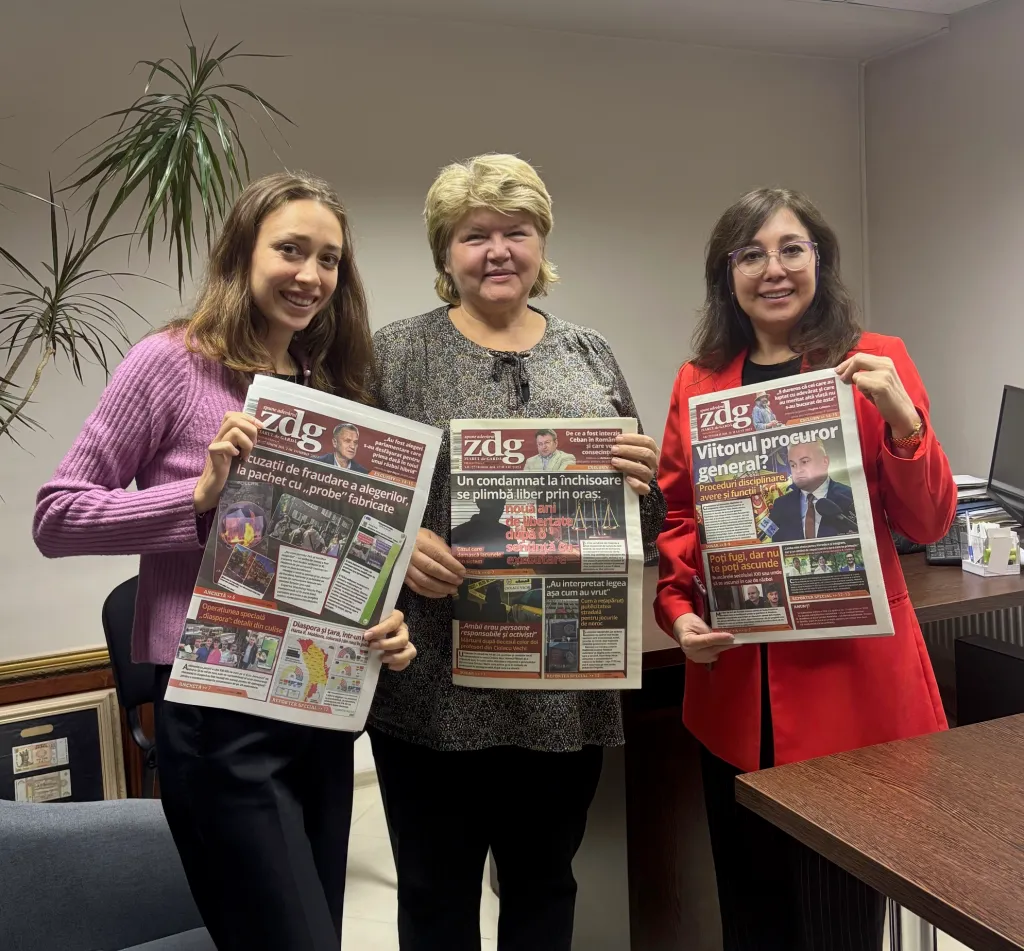
The building that houses Moldova’s oldest investigative newspaper, Ziarul de Gardă, founded in 2004, is in a small courtyard near one of the busy thoroughfares in central Chișinău, the capital. Alina Radu, the award-winning newspaper’s director, is busy checking the latest issue that just came out in print.
Ziarul de Gardă’s current burning topic has been the country’s recent parliamentary elections.
The September 28 elections — probably the most consequential in Moldova’s history — saw pro-European Union President Maia Sandu’s Party of Action and Solidarity (PAS) secure a clear majority. The stakes were high for this country of 2.4 million people, wedged between EU member Romania and war-torn Ukraine. Russia reportedly poured in millions of dollars to disseminate pro-Kremlin, anti-Western propaganda and support Russia-backed candidates.
“It was a nightmare,” Radu said, referencing Russian disinformation in the run-up to the 2025 elections. “Moldova was a real battlefield.”
Moldova’s pro-Kremlin strongholds — the Transnistria region, which has been under Russia’s de-facto control since the demise of the Soviet Union in 1991, and the southern autonomous region of Gagauzia, where Russia has the strongest influence, were the main battlefields.
A different outcome would have sent a worrying signal to Western partners of the country, which has been a candidate for EU membership since 2022.
Given Russia’s unprecedented level of election interference through vote-buying schemes and disinformation, practices already observed in November 2024, when Sandu was reelected for a second term after a close runoff, this clear victory came as a surprise — and a relief — to journalists, human rights defenders, and government officials interviewed by CPJ’s Gulnoza Said, Europe and Central Asia program coordinator, and Anna Brakha, CPJ’s Europe and Central Asia senior researcher, during an October 6-9 mission to Moldova.
‘Money and fear’
A Ziarul de Gardă investigation revealed that there had been an active “digital army”— fake social media accounts created specifically to spread Russian propaganda and disinformation in the run-up to and during the elections.
People behind the accounts received payments from Moscow via networks in Europe using bitcoin and other sophisticated methods, the investigation found. “This was a huge army,” Radu said. “Russia provided the instruments and the budget.”
According to Liliana Vițu, chair of the Audiovisual Council, Moldova’s audiovisual media regulator, an autonomous public authority, Russia spent the equivalent of 2 percent of Moldova’s GDP to influence the elections, compared to 1 percent in 2024.
“They needed to instill fear about anything related to the EU,” Radu said, adding that the Russian disinformation networks used fear-mongering narratives about the prevalence of LGBTQ+ people and possible land theft by other EU countries if Moldova joins the union.
In the weeks leading up to the elections, Moldovan police conducted major investigations and made dozens of arrests aimed at uncovering these schemes. Information about planned destabilization operations kept coming in until election day. The staff at the independent news website Newsmaker.md worked from 7 a.m. until 2 a.m. that day, struggling to keep up with the news about it all, said Olga Gnatkova, a journalist and the outlet’s development director.
A ‘laboratory’ and a ‘training ground’
“Moldova is like a training ground where Russia tests its disinformation strategies,” Ion Manole, who works for the Moldovan human rights organization Promo-LEX, which specializes in legal defense and election monitoring, told CPJ.
“We feel like we are a laboratory, and after us will come other countries,” Manole’s colleague Mihaela Șerpi added, referring to similar methods being used in the region, particularly in Serbia and Romania.
Before Moldova, the testing ground was Ukraine, said Viorica Tătaru. Her colleague Andrei Captarenco agreed. They are independent journalists who work with a range of media outlets, including independent broadcaster TV8, and are the only Moldovan journalists who regularly travel to Ukraine to cover the war. After talking to Ukrainians, they realized that the same narratives and methods — including paid protests — had been used in Ukraine by Russia in 2014, when Russia occupied Crimea and supported pro-Kremlin candidates, and anti-Western demonstrations.

‘Relatively safe’
Russia’s 2022 large-scale invasion of Ukraine is what prompted Moldova to apply for EU membership. Since then, the country has made encouraging steps forward, including in the field of press freedom.
“The Moldovan government needs to be congratulated for going through the EU screening process in record time,” Annalisa Giansanti, a spokeswoman for the EU delegation in Moldova, told CPJ, adding that the election results “will certainly impact the EU accession process, which is at full speed.”
Giansanti noted the progress in legislative alignment with the bloc, citing Moldova’s new regulatory law on a media subsidy fund, and the strengthening of the role and independence of its Audiovisual Council.
Other steps include seeking to incorporate the EU’s Audiovisual Media Service Directive into Moldovan law, making TV and radio ownership more transparent to align with one of the requirements of the European Media Freedom Act (a recent EU law to protect media independence and pluralism), and a recent amendment to a law on state advertising that defines its content and sets procedures for its allocation of public funds. “Now, all contracts must be reported,” Vițu said.
According to Anton Ialău, head of the media policy department at Moldova’s Ministry of Culture, the government has invested in fostering journalist safety. In July 2025, the country’s criminal code and code of administrative offenses were amended to detail the type of attacks perpetrated against the press and to increase penalties for obstructing its work.
Journalists Tătaru and Captarenco, who have both been physically attacked and threatened in connection with their coverage of protests organized by supporters of pro-Russian politicians, said they feel the police are on their side.
“Police try to help journalists,” Gnatkova said. “In general, in Moldova, we are relatively safe.”
The government’s pro-EU stance has made the environment more secure for journalists. “We don’t agree with everything [officials] do, but we feel free to criticize them,” said journalist Anghelina Chirciu.
But journalists fear the authorities’ ideological intolerance towards different views may lead to self-censorship as the ruling party claims the country’s only path is to the EU. “If you don’t support [the PAS], you are for Russia,” Gnatkova said. “If you criticize the ruling party, you’re criticizing EU integration. It’s unhealthy for any democracy to do that. To support a government without questioning its actions is not good for journalists.”
Over the last year, hostility toward journalists has grown as a result of internal divisions and a polarization in society deepened by Russian disinformation, which flourished in an underregulated online environment.
Reporters “are hit in the streets, and people who hit journalists are Moldovan citizens,” Ziarul de Gardă’s Radu said. “There is an environment of hate for nothing.”
Divides: Gagauzia and the Transnistria region
Moldova is deeply divided: geographically, with more than one million Moldovans living abroad; linguistically, with both Russian and Romanian languages being used by most of the population; and territorially, with the Transnistria region declaring independence in 1992, followed by Gagauzia in southern Moldova, which later returned to the country as an autonomous region.
In Gagauzia, pro-Russian narratives dominate the media, and journalists’ work is restricted. The region, which has a population of 130,000 mostly Russian and Gagauz-speaking ethnic Gagauz (Turkic) inhabitants, overwhelmingly voted for pro-Russians parties in the elections.
While journalists say they are free to report on any topic in Moldova, the Transnistria region remains inaccessible to them.
“The red line is the one that separates the left bank from the right bank [of the Dniestr River],” Captarenco said, referring to the approximately 250-mile administrative line between Transnistria and the rest of the country.
With a population of about 320,000, according to Ivan Turcan and Marian Soroceanu, representatives of Moldova’s State Chancellery’s Bureau for Reintegration Policies, a government body that oversees the negotiation process on the Transnistrian conflict, the region is a thin strip of territory between the eastern bank of the Dniester River and Moldova’s border with Ukraine where Russia has a key military base with around 1,500 troops.
Turcan said there are no independent journalists in the region: All media outlets are under the “strong control” of local authorities or in Russian hands. Independent Moldovan outlets are blocked, while Russian TV channels spread propaganda freely. “It’s a parallel reality,” he said.
Accreditation is required to work as a journalist in the area, but none of the independent Moldovan media outlets have been able to obtain it, despite requests.
Tătaru and Captarenco, who were detained in January 2024 while covering a protest in Tiraspol, the largest city in the Transnistria region, are among several journalists who have been obstructed or detained while reporting there in recent years.
In the last few years, the regime in Tiraspol has become “crueler,” said Anghelina Chirciu, a journalist with Zona de Securitate, the first independent media outlet to cover news in the Transnistria region. Her outlet was labeled an “undesirable organization” by the unrecognized regional authorities. “We know they don’t like our work,” she said.
“We don’t have effective control of the region, but we have an obligation to our own citizens,” Turcan said, mentioning Chișinău’s investments in education, health care, and improving labor policies. But in terms of press freedom and human rights, the bureau has hit a wall, with local authorities unwilling to cooperate with the government.
Underregulated online environment
Online threats are also on the rise, especially against women journalists. “Moldova is lacking a system that regulates the online environment,” the EU official said.
In the run-up to the elections, Radu faced harassment on Telegram and Facebook, with messages calling her a “prostitute” and threatening to cut off her head. She filed a complaint with the police, but said investigations take a lot of time and financial resources.
“We want to take the threats seriously,” the Ministry of Culture’s Ialău said. To do so, the police need to better enforce recent changes to the criminal and administrative offenses codes, he said.
As with threats and hate speech, authorities are struggling to tackle disinformation on social media, particularly TikTok — whose audience in Moldova has grown significantly in recent years — and Facebook, the country’s most popular platform for political debate, according to Gnatkova. Before the elections, AI-generated bots flooded the Facebook pages of independent media outlets, adding comments in support of pro-Russian candidates, she said.
As a candidate country to the EU, Moldova also needs to adopt the regulatory Digital Services Act, which should, among other things, help address disinformation and support the rights of journalists online.
“We hope we can get some protection via the EU,” Radu said. “Social media must be free but not a place for disinformation.”
The end of U.S. aid
The freeze of U.S. foreign aid in early 2025 has been a “hard blow” for media, Radu said, but the worst part is that Russian propaganda used it as an opportunity to stigmatize media as criminals, after Elon Musk called the U.S. Agency for International Development a “criminal organization” and former State Department official Mike Benz claimed that the organization had funded more than 100 media outlets in Moldova.
“We had no money,” Radu argued. “What we had is our reputation.”
As for Newsmaker.md, the outlet has been using up the U.S. foreign aid grant they received for 2025, seemingly the last for the foreseeable future.
For independent journalist Gnatkova, the future is bleak in terms of funding and, in broader terms, the country’s press. “What’s going to happen in January?” she asked. “How will the media work in Moldova?”