


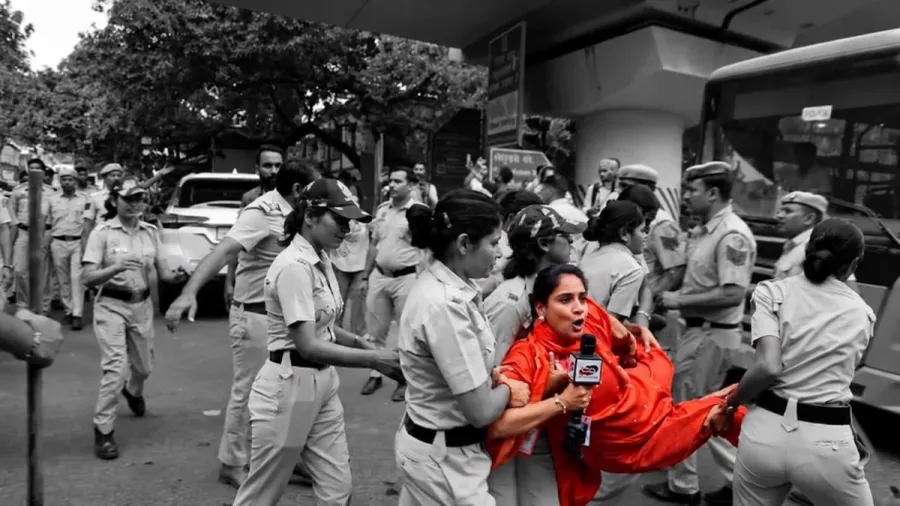
New Delhi, October 12, 2026 — More than three dozen journalists were temporarily detained, and in some cases assaulted, while they were covering protests against the country’s chief election commissioner over allegations of voter-list manipulation in New Delhi, Ahmedabad, and Pune on October 10 and 11.
In New Delhi, where the main protests broke out, at least 35 journalists were detained over the course of the next two days, according to CPJ’s review of news reports, direct interviews, and verified social media posts by editors, journalists, and their newsrooms. Two more journalists were detained while covering solidarity protests in other cities on October 10, including Alt News correspondent Kinjal in Ahmedabad and Scroll’s Divya Aslesha in Pune.
Police continued detaining journalists even after Supreme Court justices won assurances from Solicitor-General Tushar Mehta on October 11 that lawyers, journalists, and other professionals would not be impeded in their professional duties. The court, which is due to hear the matter again on October 13, also directed that no one be detained except by procedure established by law.
“CPJ’s research shows that, on October 10 and 11, Indian police detained at least 37 journalists while they were covering protests against the chief election commissioner — with several also being assaulted, heckled, or obstructed in their work,” said Kunal Majumder, CPJ’s Asia-Pacific program coordinator. “These incidents are deeply troubling and a blot on India’s democratic traditions. They violate international standards on press freedom and journalists’ constitutional rights, and also contradict the government’s assurance to the Supreme Court that journalists would not be impeded in their work. As the world’s largest democracy, India has a special responsibility to uphold press freedom, protect journalists from interference, and hold police officers accountable for assaulting or obstructing them.”
The protests were called by the Cockroach Janta Party, a youth-led political movement, together with student groups and opposition parties, to demand the resignation of India’s chief election commissioner, Gyanesh Kumar. Protesters allege that a nationwide revision of voter rolls has wrongly removed eligible voters, allegations that the Election Commission and the government deny.
Delhi Police denied permission for the demonstration, citing inadequate notice and law-and-order concerns, and a prohibitory order barred gatherings in central New Delhi. Police also restricted access to dozens of metro stations, canceled some train services, and suspended internet services within about four kilometers (two and a half miles) of the Janpath–Kartavya Path area and around makeshift detention centers. Days before the protest, Delhi Police had issued guidelines for journalists asking them to display press cards prominently.
Indian authorities deployed about 23,000 paramilitary personnel for the protests, including forces withdrawn from Jammu and Kashmir, West Bengal, and Chhattisgarh, along with at least 15,000 Delhi Police officers.
In addition to detaining journalists, police dragged some reporters by their clothes and shoved others into buses, despite their display of press cards. Authorities also seized at least five phones, pressured at least one journalist to delete footage, and drove some to holding sites up to 65 kilometers (40 miles) away.
At least five journalists were struck by police, according to their own accounts or their outlets’. On October 10, prominent Indian journalist Rana Ayyub posted on X that police threatened to detain her when she asked whether they were facilitating a man who was shouting abuse at protesters in their presence. Ayyub, a columnist for The Washington Post, told CPJ that, despite knowing she was a journalist, police beat her with a lathi (baton), resulting in injuries that are still causing her pain.
The following journalists were detained over the two days, most while displaying press cards:
- On October 10, Delhi Police temporarily detained Scroll’s Ayush Tiwari and Shoaib Daniyal; Business Standard’s Anushka Bhardwaj; Newslaundry reporters Ashwine Kumar Singh, Astha Savyasachi, and Anmol Pritam and intern Anshu; Reuters’ Saurabh Sharma; Navbharat Times’ Hritik Joshi and Rahul Charas; BOOM’s Jagriti Trisha; Shivang Shukla of Mo, India Today’s digital video platform; Molitics’ Neeraj Jha; The Quint’s Sarthak Jaiswal; Reporter TV’s Roshni Rajan and Farza TM; independent journalists Shrishti Khanna and Prashant Pundir; No Noise Stories’ Vivek Gupta; and Alt News intern Agniva Ray.
- On October 11, police detained Indian Express Hindi reporters Shashwat, Siya, and Vijay; Hindustan’s Ashish Singh; Nayab World’s Nitin Katiyar; Ulta Chasma founder Pragya Mishra; and independent journalists Nidhi Suresh and M. Rajshekhar.
- Several journalists also were detained while covering protests at Connaught Place that day. Despite wearing press cards, Peek TV journalists Vedanta Agarwal and Sara Khan were filming police detaining protesters when officers dragged them away and detained them. Khan said that a male police officer grabbed her by the neck and pushed her toward a female officer. Police detained independent journalist Shyam Meera Singh after he was heckled and abused by Hindu rightwing activists. Shortly afterward, Singh’s X account, where he had been posting short videos of the protests, was withheld in India “in response to a legal demand,” according to the platform’s notice. The account remains visible outside India.
- Police also detained at least three journalists from Malayalam-language news channels on October 11 and released them hours later. Asianet News reporter Sajin A was detained and released after about half an hour, the outlet’s Delhi head, Prashanth Raghuvamsam, confirmed to CPJ. Police grabbed 24 News reporter Suhail Mohammed by the neck and forced him into a police vehicle while he was filming. The outlet reported that its video journalist V.S. Rahul was also detained by police, who snatched his camera and threw away the microphone.
- That evening, police dragged The Caravan’s assistant multimedia producer Ryan Thomas into a detention bus on Janpath Road as he filmed a detention with his press card visible, hit him repeatedly on the head when he refused to delete his footage, slapped him, and prodded him in the stomach with a gun butt in a police car before letting him go at Connaught Place.
- CPJ has not yet confirmed the names of several other journalists detained on October 11, including a reporter with The Hindu, who was pushed onto a bus and released after mentioning that she was a reporter, as well as a PTI agency journalist. A news agency photojournalist told the media that police dragged them by the neck into a van.
- Also that day, a group of men wearing press cards surrounded Maktoob Media reporter Fida Fathima, editorial intern Nada Saeeda, and contributor Aktarista Ansari at Connaught Place in the presence of uniformed police. Maktoob Media editor Aslah Kayyalakkath told CPJ the men accused the journalists of insulting Prime Minister Narendra Modi and hurled Islamophobic slurs at them. When Fathima asked the men to show their own press identification, they refused.
A senior Delhi Police officer told The Hindu that some journalists may have been detained because they were working close to protesters and did not move away during detention operations. CPJ emailed Delhi Police for comment but did not immediately receive a response.