


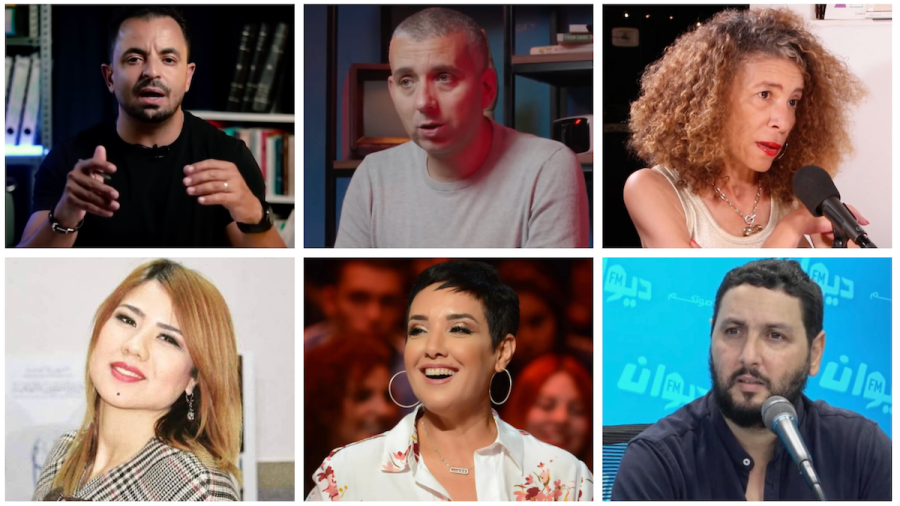
In Tunisia, at least four journalists and commentators sentenced to prison over the last year remain free, trying to work and carry on with their daily lives while knowing they could be arrested and taken into custody. Two others are in exile, unable to return home without risking imprisonment. Whether they will eventually be forced to join three other journalists who are currently behind bars in Tunisia — Zied el-Heni, Mourad Zghidi, and Borhen Bsaies — remains unclear.
The use of prison sentences against journalists represents part of a broader deterioration in press freedom in Tunisia under President Kais Saied. Once regarded as a beacon of press freedom in the Arab world following its 2011 revolution, the country has taken an increasingly authoritarian turn, particularly since Saied’s July 2021 power grab. Independent journalism has been among the most visible casualties, as authorities have expanded their censorship tactics through arrests, criminal prosecutions, and increasingly harsh prison sentences targeting journalists and commentators for their work.
As these restrictions deepen, new forms of pressure continue to emerge, as journalists do not necessarily have to be behind bars to be silenced. Today, a growing number remain physically free while being handed prison sentences, convictions in absentia, or prolonged judicial harassment that leave them under the constant threat of arrest.
For these journalists, the distinction between freedom and imprisonment is increasingly blurred. Ziad Debbar, president of the trade union the National Syndicate of Tunisian Journalists (SNJT), described the phenomenon to CPJ as “deferred imprisonment”: Journalists may remain outside prison, but the possibility of losing their liberty becomes part of their everyday reality. It’s a form of intimidation aimed at keeping them in a constant state of fear, he said.
“Press freedom cannot be reduced to freedom of movement or whether a journalist is physically behind bars,” Debbar told CPJ. “It also includes the ability to work without fear.”
Here are some of the Tunisian journalists and have been convicted but whose lives remain in legal limbo:
Hamza Belloumi and Insaf Boughdiri
In July 2026, broadcast journalists and bloggers Hamza Belloumi and Insaf Boughdiri learned that they had been sentenced in absentia to one year in prison and an 8,000-dinar (US$2,732) fine each in an appeal of a case dating back to 2015. The case stems from a video broadcast on their political program, “Al Yawm Athamen,” that showed former President Moncef Marzouki calling for a “bloodbath” in Tunisia and was later found to have been manipulated. Belloumi and Boughdiri have said the broadcast was a professional error, for which they publicly apologized at the time, and that they believed the case had been closed.
The journalists were not given the opportunity to exercise their right to a defense or appear before the court before the in absentia rulings were issued. Belloumi and Boughdiri have challenged the judgment, with their next hearing scheduled for December 2. Until then, they remain free but under prison sentences and the threat of arrest, demonstrating how a case they believed had ended more than a decade ago can suddenly place their rightful freedom at risk.
Haythem el-Mekki
Journalist and political commentator Haythem el-Mekki, who works with independent media outlet Rachma and previously collaborated with Mosaïque FM’s “Midi Show,” learned on July 15 that the Sfax Court of Appeal had sentenced him on July 8 to one year in prison over a social media post denouncing documented failings at Habib Bourguiba University Hospital in Sfax. The court overturned an earlier decision dismissing the case, which was initially brought under Decree-Law 54, a cybercrime law, before proceeding under Article 86 of Tunisia’s Telecommunications Code. El-Mekki was able to flee Tunisia the same day he learned of the sentence, he told CPJ.
“This sentence simply means that I can no longer return to Tunisia, whatever the reason, or I will be taken to prison to serve at least one year,” el-Mekki told CPJ. He said the conviction has forced him to start over abroad, both professionally and personally, by effectively ending his career in Tunisia and preventing him from seeing his family indefinitely. “I consider myself lucky. I am still free and able to continue, despite the forced displacement, smears, and accusations of betrayal,” he said.
Khaoula Boukrim
Journalist Khaoula Boukrim, founder of independent news website TUMEDIA, fled Tunisia for France in December 2025 after more than a year of mounting pressure, including the revocation of her press accreditation ahead of the 2024 presidential election and repeated police summonses over her reporting. On June 8, Boukrim learned that she had been convicted months earlier, on February 26, in two separate cases under Decree-Law 54, and sentenced in absentia to a total of four years in prison. Neither Boukrim nor her lawyer had been notified of the proceedings or verdicts, and they were initially unable to determine the specific charges behind the convictions, a local journalist told CPJ on the condition of anonymity, citing fear of reprisal.
Days before her lawyer discovered the sentences in court records, security officers had visited Boukrim’s mother’s home in Tunis, seeking information about her whereabouts. Boukrim remains free in France, but the four-year sentence has effectively closed the door on her return to Tunisia, turning her exile to escape from harassment into the condition for preserving her freedom.
Ghassen Ben Khelifa
On March 30, Ghassen Ben Khelifa, editor-in-chief of independent news outlet Inhiyez, was sentenced to two years in prison under Decree-Law 54 on charges of publishing false news and harming public security. The case stems from allegations that he administered a Facebook page accused of publishing terrorist content. Ben Khelifa has denied any connection to the page, and the SNJT said authorities had presented no technical evidence linking him to it, including on electronic devices confiscated from him.
The case has hung over Ben Khelifa since September 2022, when security forces arrested him at his Tunis home, seized his devices, and detained him for five days before releasing him pending investigation. More than three years later, he remains physically free but under a two-year prison sentence, leaving him at risk of arrest and imprisonment while the case continues.
Sonia Dahmani
Lawyer and media commentator Sonia Dahmani was released from prison in November 2025 after spending more than a year and a half in detention, but her release has not ended the judicial harassment against her. Dahmani continues to face multiple prosecutions over her media commentary, including under Decree-Law 54. In April, she received a reduced 18-month prison sentence on appeal over remarks about the treatment of sub-Saharan migrants in the country, and the following month she was sentenced to another two years in prison over comments she made about conditions in Tunisian prisons. Dahmani remains outside detention but continues to face the possibility of returning to prison.
The pressure has also extended to her family. In July 2025, Dahmani’s sister Ramla Dahmani was sentenced in absentia to two years in prison under Decree-Law 54, for simply advocating for Sonia and criticizing her ill-treatment in prison, leaving her similarly at risk of imprisonment for speaking out in her sister’s defense. Their cases illustrate how Tunisia’s judicial crackdown can extend beyond journalists and commentators themselves to loved ones and those advocating publicly on their behalf.
Prison before the prison
The impact of judicial harassment reaches beyond the journalists facing sentences. Debbar of the SNJT told CPJ that prosecutions can gradually change how journalists across Tunisia approach their work. Reporters may avoid sensitive political subjects, soften criticism, abandon investigations, or reconsider public commentary because of the potential legal consequences.
“The public sees the story that was published but not the one that was withheld,” Debbar said, which means people may never know about investigations that journalists abandoned for fear of prosecution. “The greatest danger is not only that journalists are in prison,” Debbar told CPJ, “but that prison becomes present in a journalist’s mind before they write.”
CPJ calls for an end to Tunisia’s judicial harassment of journalists
CPJ has repeatedly called on Tunisian authorities to immediately release all journalists imprisoned for their work and overturn convictions against journalists targeted for their reporting, commentary, or peaceful expression, especially now, amid an ongoing heatwave that is becoming life-threatening to prisoners.
CPJ has also urged the authorities to end the use of Decree-Law 54 and other criminal laws to prosecute journalists for their work and instead apply Tunisia’s press code, Decree-Law 115, which provides protections for journalists against non-press-related prosecutions.
The authorities should also end judicial harassment and ensure that journalists can work without the constant threat of arrest and imprisonment, as well as guarantee due process and the right to a defense for journalists facing prosecution, including in cases heard in absentia.
Until these measures are taken, journalists in Tunisia will continue to face a form of imprisonment that begins before the prison cell — one in which the threat of arrest shapes what they can report, where they can live, and whether they can safely return home.
CPJ’s email to Tunisian authorities requesting comment did not receive a reply.