


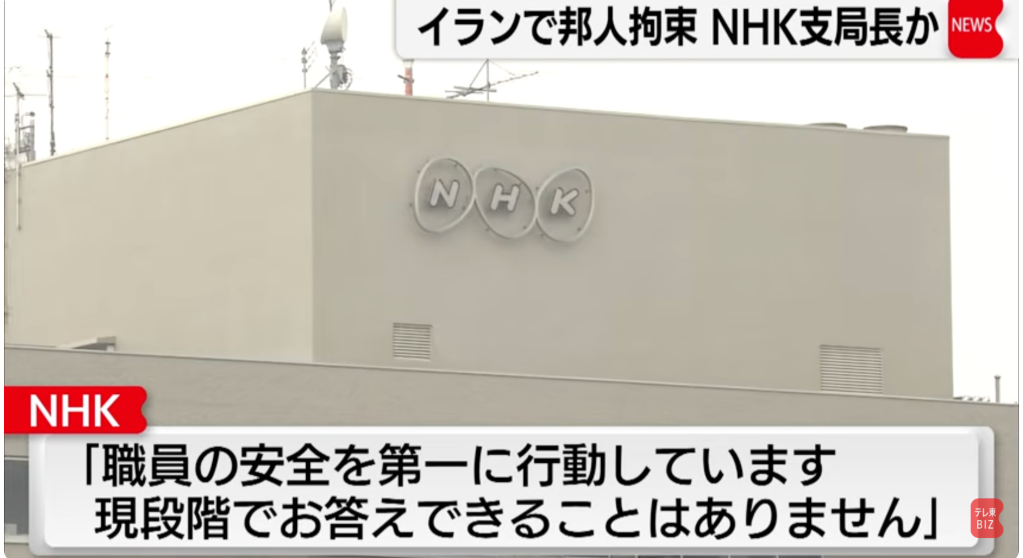
New York, February 26, 2026 — The Committee to Protect Journalists calls on Iranian authorities to immediately release Shinnosuke Kawashima, Tehran bureau chief of Japanese public broadcaster NHK, and all other journalists detained for their work, return all confiscated property, and end the harassment of NHK’s staff.
Shinnosuke was arrested on January 20 by the Islamic Revolutionary Guard Corps (IRGC) and held at a detention facility in northern Tehran, according to a source who spoke to CPJ on condition of anonymity for fear of retaliation, before he was transferred to Evin Prison on February 23.
The source claimed that NHK’s longtime videographer Mehdi Mohammedi’s passport was also confiscated, along with his personal devices, including his phone, laptop, and camera. His wife’s cell phone was also seized. CPJ was unable to independently verify the information.
Another NHK staff member — whose identity CPJ is withholding for safety reasons — fled Iran in early February. “The journalist was summoned multiple times in the past few weeks following the arrest of their bureau chief,” the source said.
“The arrest of Shinnosuke Kawashima and the intimidation of his colleagues reflects a deliberate effort by Iranian authorities to silence independent reporting,” said CPJ Regional Director Sara Qudah. “Detaining a bureau chief, transferring him to Evin Prison, confiscating a videographer’s passport and equipment, and repeatedly summoning staff are not isolated acts – they are tactics designed to pressure journalists into silence and make them fear continuing their work. Such actions are meant to force self-censorship and drive independent media out of the country.”
On February 25, Japan’s Deputy Chief Cabinet Secretary Masanao Ozaki told reporters that local authorities had detained a Japanese national in Tehran on January 20, declining to identify him by name.
“Since learning of this detention, the government has strongly demanded that the Iranian side secure the early release of the Japanese national,” Ozaki said.
CPJ has documented the arrests of 12 journalists since the crackdown on protests that erupted in late December. Seven journalists — Navid Zarrehbin, Hassan Abbasi, Artin Ghazanfari, Mohammed Parsi, Mohammad Hadi Jafarpour, Kianoosh Darvishi, and Shinnosuke Kawashima — remain behind bars.
Iranian authorities enforced a near-total internet shutdown during the crackdown, while also raiding journalists’ homes, blocking bank accounts, deactivating SIM cards, and summoning numerous reporters for questioning.
According to the latest report issued on February 23 by the U.S.-based Human Rights Activists News Agency (HRANA), at least 7,000 people have been confirmed killed in the January crackdown, with another 11,700 deaths under investigation. The group also reported that 25,800 civilians were injured and more than 53,000 people were arrested.
CPJ’s email to the Iranian mission to the United Nations in New York requesting comment did not receive a response.