


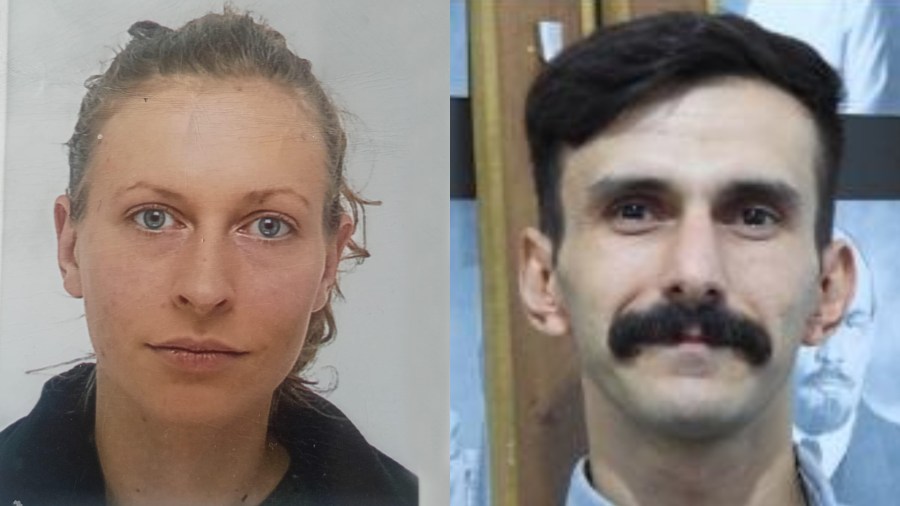
New York, September 18, 2026–The Committee to Protect Journalists calls on Turkish authorities to immediately release Ahmet Polad, a Kurdish-Turkish journalist who was transferred to Turkey this month after nearly eight months of enforced disappearance in Syria and is reported to be in extremely poor health.
Polad’s lawyer, Özlem Gümüştaş, told CPJ on Friday that the journalist, whose birth name is Mehmet Nizam Aslan and who has also been identified in previous reports as Ahmed Polad, had been transferred to Turkey and arrested but was in need of emergency medical treatment.
On January 18, 2026, Polad and German journalist Eva Maria Michelmann were detained while reporting from the northern Syrian city of Raqqa, as government forces advanced on the territory controlled by the Kurdish-led Syrian Democratic Forces (SDF). After months of denying knowledge, authorities admitted holding them in custody.
Both worked for Etkin News Agency (ETHA) and Özgür TV, which operates across several cities in Europe.
Michelmann was released on June 19 but at the time the whereabouts of Polad were unknown.
Gümüştaş told CPJ that Polad was transferred to Turkey on September 8 and arrested by a court in Istanbul on September 11 despite being in extremely poor health. The lawyer had not seen the arrest warrant and did not know what charges Polad faced as the case was classified.
Gümüştaş said Polad was regularly beaten and starved during his time in Syria and needs emergency medical care.
“Ahmet Polad suffered horribly during his captivity in Syria and now that he has been returned to Turkey, he belongs in a hospital and most definitely not in a prison,” said CPJ’s Chief Programs Officer Carlos Martínez de la Serna. “Turkey must immediately release Polad to allow him to receive the medical treatment he needs and Syrian authorities must account for what happened to him over the past months.”
Gümüştaş told CPJ that during his captivity Polad had never had any contact with Syrian officials. He was not allowed to see a lawyer and never presented to a Syrian court.
Gümüştaş said her client was beaten daily by his captors, kept in a cell with such a low ceiling that it was impossible to stand up and not allowed outside. She believed he was kept in the northwestern city of Aleppo until he was driven to the Syrian city of Idlib in early September and handed over to Turkish intelligence operatives on September 8.
Polad was then made to lie in the back of a car, handcuffed and with a bag over his head, and driven to the Turkish capital Ankara, the lawyer said. He was kept there for two days. ETHA also published details of Polad’s transfer and the alleged abuses he endured in Syria in an article on September 14, in which they quoted the journalist.
Gümüştaş said the Turkish intelligence operatives should have informed Polad’s family as soon as he was in their custody but that was not done.
She told CPJ that Polad was brought to Istanbul on September 10, put through what she called an “accelerated medical treatment” for one day at a hospital before being arrested by court a day later. She said he needed more treatment because of the beatings and added that he was suffering from malnutrition and an infestation of lice.
Gümüştaş said she would file an appeal against the arrest order but her first priority was to arrange permission for a hospital visit and an extensive check-up.
CPJ emailed Turkey’s Justice Ministry for comment but did not receive a reply. CPJ also contacted Syrian Ministry of Information official Omar Haj Ahmed, who said he was unaware of the transfer and would seek more information.