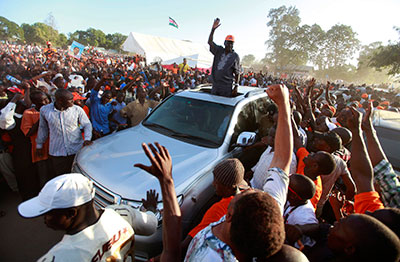
Election-related violence is a worry for journalists in many countries, but perhaps nowhere more so than Kenya, where presidential polls will be held March 4. In the aftermath of the nation’s last presidential elections in 2007, over one thousand people were killed in ethnic and political violence, live news broadcasts were banned, and the press faced a torrent of threats, leading to widespread self-censorship. Already, in recent weeks, some journalists have been harassed and their equipment confiscated, while media houses have been threatened in relation to coverage.
Compounding the problem are recent findings that some media were partisan and even overtly complicit in the 2007 outbreak of violence. As the fresh election nears, journalists should commit themselves to professional standards, at the same time that they watch out for themselves and each other over the weeks ahead.
During the party primaries in January, security agents critically injured two journalists attached to the Daily Nation, while the National Alliance Party attacked Royal Media Services reporters in Nairobi. Also recently, Robert Wanyonyi, Osinde Obare, and Paul Gitau of The Standard; Walter Barasa and David Wainaina of Mediamax; Mathews Ndanyi of Radio Africa Group; Suleiman Mbatia of Nation; Vincent Musundi of Royal Media Services, and others have reported nasty experiences at the hands of either political activists, security agencies, or criminal thugs. Since November 2011, the Media Council of Kenya has received about 30 cases of harassment, intimidation, and violent attacks on journalists. None of the cases has fully been investigated or prosecuted by the authorities in Kenya.
Some parts of the country have become no-go areas for journalists who are perceived not to represent local politicians, activists, business barons, or their interests. This geographical zoning is a dangerous trend for media freedom and freedom of expression.
In addition to the physical threats and attacks against journalists, there are some reports that the judiciary has levied huge fines in civil cases related to defamation, while some media houses have failed to respond to court summons and still others have ignored the plight of their journalists’ altogether. The concern is that if something is not done in time, the harassment of journalists and resulting self-censorship will become the norm.
Increasing attacks against journalists as the elections in Kenya approach are not without rationalization. CPJ and other monitoring groups noted the Kenyan media’s partiality along with even, in some cases, evidence of incitement in the 2007 post-election violence. Near the start of the current electoral campaign, more than a quarter of news reports presented only one viewpoint, according to the Media Council of Kenya (MCK), which also noted that some news outlets were “reporting unconfirmed rumors and publishing sensational headlines add[ing] to the unnecessary heightening of tensions.”
Indeed, the government’s own Independent Review Commission on the General Elections and the Commission of Investigation into the Post 2007 Election Violence were categorical on the media’s role both overtly and covertly in stirring up and abetting the violence by their performance, or lack thereof, during the country’s most trying period since independence.
Finally, the confirmation of charges against former radio journalist Joshua Sang at The Hague for crimes against humanity in connection with the violence that followed the 2007 elections was a sobering indictment on the media and belatedly served as a wake-up call to the entire profession in Kenya. The case is poised to come up in April. Sang has denied playing any role in drumming up tribal hatred through his broadcasts in the run-up to the 2007 election.
The recent harassment and attacks against journalists are violations of Kenya’s Constitution as well as international treaties to which the country is a party, including the African Charter on Human and People’s Rights, U.N. Security Council Resolution 1738, and UNESCO Resolution 29.
As the statutory body mandated with protecting journalists and promoting their rights through the Media Act of 2007, the Media Council of Kenya is concerned about increasing cases of attacks and intimidation against journalists and media houses. The council has taken several steps, including meetings with media owners and senior editors beginning in September 2012, as well as countrywide training on safety and protection for journalists.
The council has proposed the following measures on the issue:
1. Implement the recommendations of a baseline survey that was commissioned by the Kenya Media Programme through the Media Council of Kenya to map out the restrictions, attacks, harassment, and intimidation against media workers and improve awareness of the problem.
2. Carry out a study on journalists’ working conditions, including remuneration, and establish how this relates to safety and security.
3. Establish a common fund to deal with issues of safety and security. Media houses should be among the contributors.
4. Adoption by media houses of a more actionable approach to the plight of journalists, including by providing life insurance and protective gear as well as counseling for those who have covered traumatic events.
5. Training journalists on their personal responsibility in matters of safety and security.
6. Sensitize individual journalists and media houses to raise awareness and escalate issues of safety crises, including identifying and shaming the culprits.
7. Develop a binding resolution from industry players including media owners, editors, Kenya Union of Journalists, and Kenya Correspondents Association on a safe working environment for journalists in Kenya.
8. Reach out to other constituents involved with security in the country, including police, the director of public prosecutions, political parties, and the judiciary to raise the issue of safety and protection of journalists.