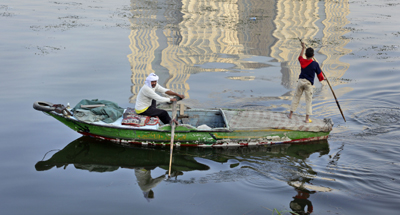
He’s young, unemployed and carries himself with the innocence of a man who hasn’t spent much time outside his own village. But Egyptian blogger Tamer Mabrouk is the real deal. Appearing at an international media conference in Bonn, Mabrouk’s description of chemical dumping into a brackish lagoon on the northern Nile Delta near the Mediterranean Sea was punctuated by photos of unmistakable filth. He won over the audience when, in response to a question on how one travels with sensitive material, Tamer deftly removed a memory card secreted in an electronic device and held it in the air. That, he said, is where he had carried documents for this trip.
The lines between journalism and blogging have never been blurrier, but the risks and challenges of reporting on environmental issues are clear. BP workers and U.S. Coast Guard personnel have denied access to photographers and camera crews trying to document the ongoing oil spill off shore of the U.S. coastline in the Gulf of Mexico. In many other nations, extreme and sometimes violent reprisals have been reported in the wake of stories on environmental degradation.
Before I tell you about the journalists who made it to the June 22 environmental panel at the third annual Global Media Forum hosted by the German state broadcaster, Deutsche Welle, I’d like to tell you about a few who were unable to travel. Few journalists have done more to document illegal logging and other encroachments on the Brazilian Amazon than Lúcio Flávio Pinto. But, in response to his stories, private companies, government officials, and other actors have filed more than 30 lawsuits against him in courts whose integrity is challenged. The point of the suits is to harass, if not drive him into bankruptcy, says Pinto who turned down the invitation to join the panel in Germany. If he were to leave Brazil for even a few days, he explained, he might fail to respond to a judge’s unexpected ruling and thereby lose a case seeking damages.
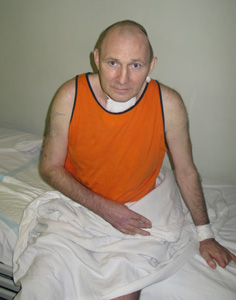
Another potential panelist just couldn’t physically travel. Mikhael Beketov was a Russian reporter who criticized the local government’s plans to deforest an area in order to build a highway between Moscow and St. Petersburg. He was later found in a coma lying in the garden of his home, at least a day and a half after assailants broke his skull, smashed his fingers, broken his legs, and left him in the freezing cold. One leg and several fingers were later amputated. Elsewhere, environmental journalists in Guinea and Bulgaria have been threatened; journalist Joey Estriber was abducted by unidentified men in the Philippines, never to be seen again.
But one thing that all the panelists in Bonn made clear is that subtle forms of pressure can also silence environmental reporters. Liu Jiangiang is one of China’s few journalists whose stories have led authorities to suspend if not stop dams and other construction projects with potential environmental consequences. He explained that the unwritten rules about what is and is not permitted in China may change without warning, and that pressure often comes from hidden sources to communicate “don’t do that again.”
Elsewhere in Asia, however, the environment is still seen as a minor concern. Rina Saeed Khan writes the weekly “Earthly Matters” column for Dawn, Pakistan’s largest English-language daily. She told a packed room in Bonn that terrorist bombings still make the front page in Pakistani papers, and that climate change or other environmental stories make page two at best–even though, she added, there is sometimes a connection between them. There is a nexus between militants and what Khan called the “timber mafia” in the nation’s northwest tribal areas. She also warned that in South Asia, like on several other continents, stories about competition over dwindling water supplies are looming.
In Haiti, it’s not the water but plastic water bottles that are adding to the country’s growing waste in the wake of the January earthquake, according to relief agency sources. Roosevelt Jean Francois is the leader of a community-minded journalist organization called CECOSIDA that promotes leadership development and training on reporting health, environmental and other matters. He noted that one yet untold effect of the relief efforts is the corruption, especially among local officials, over controlling distribution of foreign aid. Francois also noted that Haitian journalists covering any sensitive matter operate in an environment where reporters enjoy little protection against threats and violent reprisals.
Environmental reporters are more often silenced quietly through economic pressure, noted Jean François Julliard, secretary-general of Reporters Without Borders. The pressure may be so great on traditional journalists, noted Julliard, that bloggers may emerge as the chroniclers doing the best reporting. By then I had already underscored to the audience that RSF, the Paris-based press freedom watchdog, had issued a report on the myriad risks of environmental reporting worldwide.
The case of the young Egyptian blogger, Tamer Mabrouk, illustrated the point. He not only got fined for his online exposés, including documents and photographs of dumping by Trust Chemicals Company into Manzala Lake. He lost his job at the factory, too.
This blog is dedicated to colleague and friend Persephone Miel, a champion of press freedom, kindness and humor.