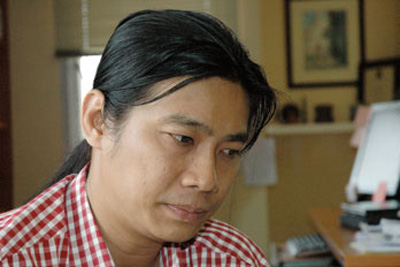
As international donors examine their priorities in light of Burma’s new regime, exile-run news media face potential cutbacks. The most critical news reporting on the long-closed nation may be endangered. By Aung Zaw
Published September 20, 2011
CHIANG MAI, Thailand
“In medias res,” the Latin phrase meaning “in the middle of the action,” is usually used in a literary context, but sometimes I feel it describes the experience of a journalist in exile. It has been 18 years since I founded The Irrawaddy, a news publication (and now multifaceted news service) based in Chiang Mai. That’s a long time, but the end of our journey—our eventual return to a democratic Burma—is still nowhere in sight.
Since we don’t know how far we are from reaching our goal—which is not really the end, but actually just the beginning of our real work of restoring press freedom in Burma—we feel stuck somewhere in the middle. And so we throw ourselves into the day-to-day routine of running a media organization, all the while wondering when we will be able to practice our trade on our own home soil.
More in this report
• Transition neglects press freedom
• EU conflicted on sanctions
• Journalists in prison
Multimedia
• Video: Undercover heroes
In print
• Download the pdf
In some ways, being a journalist in exile means being not in the middle of the action, but far from it. These days, however, it is possible to keep your ear close to the ground in one country while keeping your feet firmly planted in another. Through our network of sources and undercover reporters inside Burma, and greatly aided by the latest technology, we manage to dig a little more dirt every day—like prisoners tunneling our way to a truth the authorities want to prevent us from reaching.
It’s laborious work, but the reward is in knowing that every inch we move forward makes a difference. Sometimes, though, it’s difficult to know how much of a difference we make. That’s why I often wonder what measure of success we can apply to our work.
By the conventional standards of a modern media organization, we’re not doing too badly. We can point to our growing range of products—from our original magazine (now a quarterly e-magazine with a limited print run) to our well-trafficked Burmese- and English-language websites, from our blog and podcast to our television and radio programs broadcast by the Democratic Voice of Burma and Radio Free Asia—as evidence of our continued relevance.
We can also look at the numbers: Our websites attract visitors from around the world and increasingly from cyber-savvy viewers inside Burma, where proxy servers bypass government efforts to block “undesirable” content. Between them, our Burmese and English websites receive eight or nine million visits annually, with our Burmese site showing especially strong growth.
The feedback we receive every day from our readers suggests that we are satisfying a demand. Our weekly television show broadcast via DVB has won wide recognition. These days, most people I meet from inside Burma tell me they’ve seen and appreciate our program.
It would be nice to say that we’ve helped in some way to improve the media environment inside Burma. But our only contribution in that regard has been to provide an outlet for colleagues working within the country’s draconian censorship system who want to share stories that they can’t report in the domestic press. Otherwise, the situation of journalists in Burma remains as grim as ever, even under the current “civilian” regime.
Much has been made of the supposed “opening” of the Burmese media since last year’s election. The fact that pictures of pro-democracy leader Aung San Suu Kyi, who was released from more than seven years of house arrest a week after the November 7 polls, were allowed to appear in print has been seen by some as a sign of positive change. But I have my doubts.
There are other issues that remain very much taboo to Burma’s rulers. In the country’s border regions, human rights violations remain rife in conflict zones. No local publication would dare hint of the rape, murder, and forced relocation that are part of the army’s campaign to impose its will on ethnic minorities. The brutal suppression of hunger strikes by political prisoners is another subject that will never appear in the Burmese press. Forced labor, child soldiers in the Burmese army, and massive deforestation by cronies of the ruling generals are also among the many unmentionables.
Even the impact of mega-projects that will transform Burma’s landscape forever, affecting potentially millions of its citizens, cannot be discussed within the pages of the country’s newspapers. Dams in the Kachin, Shan, and Karen states are being built to produce energy for Burma’s neighbors, while its citizens continue to live with brownouts. In Arakan state, a gas pipeline for China will enrich the generals but do nothing for local people.
There has been much speculation that Thein Sein, the ex-general and former prime minister who now ostensibly leads the country as its president, will start holding regular press conferences. So far, however, he remains as remote from the independent press as his predecessors, who were never very interested in answering questions from anybody.
This lack of real progress inside Burma—on the issue of media freedom, or on any other front—hasn’t prevented some from declaring this a turning point in the country’s transition to democracy. This has put new pressure on the exile media: As some governments move toward more active engagement with Naypyidaw, donors that have long supported our work also seem inclined to shift their attention toward the possibilities, however illusory, of effecting change from within the country.
Does this mean we are losing our allies, the foundations and government agencies that share our commitment to press freedom in Burma? Probably not, but our dependence on their support has never seemed more precarious. And in some cases—in which former supporters have attacked us for our activities, presumably to curry favor with a regime they see as a viable “partner”—we have been forced to ask ourselves who our real friends are.
Meanwhile, we have no doubt who the enemy is—anyone who stands in the way of telling the stories that need to be told. Even when we are being attacked by hackers and other cyber-phantoms, as we recently were, we keep our eyes on what is really happening in Burma and try not to get sidetracked by distractions. If anything, we take these attempts to derail our efforts as a sign that we’re on the right track.
Despite the challenges that face us on a daily basis, and the uncertainties that have always hung over us, we know the only way forward is to keep working every day. Eventually, Burma will have that breakthrough moment when everything changes, for real and forever. And when that day comes, we’ll be ready for it.
Aung Zaw is founder and editor of The Irrawaddy.