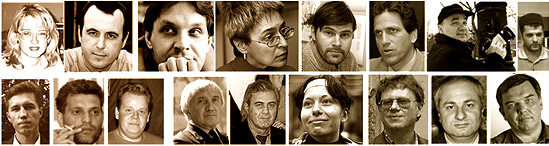
Excerpts from the work of journalists slain in Russia since 2000
Anatomy of Injustice: The Unsolved Killings of Journalists in Russia
Paul Klebnikov
“The Golden Hundred: Russia’s Richest People of 2004”
By Paul Klebnikov and Kirill Vishnepolsky
Forbes Russia (Originally published in Forbes Russia on May 13, 2004; translated and republished by Forbes.com on July 22, 2004)
Russia has more billionaires in proportion to gross domestic product than any other major economy—36 individuals in relation to a GDP of $458 billion. Though it would be wrong to correlate net worth to GDP (the former is a question of capital, the second of revenue), comparing the two gives an indirect indication of the degree of concentration of wealth in a country. The fact that the combined net worth of Russia’s 36 billionaires ($110 billion) is equivalent to 24 percent of GDP speaks volumes.
When Forbes published its most recent list of the world’s billionaires, in February of this year, the U.S. was the undisputed leader in the number of billionaires. The combined net worth of America’s 277 billionaires was $651 billion—equivalent to 6 percent of America’s GDP of $11 trillion. The second-highest number of billionaires could be found in Germany—52 billionaires in a country with a GDP of $2.1 trillion. And Japan, with the world’s second-largest economy and a GDP of $3.7 trillion, counted fewer billionaires than Russia—only 22 people.
Russia’s capital is not only concentrated in the hands of a relatively small group of individuals, it is also highly concentrated in one part of the country—the city of Moscow. According to Forbes estimates, all but three of Russia’s 36 billionaires either live in Moscow or have made their fortunes in companies based in the city. No other city in the world can boast such a number of homegrown billionaires—even New York could boast only 31 billionaires, according to the latest Forbes list of the world’s billionaires.
Inherited wealth
When we calculate the fortunes of the wealthiest Americans—those included on the “Forbes 400” list—we consider whether the bulk of an individual’s fortune is inherited or not. The fact that inherited fortunes account for just 20 percent of the “Forbes 400” speaks of the ability of the U.S. economy to reinvent itself rather than to rely simply on the achievements of past generations.
Naturally, since Russia emerged from communism just 13 years ago, one cannot speak of inherited family fortunes. But most of the members of Forbes Russia’s “Golden Hundred” list have inherited natural resources and enterprises of an entire country—the Soviet Union. This kind of inheritance forms the basis of the net worth of 66 members of our list. Only 34 individuals made their fortunes by starting some fundamentally new business—mostly in the telecommunications sector, construction, and food and beverage production, or by the creation of retail chains. The scarcity of new sources of wealth in Russia indicates to what extent the Russian economy still relies on the achievements of the past.
Finally, the members of Forbes Russia’s “Golden Hundred” list are remarkably similar in terms of biography and personal characteristics. The average member of our list is a 47-year-old male who was born outside Moscow but received his higher education in the Soviet capital. With the legalization of private trading in 1988, the typical member of the “Golden Hundred” made a small fortune importing personal computers. Several years later, he branched out into banking and raw material exports. Today, he typically owns a majority stake in an oil or metal company. He is married and spends a good part of the year in Western
(Reprinted with permission of Forbes Russia and Forbes.)
Anna Politkovskaya
“Designated Terrorists: The Anti-Terrorist Policy of Torture in the North Caucasus” (Originally published in Novaya Gazeta on October 12, 2006; translated by Yelena Leonova and republished on October 13, 2006, in Johnson’s Russia List, a project of the World Security Institute)
Every day, there are tens of folders in front of me. These are copies of materials from criminal cases against people who are being investigated or have already been jailed for “terrorism.”
Why is the word “terrorism” in quotation marks here? Because the overwhelming majority of these people are designated terrorists. By 2006, the practice of designating people as terrorists has not only displaced any and all real anti-terrorist efforts, but has actually started to generate revenge-seekers—potential real terrorists. When prosecutors and courts do not work to carry out the law and punish the guilty but, rather, to fulfill political orders and achieve anti-terrorist statistics pleasing to the Kremlin, such criminal cases turn out like hot cakes from an oven.
The conveyor belt of “organizing full confessions” excels at providing good statistics on “fighting terrorism” in the North Caucasus.
Here is what the mothers of a group of young convicted Chechens wrote to me: “In effect, these penitentiaries have turned into concentration camps for Chechen convicts. They are subjected to ethnic discrimination. They are not allowed out of one-person cells or punitive solitary confinement. The majority, or almost all of them, have been convicted on fabricated charges, with no material evidence. Held in brutal conditions, subjected to humiliation, they are developing a hatred for everything. This is a whole army of young men who will return to us with their lives ruined, their outlooks distorted. …”
To be honest, I fear their hatred. I fear it because it’s like a river that will overflow its banks sooner or later. And it will be taken out on everyone—not just the investigators who tortured them. The “designated terrorist” cases are the arena where there’s a head-on clash between two ideological approaches to what is happening in the zone of the “counter-terrorist operation in the North Caucasus”: Are we using the law to fight lawlessness, or are we hitting “their” lawlessness with “ours?
(Reprinted with permission of Novaya Gazeta and Johnson’s Russia List.)
Eduard Markevich
“Expansion”
(Originally published in Novy Reft on January 12, 2000; translated for CPJ by Ekaterina Lysova)
I decided to write this article after learning about a search in the apartment of [Alevtina Nikolaevna] Urusova, a sports instructor at the [Reftinsky] town administration.
I had to meet with a lot of people in order to carefully investigate this case and be able to give you an adequate account of what had happened. What I learned has changed my perception of things I have ignored in the past.
One evening the police broke into A.N. Urusova’s apartment without a warrant, turned everything in the apartment on its head, and confiscated sports equipment she kept at home. … A.N. Urusova was called for an interrogation. The interrogation lasted for eight hours, and was accompanied by threats, tears, loss of consciousness, and the arrival of an ambulance.
It turned out that the police were not very interested in A.N. Urusova herself. … And all that ostentatious strictness of the “siloviki” [law enforcement and security agents], and their zealous intent to fight against “those who steal social property,” was nothing more than a sham. All that was needed from the sports instructor was to name the names of the persons and list the quantities of the bribes they allegedly passed through her to the head of the town administration, M. Shantarin. They also wanted her to name the places and the dates those alleged transactions took place. Moreover, they demanded that she sign some papers compromising to Shantarin.
To her credit, Alevtina Nikolaevna [Urusova] withstood the pressure and did not succumb to threats (of the “I’ll put you in jail!” type) or to the temptation of saving herself from police harassment by confirming false accusations against an innocent man.
According to unofficial sources, the police have been blackmailing M. Shantarin by threatening to put his son in prison on fabricated charges. This is an alarming fact: The police are becoming interested in politics. And not just in Reftinsky. The recent expansion of the “siloviki” into the federal government is noticeable: First, Russians, exhausted by failed reforms, were forced to vote for the political party Unity, headed by [army general] Sergei Shoigu; then, the tendency continued at the executive level when V. Putin—a “silovik” to the bone—became president.
Feeling the support of the federal government, our detectives have raised their heads, striving for power and influence in the local administration.
A police officer does not have much of a chance of being elected to office—people do not like the police, and that’s that. Particularly here in the Urals—a region for ages used by Moscow as a dumping ground for inconvenient, dissenting citizens. So, the direct path to political power is shut to police officers here. Now, it is another matter if a high-ranking town official has sons who can get into trouble. … It is not that hard to influence the powerful by preying on their parental feelings.
No one is allowed to destroy the foundations of democracy in our country, even in a small town, even in the name of some good cause. Those in uniform have always used raw force as their main argument.
But we are not going to stand by, doing nothing, while the police are trampling one of the most valuable achievements of our country—our democracy—before our eyes.
(Reprinted with permission of Novy Reft.)
Yuri Shchekochikhin
“The Three Whales [Furniture Store] Case:
A Judge Threatened, a Prosecutor Dismissed, a Witness Murdered”
(Originally published in Novaya Gazeta on June 2, 2003; translated for CPJ by Ekaterina Lysova)
This is not a story about tables and chairs; this is a different, a completely different story, which points directly to Russia’s place in the world, to the kind of country we live in, to the history we are currently writing, to our elected president and parliament, and to our politically appointed government officials.
The Three Whales case is symbolic of our time! Symbolic for the parliament—its Security Committee dedicated an entire session to the affair, and the State Duma sent dozens of letters to the Prosecutor General’s Office. Symbolic for
It sounds like a joke! The independent presidential prosecutor Loskutov has strangely not received a letter from Frank Helmut, the German criminal police representative in Moscow. The letter directly names the dummy German companies established by [Three Whales principal] Zuyev; lists Zuyev’s accomplices who—along with him—are suspected of money-laundering and creating a criminal organization; and informs the Russian side of Italian arrests made in the matter, as well of the German authorities’ readiness to collaborate with Russia on this case!
He doesn’t have this letter; it has not arrived, or it has been lost, or it has just disappeared in the corridors of the Prosecutor General’s Office. I can give him a copy of the letter, but will it make any difference? And this is not the point! The question is: What is really in the power of our elected president to do? To provide some senior citizen with a telephone line? To utter some pretty sentence in German? To take off in a fighter jet [as a photo op]?
“Who is he, Mr. Putin?” I hardly remember how many times I have heard this question from my foreign colleagues when he suddenly appeared at the top of Russian political power. Three years have elapsed since then. And I still haven’t found a clear answer to this question.
Twice I have appealed to the president with personal inquiries regarding, believe me, important state issues. Twice I have had to repeat the same phrase: “I understand your desire to create a working team, but it seems to me not a team but a pack of wolves has been circling around you. And Russia is tired of living under this ruling pack.” Twice, in response, I have received meaningless notes from Kremlin clerks.
(Reprinted with permission of Novaya Gazeta.)
Ivan Safronov
“The Bulava Missile Failed”
By Ivan Safronov and Elina Bilevskaya
(Originally published in Kommersant on December 26, 2006; translated for CPJ by Ekaterina Lysova)
Kommersant has learned that the test of the modern intercontinental ballistic missile Bulava, which was launched on Sunday from the Dmitry Donskoi nuclear submarine, was unsuccessful. This is Bulava’s third consecutive crash. The problems associated with launching Bulava cast doubts on future plans to supply the nuclear navy with this kind of missile. Bulava was expected to become the main striking force of the Russian navy’s strategic nuclear forces in the next decade.
According to Kommersant’s sources, at the end of last week, the Dmitry Donskoi submarine went to sea in order to launch Bulava. Yesterday, the submarine came back to the base in Severodvinsk. The launch of the missile was scheduled for Sunday, but no official announcements have been made. It’s worth pointing out that the Defense Ministry always makes official statements following the successful launches of ballistic missiles. Sometimes, Defense Minister Sergei Ivanov personally reports the successful launches to President Vladimir Putin in front of TV journalists. A Kommersant source in the Joint Staff of the Navy Fleet noted that after Bulava’s previous launch failure on October 25 (incidentally, this was the day of the president’s annual televised conference with the Russian people), the distribution of any information about the missile test was banned.
Yesterday, Igor Panarin, the press secretary of the Federal Space Agency (responsible for the creation of Bulava), neither confirmed nor denied information about the failed missile launch. He promised Kommersant that “the agency would comment right after the Defense Ministry issues its official statement.” However, the Defense Ministry was mute until yesterday evening. The head of the communications department of the Defense Ministry, Sergei Rybakov, told Kommersant then that he “is not commenting on the situation” with Bulava’s launch. According to Second Rank Captain Igor Babenko, the deputy head of the Northern Fleet’s press service, the responsibility for everything that takes place around the Bulava missile launch lies entirely on the developer—the Moscow Institute of Combustion Engineering. “The military does not have a right to comment on anything related to the tests of this missile until the missile is transferred to the fleet for service,” Babenko told Kommersant.
After the failed Bulava launches in September and October 2006, the testing program was changed. While both tests in the fall were carried out with the Donskoi submarine under water in the White Sea, the December 24 launch was done with Donskoi above water. However, the third attempt to launch Bulava within the last four months failed, too, according to the information obtained by Kommersant.
We will remind you that after three failed attempts to launch the navy’s modernized nuclear missile Bark in 1997, the Russian Security Council decided to terminate its development by the Makeev assembly plant. It was decided that work would be transferred to the Moscow Institute of Combustion Engineering, which would have to develop a modern nuclear missile that would then be produced by the Votkin factory in Udmurtiya. The Moscow Institute of Combustion Engineering had previously developed land-based ballistic missiles for the strategic-missile military force.
According to a Kommersant source in the Defense Ministry, an intergovernmental commission was to start an investigation today into the Bulava launch failure. In addition, the source did not deny the possibility that the results of the work of the commission could be examined at a special meeting of the military-industrial commission led by Vice Prime Minister and Defense Minister Sergei Ivanov. “The failure casts doubts on carrying out the state military program to equip the Russian navy with the Bulava missile starting in 2007,” the source explained.
(Reprinted with permission of Kommersant.)
Maksim Maksimov
“They Beat Their Own and Fear No One”
(Originally published in Gorod on April 5, 2004; translated for CPJ by Ekaterina Lysova)
In the period of one week, the apartment of an investigator with the Main Department of Investigations [in the St. Petersburg Interior Ministry] was broken into twice, in both cases by police officers. Strange that this may be, in both cases, the Central Federal District’s prosecutor’s office found no criminality in the police actions, and refused to open a criminal case into the matter. However, the investigator (we will call her N for safety concerns) did not agree with the prosecutor. Last week, the Smolninsky Federal Court of the Central Federal District held a hearing to review N’s appeal, and ruled that the prosecutor’s decision was illegal and unfounded.
Colleagues and bandits
Here is N’s account of the events. On February 19, 2004, about half an hour after midnight, unknown men smashed the front door and broke into her apartment. One of them, in response to her question, “What’s going on?” aimed a pistol at her stomach and ordered her to “shut up.” This event reminded her of an armed assault. Only after a uniformed police officer came through her door did investigator N realize that the men were not criminals, but her colleagues.
N showed her police identification, introduced herself, and asked her uninvited guests to do the same; she also asked them to explain the reason why they broke into her home. But, in response, all she received was a torrent of vulgarities. No one showed her any documents. One of the men said that “the deputy of the Regional Department of Internal Affairs Solovykh is working here,” and if she kept complaining, she would be taken to police station No. 76. The investigator once again asked that the men leave her apartment. When they were leaving, one of them kicked her in the stomach.
N then saw the police officers break into a neighboring apartment, which was rented by a Chechen-Azerbaijani family, take the people out on the street—without allowing them to even put their jackets on—and drive them away. The investigator dialed 02 [the emergency phone number] right away. The police team that arrived refused to take down her account of the break-in and only filled out some form.
The same day, N filed an appeal with the city prosecutor, asking him to open a criminal investigation against the police team headed by Solovykh on the charge of illegally breaking into her apartment. But while she was waiting for the appeal’s result, the story unfolded in an unexpected way.
Six days later, on February 25, after coming back home from work at 9:30 p.m., the investigator noticed that the lock of her apartment door was broken, the door itself was open, and the lights were on. N found out from a neighbor that this time around, it was a drunken local police officer by the name of Shapovalov who had broken into her home, just an hour before. According to N’s neighbors, the officer was looking for something in her apartment, and when he found a file full of documents, he left with them. For some reason, he also took the neighbor’s sister and niece away with him.
The investigator dialed 02 again, where she was told that a team from police station No. 76 would soon be dispatched. When N objected, explaining that the officers who first broke into her home worked at none other than police station No.76, the 02 operator on duty rejected her request to send a different police team. Had N not been an investigator, she would have had to make many more calls and explain her story time and again. But since she was one, she first reported what happened directly to the head of her department, and then contacted other appropriate officials in the [Interior Ministry’s] Main Department of Investigations.
(Reprinted with permission of Gorod.)
Magomed Yevloyev
“On the Situation in the Republic of Ingushetia”
(Originally published on the Web site Ingushetiya.ru, on an unknown date, and republished on Ingushetia.org on February 25, 2009; translated for CPJ by Ekaterina Lysova)
The situation in the Republic of Ingushetia has been deteriorating and might lead to social turmoil with serious negative political and economic consequences.
Below, I have briefly laid out the salient points, characterizing the current state of affairs in the republic.
Because of the blundering policies of Ingushetia’s administration; its insufficient attention to the problems of unemployment, the poor standard of living, and other issues the effect of which has been compounded by pervasive corruption among state officials; and because of the detachment of authorities from the needs of their constituents—the credibility of the local and federal government has dropped to its lowest.
Wahhabism—the radical movement in Islam—has gained popularity among young people, particularly those living in rural areas.
A lot of youths have been joining Wahhabi groups while the regional government passively stands by, doing nothing to prevent the trend. In fact, Wahhabi clubs have been freely and publicly propagating their theories—which are foreign to traditional Islam—in various parts of Ingushetia.
As a result, it has become possible for Chechen rebels to establish military bases and tent camps in the forests of Ingushetia, and be actively joined by Ingushetians who are attracted to the ideas of Wahhabism.
Those were the groups responsible for the attack on power structures and peaceful citizens on the night of June 22, 2004.
Ingushetia’s president, Murat Zyazikov, has no authority among the population. The last traces of it—which had only lingered on due to President Vladimir Putin’s support for him, a fact Zyazikov has missed no opportunity to point out—vanished following the June 22, 2004, events in Ingushetia, and the terrorist act committed on September 1 in Beslan.
During the armed attack of the rebels on the night of June 21-22, Murat Zyazikov, as the commander-in-chief of the republic, not only did not lead the actions of resisting the rebels, but disappeared somewhere. Most residents of Ingushetia are convinced that he was hiding in the basement of one of his relatives.
The population’s discontent peaked with regards to Zyazikov’s behavior during the terrorist act in Beslan. The elders heading Ingushetia’s main clans—who wanted to go to Beslan—were looking for the president for three days and could not find him; he only reappeared after the school hostage crisis was over.
During his short tenure as president, Murat Zyazikov has alienated almost all federal officials: the head of the Supreme Court, the interior minister, the prosecutor of the republic, the head of the security service, and representatives of the Southern Federal District. Zyazikov wants to replace all of them with people loyal to him. He has partly succeeded in this—those and other government posts are openly auctioned off in the republic.
(Reprinted with permission of Ingushetia.org.)
Natalya Skryl
“Ordinary Extraordinary Meeting”
(Originally published in Nashe Vremya on January 25, 2002; translated for CPJ by Ekaterina Lysova)
Scheduled for 8 a.m. on Sunday, January 20, the Tagmet shareholders’ meeting went calmly, as was planned by the stock owners with a controlling share. Everyone but an Alfa-Eco representative, who did not consider the meeting legitimate, was allowed to speak. In addition, the general director, Sergei Bidash, exchanged remarks with the director of the Alfa-Eco metallurgical department, Vadim Kucharin, basically saying: “We respect you, but you don’t respect us.” The voting showed that the Alfa stake in the company has not increased: The previous power balance has remained in the new board of directors.
In the place of Vladimir Verba, who resigned a month ago, Nikolai Orlov, the general director of the public corporation Priasovsky, was approved as chairman of the board of directors. Thus, the meeting safely reached a “status quo.” Only a beefed-up security presence at the entrance [to the plant] pointed to tensions. Since Friday afternoon, armed guards have not let anyone into the building where the meeting was supposed to take place. On Sunday morning, even a court officer who carried an order to cancel the meeting was not allowed into the building.
The main events that led to the resignation of the chairman of board of directors took place in December. It sounds like a detective story.
The first meeting of the board of directors took place on December 21 on the initiative of the company Dzhnou Properties Limited, which is considered to be a partner of Alfa. The agenda of the day was to hold a shareholders’ meeting to re-elect the board of directors. The thing is that Mr. Kazakov, the Dzhnou representative at Tagmet, resigned after his appointment as the Rostov Region representative at the Federation Council, and his replacement had to be approved at the meeting. In addition, Alfa demanded a report on the situation around the plant. Directors were discussing when and where the next meeting would be held—in Taganrog or in Moscow—until nightfall. According to Bidash, they finally decided on Taganrog. However, Alfa claims that an agreement was never achieved.
…
On that same day, December 21, the Taganrog court issued a decision crucial to the development of further events. In April of the previous year, following an Alfa initiative, a new edition of company guidelines was approved at one of the shareholder meetings. According to the changes, the board of directors were to approve all important decisions by a minimum of 10 out of 11 votes. One shareholder considered this a violation of his rights, and the court supported his claim.
According to Vadim Kucharin, everything that happened afterward falls within the “domain of speculation.” On December 26, Vladimir Verba signs a document canceling the upcoming meeting of the board of the directors and then resigns. The minutes taken at the December 21 meeting are allegedly rewritten. Each side explains the reasons that led to the chairman’s resignation in its own way.
It should be said that Vladimir Verba … owns about 16 percent of Tagmet’s shares, so any of the parties involved cannot be uninterested in trying to draw him to their side. We can only guess what the methods of dealing with the former chairman have been.
(Reprinted with permission of Nashe Vremya.)
Vagif Kochetkov
“Protek: The Benefactor Forced Upon Us”
(Originally published in Molodoi Kommunar on June 17, 2005; translated for CPJ by Ekaterina Lysova)
Doctors advise that sick, low-income people stock up on healing herbs for self-medication.Well, the times are good for this. To rely on the state, which is supposed to provide free medications, is not recommended to Tula residents. Even the regional administration does not know what to do with the confusing Law No. 122 [on medical coverage] and the commercial interests that accompany it.
“A protection racket” for a closed company
There is only one “benefactor” on our market, which has been authorized to provide medication to those citizens who have the right to get state social benefits: the closed joint-stock company Protek Center for Implementation.
The Moscow-based Protek did not appear in the Tula region out of thin air. The government of the Russian Federation forced it upon us. There have been rumors floating about in the corridors of the Tula White House [the government building] about a special relationship between this company and Russian Health Minister Mikhail Zurabov. This seems to be the reason no one in the previous [Tula] regional administration would stand up for the interests of local residents dependent on state medical benefits. How come the governments of the Moscow, St. Petersburg, or Sverdlovsk regions could do it and Tula’s could not? In the Tula region, Protek has de facto monopolized the medical benefits’ market: In the past five months, Protek sales people have dictated their conditions, forcing local pharmacies and hospitals to accept their one-sided contracts.
Complete losses
Here are the opinions of those directly dealing with the implementation of Law No. 122 on the ground. Among them are the doctors and heads of the pharmacies who “lucked out” to be Protek partners.
“We have borne total losses,” says E. Koshar, head of the Bogoroditsk central district pharmacy. “The contract forced upon us by Protek does not benefit us. We provided [Protek] with offices as well as with our specialists who have done additional work without being paid. Protek hasn’t even paid for what we have spent on them from our own budget.”
Here I need to clarify. As a matter of fact, according to Law No. 122, the prescriptions for low-income patients are issued in a new way and in compliance with the government-approved list of medications. This list contains 2,000 items and each item has its own code. A company chosen by the government theoretically should itself manage the process of prescribing medicines, providing services in the pharmacy, and paying the Medical Insurance Fund. But in Tula, all this is being done by the personnel of local hospitals and pharmacies. For free. And this is despite the fact that Protek has enough resources to do the work on its own.
“Workers are quitting their jobs,” complains L. Kashirina, the director of the state-owned company Shchekinskaya. “Our pharmacy bears losses. Protek’s leadership is confusing everybody. Until recently, we hoped for good relations with this company, but their contract hurts us. These so-called partners don’t even want to hear us out.”
(Reprinted with permission of Molodoi Kommunar.)
Valery Ivanov
(Under the pen name Gamlet Oganesyants)
“This Is How It Happened”
(Originally published in Tolyattinskoye Obozreniye, in April 2000; translated for CPJ by Ekaterina Lysova)
It might sound strange, but it is much more difficult to explain to members of the law enforcement agencies—rather than to the criminals—that freedom of speech is not just a declared right in the Constitution, but a reality for us who live in Togliatti. In order to prove this, we had to endure a criminal investigation, which the Federal Security Service (FSB) opened against us because of an article we published. The FSB charged us with an alleged disclosure of state secrets.
This happened in the spring of 1999. By that time, we had become pretty strong as a publication. People trusted us, and we had added an extra section to the paper called “Tolyattinskoye Obozreniye in Every Home.” By that time, we had become able to influence public opinion. Elections were coming up. Because we were absolutely independent, many politicians viewed us as a real threat. And this was because none of them could predict how we would behave during the campaign. I believe that those fears were the reasons for the launching of a criminal case against us. So, the story began when the surveillance department of the Togliatti police somehow caught on fire and burned down. We reported on it. However, it seemed a little strange that this department was burned down just after a tragic fire damaged the police department in Samara [the regional capital]. In a strange coincidence, official documents at both these police departments were destroyed in the fire. We were sure that those events were related to corruption deals—and that certain people had simply tried to cover up their tracks by burning compromising documents. And if with the Samara fire—in which a lot of people died—people believed that what happened was an accident, when a second fire followed it, that version of events did not sound truthful. We connected the dots and published an article. Many were outraged by it.
If we hadn’t published the article about the fires, no one would have known anything. Our publication led to several inspections conducted by the Interior Ministry. Later we learned that the Interior Minister, who had come for a visit to Togliatti, was yelling furiously: “Close down this newspaper!”
Well, it looks like someone perceived his statement as a call to action. A criminal case for the alleged disclosure of state secrets was opened against us. Here, we were confronted with the FSB machine, and we came out of this confrontation with deep respect for this agency. Since the FSB has been in the shadows, we couldn’t possibly imagine that it had managed to hold on to its former habits and skills so well. But when FSB agents began calling us in for interrogations, when we learned that almost all of us had been under a 24-hour surveillance (we should point out that the FSB did not even try to hide this, but, instead, was blatant about it), when the chance of being imprisoned became real, when we saw our sources being uncovered, when we were interrogated about our family relations dating almost back to the October Revolution, and when agents demanded that we identify our sources of information—we realized that the FSB had managed to preserve its professional skills.
Having said that, I think that low-ranking FSB members did not know that they were executing someone’s political orders; they were simply working diligently. But why? If they were working to punish some criminals, we could just thank them for a job well done. But they were working against a newspaper that had committed no crime and was simply trying to honestly inform its readers about what was going on in their city.
Despite enormous pressure, none of us at Tolyattinskoye Obozreniye gave away our sources … We managed to attract the support of some members of parliament, as well as the attention of regional and federal media who became interested in our case and came to our aid. We also carried out our own investigation into the activities of FSB officials, the results of which could have led to a loud scandal. …
As a result, the regional prosecutor’s office admitted that we had committed no crime and closed the case against us. So, yet again, we defended our press freedom and the right of citizens to receive accurate information. Incidentally, we would have to do that many times over.
(Reprinted with permission of Tolyattinskoye Obozreniye.)
Aleksei Sidorov
“The Black Gold of the Criminals
and State Officials”
(Originally published in Tolyattinskoye Obozreniye, on December 20, 2001; translated for CPJ by Ekaterina Lysova)
Let us begin with the fact that in Togliatti there is no such thing as centralized purchase of oil products for municipal transportation. The mayor’s office, the health department, the housing department, the transportation department, the city legislature—all of these have their own means of transportation. And all of them buy gasoline separately, from different providers, for different prices. Naturally, this situation is conducive to all kinds of abuse by bureaucrats and directors of municipal transportation. That is, they usually purchase gasoline at inflated prices above what it costs at any gas station in the city. One “overspent” ruble, paid from the budget for a liter of gasoline, can bring many millions of rubles in profit to a businessman. No one doubts that the businessman will share this financial gain with the person responsible for signing the beneficial contract.
Thus, during the first quarter of 2001, the biggest passenger transportation company in the city, ATP-1, would buy gasoline No. 76 for the price of 7 rubles and 30 kopeks. It means that ATP-1 would pay one ruble more for the same one liter of gasoline than the citizens would. As a result of this “generosity,” ATP-1 lost 9.8 million rubles. But then a miracle happened right after a revision was executed by the financial department of the mayor’s office. In particular—the cost of one liter of gasoline went down by two rubles. By the way, we should point out that the individual responsible for getting and distributing gasoline at ATP-1 is the son of the company’s director. Dad buys and the son distributes. The revision uncovered a lot of violations in the regulations for storing and distributing gasoline. So many violations have been identified that dad even had to formally scold his son.
Everyone knows that organized crime groups (OPG) control the “gasoline business” of municipal institutions. In theory, some ATP directors get to know the criminals in the following way: A contract is signed by companies controlled by the OPG; then if anyone else offers a better deal regarding gasoline or spare parts, the offer is rejected. In case an ATP director dares to break the “working” relationship with the criminals, he would find himself in a hospital very soon.
On February 8, 2000, ATP-2 director Nikolai Konyayev was attacked. Unidentified assailants beat him up with iron rods right in the entrance of his apartment building. According to investigators, Konyayev had refused to accept an offer from one of those groups to only receive gasoline and spares from them.
On November 22, 2001, Aleksandr Chursin, the head of the department responsible for the city’s alternative means of transportation at the mayor’s office, was attacked as well. Based on what we managed to find out about the investigation of this case, the attack was related to Chursin’s professional activities. As a matter of fact, most of the means of alternative transportation in the city [mini-buses] have been controlled by organized crime groups. Not until recently did the mayor’s office try to regulate these alternative means of transportation. Consequently, those who ran the mini-buses practically did not pay taxes or issue passengers tickets (that is, they pocketed the ticket money), so the local budget did not receive any money from them. While the routes worked by the alternative mini-buses are the busiest and, therefore, the most profitable, the number of municipal buses on those same routes has been declining. The mayor’s office recently decided to get involved and put things back in order. Chursin was given the task. But soon after he started working on a reform, unidentified attackers came to him with iron rods.
These cases are not isolated.
(Reprinted with permission of Tolyattinskoye Obozreniye.)
Igor Domnikov
“Lipetsk Awoke in an Economic Miracle”
(Originally published in Novaya Gazeta on February 21, 2000; translated for CPJ by Ekaterina Lysova)
By the way, we have touched upon a name among the servants of the Komsomol that is most unloved by me—Dorovskoi, who is the deputy governor of economics. When you drive through the [Lipetsk] region and see something disgusting, you need not wonder who is responsible for it.
We should say that even the powerful Dorovskoi sometimes makes childish mistakes. But no one either reprimands him or points this out to him. For example, he authorized an ice cream factory, “as an exemption,” to sell its products from May to September on ice cream stands without cash registers “with the goal of improving customer service.” Even those who don’t know a lot about trade in Russia, will raise their eyebrows, unbutton the top of their shirts, and say after a moment of silence, “Wow, such a daring guy! I bet you he will be the boss in prison.”
Those people may be even more outraged when they find out that this authorization is fake, issued under an invalid number. But we shall reassure the skeptics: Nothing bad will happen to Dorovskoi. Believe me, he has been in even thicker situations, made even bigger mistakes, but he still walks free.
I would very much like to make an upset face and demand that the Prosecutor General help his Lipetsk colleagues punish Dorovskoi for getting too intimate with Lipetsk’s ice cream [business], but, for some reason, I don’t believe that would make any difference.
Unfortunately, my storytelling gift is insufficient to convey the scope with which this sort of barter is practiced in the region. All this inedible mash of figures, names, and orders—it is not appropriate for the newspaper.
The system in its essence is simple. The businesses make money but do not pay taxes; they profit by pushing either their own products on the market, or some farm produce they bought at low prices. Sometimes things are head-on: The budget credits all debt, though much of it stays unpaid. It is not that interesting to dig inside this mess. I am just going to say that one-third of Lipetsk’s residents do not pay their maintenance bills—they have no money at all, while factory managements purchase large quantities of furniture, video and audio equipment, and so on.
(Reprinted with permission of Novaya Gazeta.)