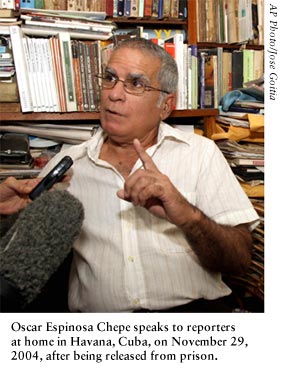
New York, November 29, 2004—At least one of the 27 journalists imprisoned in Cuba since a March 2003 crackdown on the independent press has been released from custody on a medical parole, and several others have been transferred to prison hospitals in Havana. CPJ called on Cuban authorities today to release all of the journalists still behind bars.
Oscar Espinosa Chepe, who suffers from several health problems, told CPJ he received word this morning that he had been paroled. Chepe, who had been in the hospital at Combinado del Este prison, said authorities warned him that he would be sent back to prison if he ran afoul of the government again.
“We are heartened by the release of Oscar Espinosa Chepe, and relieved that he can once again be with his family,” CPJ Executive Director Ann Cooper said. “But more than two dozen journalists are still being held without cause; their only offense was doing their jobs. We again call on Cuban authorities to immediately and unconditionally release all imprisoned journalists, and to allow them to work freely.”
News reports said a second imprisoned journalist, Edel José García, had also been granted a medical parole. His family told CPJ today that they had no official word of the parole and were seeking information from Cuban authorities.
At least six other imprisoned journalists have been moved to Havana prison hospitals in recent days, although it was unclear whether they would be released and on what terms. Because news of their transfers came after the Cuban government announced a resumption of formal diplomatic contacts with Spain, it was widely speculated that their possible release could be part of negotiations between the Cuban and Spanish governments aimed at normalizing relations between Cuba and the European Union.
Journalists Pedro Argüelles Morán, Pablo Pacheco Ávila, and Jorge Olivera Castillo were taken Friday, November 26, to the prison hospital at Combinado del Este, where they underwent medical checkups, said Margarito Broche, a political dissident who was with them. Broche was released today on a one-year medical parole.
José Ubaldo Izquierdo and Omar Ruiz Hernández were also transferred November 26 to the hospital at Combinado del Este, according to relatives of other imprisoned journalists. And journalist Raúl Rivero, who was awarded UNESCO’s prestigious Guillermo Cano World Press Freedom Prize this year, was moved November 26 from a prison in central Ciego de Ávila province to the Carlos J. Finlay Military Hospital in Havana, according to news reports.
Under the Cuban Penal Code, the courts or the Ministry of the Interior have discretion to grant parole (licencia extrapenal) for any period of time “deemed necessary.” Last June imprisoned journalist Carmelo Díaz Fernández was granted a medical parole and sent home. At the time he was warned that he would be sent back to prison if he recovered from his illnesses, or if did not maintain “good behavior.”
Also in June, journalist Manuel Vázquez Portal, CPJ’s 2003 International Press Freedom Award winner, was released without explanation. Upon his release, state security officers suggested that he leave the country. In October, Vázquez Portal was finally given a document indicating he had been granted a medical parole.
With 26 imprisoned journalists, Cuba remains one of the world’s leading jailers of journalists, second only to China. The journalists have been jailed since March 2003, when the Cuban government arrested them as the world’s attention was focused on the war in Iraq. In April 2003, the journalists were tried summarily behind closed doors, and sentenced to prison terms ranging from 14 to 27 years.
