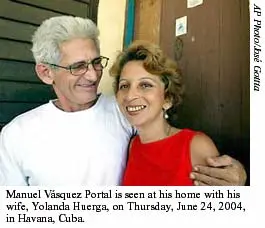
New York, June 24, 2004—Authorities granted medical parole to imprisoned journalists Manuel Vázquez Portal and Carmelo Díaz Fernández within the last week. The two men, who suffer from several health conditions, were among the 29 journalists imprisoned in Cuba since March 2003.
Vázquez Portal, a writer with the independent news agency Grupo de Trabajo Decoro, was brought to his home in the eastern Havana neighborhood of Alamar around midnight yesterday. He was serving an 18-year prison sentence in Boniato Prison, in eastern Santiago de Cuba province.The journalist has a lung disease similar to emphysema.
In May 2003, Vázquez Portal wrote a prison diary describing the harsh conditions in Boniato Prison. The journalist’s wife, Yolanda Huerga, smuggled the diary out of prison and gave it to the foreign press. In recognition of the efforts by Cuban independent journalists to disseminate news in a climate of harsh government repression, CPJ honored Vázquez Portal with one of its International Press Freedom Awards in November 2003.
Díaz Fernández, a journalist with the independent news agency Agencia de Prensa Sindical Independiente de Cuba (APSIC), was sent home on June 18. He was serving a 16-year prison sentence and was receiving medical treatment for his high blood pressure at the time of his release from a prison hospital in Havana. Díaz Fernández told CPJ that he was warned just before his release that he would be sent back to prison if he recovered from his illnesses or did not maintain good behavior.
Under the Cuban penal code, the courts or the Ministry of the Interior have discretion to grant parole (licencia extrapenal) for any period of time “deemed necessary.”
“We are happy that Vázquez Portal and Díaz Fernández are home with their families, but we are gravely concerned about the 27 other journalists who remain in Cuba’s prisons,” said CPJ Executive Director Ann Cooper. “We urge the Cuban government to unconditionally release all imprisoned Cuban journalists and to stop harassing those who are free.”
Background
Vázquez Portal and Díaz Fernández were imprisoned in April 2003 in a massive government crackdown on the independent media and political opposition. The detention of political dissidents and journalists—who were accused of being “counterrevolutionaries” at the service of the United States—began in March 2003, during the first week of the Iraq war.
The journalists’ summary trials were held on April 3 and 4 behind closed doors. Some journalists were tried under Article 91 of the Penal Code, which imposes lengthy prison sentences or death for those who act against “the independence or the territorial integrity of the State.” Other journalists were prosecuted for violating Law 88 for the Protection of Cuba’s National Independence and Economy, which mandates up to 20 years in prison for anyone who commits acts “aimed at subverting the internal order of the Nation and destroying its political, economic, and social system.”
On April 7, 2003, courts across the island announced prison sentences for the journalists ranging from 14 to 27 years. In June of 2003, the People’s Supreme Tribunal, Cuba’s highest court, dismissed the journalists’ appeals for annulment (recursos de casación) and upheld their convictions.
The imprisoned journalists, who are being held in maximum-security facilities, have denounced their unsanitary prison conditions, inadequate medical care, solitary confinement, and lack of access to the press and television. They have also complained of receiving foul-smelling and rotten food.
