Go »
  Go »

Morocco

2012


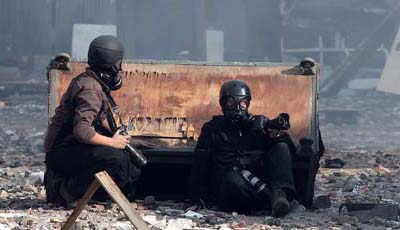
Photographers take cover during November protests in Tahrir Square. (AFP/Mahmud Hams)

The Middle East's political shifts changed conditions for journalists dramatically. The emerging trends favor free expression, but are filled with ambiguity and depend on the political configurations to emerge after the revolutionary dust has settled. By Mohamed Abdel Dayem

King Mohamed VI pledged a series of constitutional reforms in March after the region’s wave of popular uprisings passed through the kingdom. But the reforms did not extend to opening up the press. Authorities took concerted measures to suppress coverage of mass protests in Casablanca’s streets. During a March protest in the capital, Rabat, uniformed police assaulted  several journalists covering its violent dispersal. The biggest and most controversial case in the kingdom was that of Rachid Nini, a prominent government critic, executive editor of the Moroccan daily Al-Massae, and owner of Al-Massae Media Group. He was detained in April and sentenced to one year in prison on charges of “denigrating judicial rulings” and “compromising the security and safety of the homeland and citizens.”

« Previous Year: 2011 | Next Year: 2013 »

  Go »
Text Size
A   A   A
Contact

Middle East
and North Africa

Program Coordinator:
Sherif Mansour

Research Associate:
Jason Stern

smansour@cpj.org
jstern@cpj.org

Tel: +1 (212) 300-9018,
+1 (212) 300-9017
Fax: 212-465-9568

330 7th Avenue, 11th Floor
New York, NY, 10001 USA

Twitter: @CPJMena

فيسبوك : لجنة حماية الصحفيين بالعربية

Blog: Sherif Mansour
Blog: Jason Stern