CPJ
2013
Defining success in the fight against impunity
For the second time this year, the U.N. Security Council took up the issue of protection of journalists. In a discussion today sponsored by the French and Guatemalan delegations, and open to NGOs, speaker after speaker and country after country hammered home the same essential facts: The vast majority of journalists murdered around the world…
Tweets from a night at the 2013 #IPFA gala
On Tuesday night, CPJ honored four courageous journalists with the 2013 International Press Freedom Awards. The gala dinner, at New York’s Waldorf-Astoria hotel, raised more than $1.65 million for CPJ’s worldwide press freedom advocacy. The awardees–Janet Hinostroza (Teleamazonas, Ecuador), Bassem Youssef (Egypt), Nedim Şener (Posta, Turkey) and Nguyen Van Hai (Dieu Cay, Vietnam)–face severe reprisals…
Interactive Timeline: 12 months of impunity at a glance
In December 2012, the Committee to Protect Journalists and 27 partner organizations launched Speak Justice: Voices against Impunity as part of an international effort to seek justice for the hundreds of journalists who have been murdered around the world. Today, on International Day to End Impunity, we are taking a look back at what has…
CPJ report reflects seriousness of US press freedom gaps
On Thursday CPJ launched its first comprehensive examination of press freedom conditions in the United States. The report, “The Obama Administration and the Press: Leak investigations and surveillance in post-9/11 America,” highlights the growing threat to reporting on national security and similar sensitive government issues. It was written by Leonard Downie, Jr., the former executive…
Live stream: Obama and the press
The Committee to Protect Journalists today released its first comprehensive report on press freedom conditions in the United States. Leonard Downie Jr., former Washington Post executive editor and now the Weil Family Professor of Journalism at Arizona State University’s Walter Cronkite School of Journalism and Mass Communication, is the author. Tune in here for a…
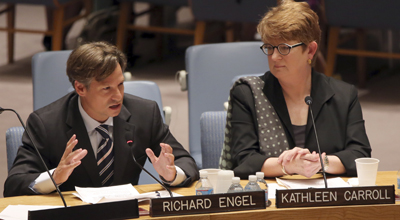
After Security Council, what next for journalist safety?
Speaking at a U.N. Security Council discussion about the protection of journalists, Associated Press Executive Editor and CPJ Vice Chair Kathleen Carroll remembered the 31 AP journalists who have died reporting the news and whose names grace the Wall of Honor that visitors pass as they enter the agency’s New York headquarters. Most were killed…
In 2 major efforts, journalist security tailored to fit
In the past, donors and groups providing security to journalists in less-developed nations tended to export a Western, military-style of training designed for a war-time environment. But the danger of covering combat is one thing. Being fired upon by a motorcycle-riding assassin is another–as is being sexually molested in a crowd, discovering a video camera…
Attacks on Knight Center sites reflect digital dangers
The two websites at the University of Texas at Austin, at first blush, seemed to have been unlikely targets for attack. The Knight Center for Journalism in the Americas and its blog cover news about journalism, press freedom and journalist safety throughout the Western hemisphere, with an emphasis on trends in Latin America. The website…
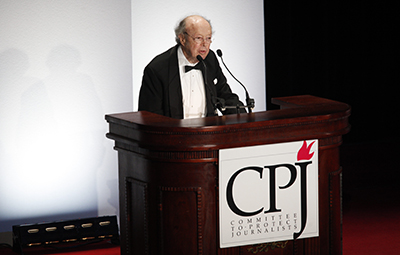
Tony Lewis gave CPJ authority, devotion over decades
Back in 1981, when CPJ was being formed and its board of directors assembled, Tony Lewis, who died today at age 85, was one of the first people we approached. As the author of books such as Gideon’s Trumpet, as a widely read columnist for The New York Times, and as an outspoken defender of…
Mission Journal: Who is a journalist in Egypt?
Egyptian journalists, besieged by punitive lawsuits and under threat, agree that under President Mohamed Morsi “there is no press freedom, only the courage of journalists,” as editor Ibrahim Eissa put it. What they can’t agree on is–in a climate of freewheeling, mutable media–who exactly is a journalist?