Go »
  Go »

Russia

2012

Pages: 1 2 or All


(AFP/Pedro Pardo)

Almost half of the 67 journalists killed worldwide in 2012 were targeted and murdered for their work, research by the Committee to Protect Journalists shows. The vast majority covered politics. Many also reported on war, human rights, and crime. In almost half of these cases, political groups are the suspected source of fire. There has been no justice in a single one of these deaths.

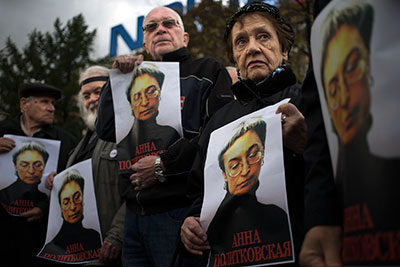
People holding portraits of Anna Politkovskaya in Moscow on October 7, the 6th anniversary of her murder, call on authorities to punish the killers of journalists in Russia. (AP/Alexander Zemlianichenko)

The trial of Dmitry Pavlyuchenkov, a former police lieutenant colonel and a key suspect in the 2006 murder of prominent Russian journalist Anna Politkovskaya, started at Moscow City Court today under presiding Judge Aleksandr Zamashnyuk. 

The tortured and decapitated body of 39-year-old María Elizabeth Macías Castro was found on a Saturday evening in September 2011. It had been dumped by the side of a road in Nuevo Laredo, a Mexican border town ravaged by the war on drugs. Macías, a freelance journalist, wrote about organized crime on social media under the pseudonym "The Girl from Laredo." Her murder, according to the Committee to Protect Journalists, was the first in which a journalist was killed in direct relation for reporting published on social media. It remains unsolved.

Approximately 30 journalists are targeted and murdered every year, and on average, in only three of these crimes are the killers ever brought to justice. Other attacks on freedom of expression occur daily: bloggers are threatened, photographers beaten, writers kidnapped. And in those instances, justice is even more rare. Today, the Committee to Protect Journalists joins freedom of expression advocates worldwide in a 23-day campaign to dismantle one case at a time a culture of impunity that allows perpetrators to gag journalists, bloggers, photographers and writers, while keeping the rest of us uninformed.

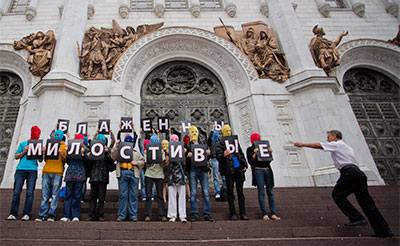
A security guard at the Christ the Saviour Cathedral, right, runs toward Pussy Riot supporters holding Cyrillic letters reading 'Blessed are the Merciful' in Moscow on Aug. 15. (AP/Novaya Gazeta, Yevgeny Feldman)

Record-high temperatures swept most of Europe this summer, but in Moscow the weather, much like the political climate, was chilly. I spent three months in the capital at the invitation of the Russian Union of Journalists, and witnessed how Vladimir Putin's third term in office kicked off with the passage of restrictive laws, harassment and prosecution of dissent, the jailing of an irreverent punk-rock band, and death threats by a top-ranking official against a prominent editor. 

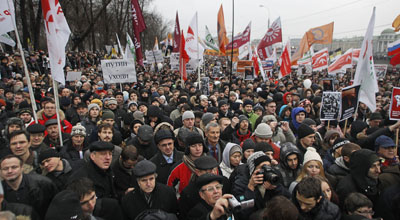
Thousands gathered in December 2011 to protest the alleged vote rigging in parliamentary elections. (AP/Alexander Zemlianichenko)

Shortly after the May 7 presidential inauguration of Vladimir Putin, the Russian parliament passed four major bills in record time--all of them meant to counter the protests that first erupted in the country in December 2011.

CPJ Deputy Director Robert Mahoney testified before the Tom Lantos Human Rights Commission in Washington on Wednesday, highlighting global attacks on press freedom and, in particular, assaults on the press in Honduras, Russia, and Turkey.

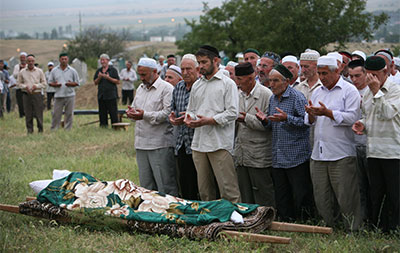
People pray at the burial of Natalya Estemirova in Chechnya July 16, 2009. (AP/Musa Sadulayev)

Three years ago this week, Natalya Estemirova, a contributor to the independent newspaper Novaya Gazeta and a local staffer for the Moscow-based rights group Memorial, was murdered in the North Caucasus, Russia's volatile region, where she was famous for her work as a defender of human rights. 

Nadira Isayeva (AP/Sergei Rasulov)

Nadira Isayeva, a 2010 CPJ International Press Freedom Award winner, has been living in exile since she left her native Dagestan, in Russia's volatile North Caucasus, in November 2011. Isayeva, the editor-in-chief of the independent weekly Chernovik, had been harassed by security forces for her relentless, critical coverage of their heavy-handed anti-terrorism operations in the region. Yet she was hesitant to leave, unable to imagine herself not reporting on these issues.

After fellow human rights advocates finally convinced Isayeva to leave, she came to New York, where she works as a fellow at Columbia University's Harriman Institute. (The interview has been edited).

Judges hear a case in the European Court of Human Rights. More than 60,000 people sought the court's help in 2011. (AFP/Frederick Florin)

The European Court of Human Rights is a victim of its success. In 2011, more than 60,000 people sought its help after exhausting all judicial remedies before national courts. But now, some member states of the Strasbourg-based Council of Europe are pushing for reforms of the prestigious institution and are pointing at the number of cases to make their argument. Instead of enhancing the court's capacity to deal with the backlog of cases, their moves would clip the court's prerogatives and undermine a citizen's capacity to defend his most fundamental rights.

2012

Pages: 1 2 or all
Next Page »

« Previous Year: 2011 | Next Year: 2013 »

  Go »
Text Size
A   A   A
Killed in Russia

55 journalists killed since 1992

35 journalists murdered

31 murdered with impunity

Attacks on the Press 2012

9th Impunity Index ranking, reflecting poor record in combating anti-press violence.

Country data, analysis »

Contact

Europe and Central Asia

Program Coordinator:
Nina Ognianova

Research Associate:
Muzaffar Suleymanov

nognianova@cpj.org
msuleymanov@cpj.org

Tel: 212-465-1004
ext 106, 101
Fax: 212-465-9568

330 7th Avenue, 11th Floor
New York, NY, 10001 USA

Facebook: CPJ ECA Desk

Blog: Nina Ognianova
Blog: Muzaffar Suleymanov