Go »
  Go »

Venezuela

2012


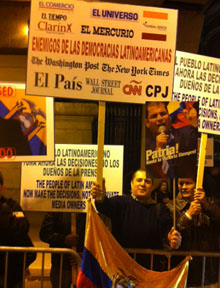
Protesters gather outside the Cabot Awards on Thursday. (CPJ/Sara Rafsky)

The Maria Moors Cabot Prizes, administered by Columbia University Graduate School of Journalism in recognition of journalistic contributions to Inter-American understanding, are the oldest international prizes in journalism. But Josh Friedman, director of the prizes, said this year marked the first time he remembered arriving at the awards ceremony to be greeted by protesters screaming from behind barricades. The tuxedo and gown-clad guests last night shot confused glances across the street from Columbia's Italian Academy building, where about 20 protesters brandishing Ecuadoran flags and pictures of President Rafael Correa yelled slogans like "Down the with corrupt press!" and "Long live President Correa!" One sign identified a long list of alleged "enemies of Latin American democracy" that managed to include the leading dailies of South America, the United States, Spain, the Ecuadoran press freedom group Fundamedios and the Committee to Protect Journalists.

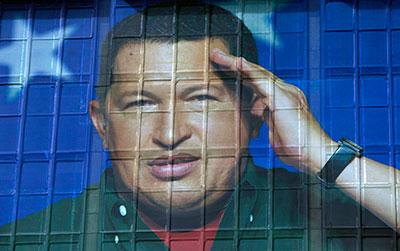
As Venezuela's election nears, President Hugo Chávez has a clear advantage in media access because he has broken down the independent press with threats and regulations while building up a huge state media apparatus. (AP/Ariana Cubillos)

Violence and legal harassment: the two greatest obstacles to press freedom in Latin America today. That's the message that CPJ Executive Director Joel Simon is delivering this morning in Washington, D.C., at a briefing hosted by Congressman Sam Farr. Farr, a California Democrat, hosts a monthly series looking at emerging trends in the Western Hemisphere. The panel today also includes Commissioner Dinah Shelton of the Inter-American Commission on Human Rights and Delphine Halgand of Reporters Without Borders.

Chávez' Twitter page. (AFP/Juan Barreto)

Online penetration in Venezuela has increased in recent years, with 40 percent of its population online, according to the International Telecommunication Union. A significant amount of activity takes place on Twitter, where Venezuela has the highest penetration in the region after Uruguay, according to local research company Tendencias Digitales. President Hugo Chávez Frías, who has more than three million followers on Twitter, uses the platform regularly to convey official news--as he did on Tuesday when a raging fire at an oil refinery was extinguished, leaving 48 people dead, according to a report on EFE.

« Previous Year: 2011 | Next Year: 2013 »

  Go »
Text Size
A   A   A
Killed in Venezuela

5 journalists killed since 1992

2 journalists murdered

Attacks on the Press 2012

1 Critical television station left, which faces steady fines and regulatory actions.

Country data, analysis »

Critics Are Not Criminals: Campaign Against the Criminalization of Speech
Contact

Americas

Senior Program Coordinator:
Carlos Lauría

Research Associate:
Sara Rafsky

clauria@cpj.org
srafsky@cpj.org

Tel: 212-465-1004
ext. 120, 146
Fax: 212-465-9568

330 7th Avenue, 11th Floor
New York, NY, 10001 USA

Twitter: @CPJAmericas

Facebook: CPJ en Español

Blog: Carlos Lauría

Blog: Sara Rafsky