When you see the top echelon of the EU press corps–The Guardian, Die Sueddeutsche Zeitung, Le Soir, and others–gathering in front of a meeting room at the European Parliament in Brussels you know that you should follow them inside. These seasoned correspondents select their assignments with a keen sense of urgency, and when they skip the daily 12 o’clock press briefing at the European Commission you know that they mean business.
Indeed, on Tuesday, the room was packed at the hearing convened by the Alliance of Liberals and Democrats for Europe (ALDE), the third largest political group of the European Parliament. The topic–the new Hungarian media law–is headline news in Brussels. There is outrage at what is seen as a crude attack against press freedom that, if not blocked, might contaminate other EU countries. But there is also bewilderment: How is it that a country on the verge of assuming the rotating presidency of the EU dared to adopt in late December despite successive warnings a highly contentious new law on the media? “It looks like a provocation,” said a European Commission official who requested anonymity because he was not authorized to speak publicly on the issue. “When you get such a prestigious mandate you avoid controversies that will undermine your action, especially if you are a small member state.”
The panelists invited by the Liberal group did not mince their words to condemn a law that severely restricts press freedom and tightens state control on the media. In a video interview from Budapest the famous dissident under communism and renowned writer György Konrad described the press law as “a case study in Demokratura, a kind of regime that offers “a mix between democracy and dictatorship.” “My country,” he warned, “is reverting to the old rhetoric of statism, centralization and paternalism and moving away from liberal democracy.”
Miklos Haraszti, former OSCE representative on freedom of the media, denounced an “unprecedented” attack against press freedom aimed at establishing the subordination of the media to the whims of the ruling party and instituting self-censorship among journalists. “It is practically like in Belarus,” he added. “This law is the tip of the iceberg at the ending point of a process whereby the Hungarian government is misusing its legislative majority to methodically dismantle legal balances and constitutional guarantees.”
György Schöpflin, a leader of Fidesz, the Hungarian ruling party, and a member of the center-right European People’s Party (EPP), tried to counter the accusations. But his arguments fell flat: Instead of providing a legalistic rebuttal he mostly put the blame on an alleged anti-Hungarian conspiracy pushed by begrudged members of the opposition and arrogant Western European media. He even accused his critics of “boosting Euro-skepticism and the far right in Hungary.”
The real news however was the presence of EU Commissioner for the Digital Agenda Neelie Kroes. Of course, she belongs to the Dutch center-right Liberal party and she might have relished the occasion to sting a member of a rival parliamentary group but a commissioner is supposed to be “politically neutral” and in any case speaks on behalf of the entire commission.
“You are well aware that, beside specific questions concerning the audiovisual media services directive, the new media law raises broader political questions concerning freedom of expression,” she said. “Freedom of expression constitutes one of the essential foundations of our democratic societies.”
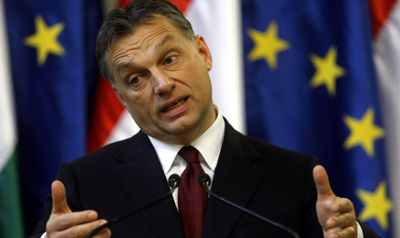
Kroes promised that her services would seriously and thoroughly analyze the Hungarian law. She also confirmed that Orban last Friday in Budapest committed himself to “making adjustments should the commission find that aspects of the law do not conform with the EU rules.”
“I am fully confident,” she concluded, “that Hungary, being a democratic country, will take all the necessary steps to ensure that the new media law is implemented in full respect of the European values on media freedom and relevant EU legislation.”
The EU knows that it cannot skip the debate. Far from just being a case of legal compatibility with EU laws, the Hungarian press legislation is seen as a major assault against the values enshrined in the European Charter of fundamental rights and the European Convention on human rights. “It is not about respecting a technical directive,” said Dutch center-left liberal MEP Sophie In’t Veld. “It is about the core values of the EU.”
Next week the controversy will travel to Strasbourg, the other seat of the European Parliament, where deputies will meet in plenary session to listen to Orban’s official presentation of the priorities of the Hungarian EU presidency.
“We don’t want to mix questions linked to the rotating presidency with the controversy on the press law,” confided Guy Verhofstadt, former Belgian prime minister and the current president of the European Liberal and Democrats group.
Indeed, but most observers agree that the Hungarian government has already decided otherwise by sticking to a national political agenda that risks ruining its presidency of the European Union.