Paul Klebnikov
United States/Russia
Killed in Moscow July 9, 2004
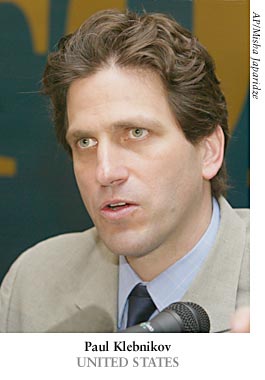 Paul Klebnikov, an American journalist of Russian descent, was shot nine times by at least one assassin in a passing car when he stepped outside his office on July 9, 2004, in Moscow. He died shortly after arriving at a hospital, becoming the 11th journalist in Russia to be murdered in a contract-style killing since President Vladimir Putin took power in 2000. To date, no one has been brought to justice in any of the cases. Paul Klebnikov, an American journalist of Russian descent, was shot nine times by at least one assassin in a passing car when he stepped outside his office on July 9, 2004, in Moscow. He died shortly after arriving at a hospital, becoming the 11th journalist in Russia to be murdered in a contract-style killing since President Vladimir Putin took power in 2000. To date, no one has been brought to justice in any of the cases.
Klebnikov joined Forbes magazine in 1989 and rose to the position of senior editor specializing in Russian and Eastern European politics and economics before leaving the U.S.-based magazine to assume the editorship of Forbes Russia in 2004. Klebnikov launched the magazine in April 2004, believing that reforms were propelling the country toward greater transparency in business and politics. With his fluency in Russian and doctorate from the London School of Economics, Klebnikov was uniquely qualified to investigate Russia’s business world. In his first editorial, Klebnikov wrote that Russian business had arrived at a “new, more civilized stage of development” and cited the launch of Forbes‘ Russian edition as evidence. Forbes Russia attracted significant attention in May, when it published a list of Russia’s wealthiest people and reported that Moscow had 33 billionaires, more than any other city in the world. Publication of the list focused attention on Russia’s richest people, many of whom are trying to keep a low profile. Klebnikov’s book, Godfather of the Kremlin: Boris Berezovsky and the Looting of Russia, was published in August 2001 and outlined the rise of one of the country’s most powerful oligarchs. |
|
LINKS “The Precarious Right ot Speak the Truth,” Forbes. com “Same Old Ruthless Russia,” Washington Post, July 13, 2004 “Journalists’ Deaths Make It Harder to Excuse Putin’s Excesses,” by Serge Schmemann, New York Times Musa Klebnikov’s Remarks at the IPFA Dinner On behalf of Paul’s family and mine, who are here this evening, I thank you for this award. Immediately after Paul’s death, when our family was truly at a loss, CPJ came forward with solid advice and help. We are deeply grateful for everything you have done; this is a truly remarkable organization. Paul was a journalist but he was also a historian. He was drawn to big ideas and the broad strokes of human history and looked for lessons in periods of great peril when people rose to face great threats with courage. As a descendent of Russian military men, he was fascinated with Russians’ battles with Napoleon and their terrible struggles through World War II. Paul was deeply concerned that Russia today is not facing its moral and civil challenges. This time it isn’t a foreign invader but cynicism that threatens. Being surrounded by criminality, greed and misuse of power has made people suffer from apathy and hopelessness. Paul wanted to help ordinary Russians find courage. He was thrilled to edit a magazine for Russians, and use it to expose economic and moral corruption, and offer positive models instead Many people responded to his dynamism and conviction. All sorts of people: –important officials, policemen, priests, soldiers, businessmen, village folk, artists, students, and fellow journalists–fed Paul’s hope for Russia. Often they took significant risks to supply him with critical information. I pray that they are inspired by Paul’s death and will find courage. It is these people and their call for a civil society that must continue to be heard and encouraged. The press has to be allowed to speak the truth however ugly or beautiful. We want Paul’s murder solved and we want his legacy respected. One great journalist has been killed, but I hope other journalists will pick up the banner and fight on, because the attack on one is an attack on all journalists, and in this case, on hope itself. |